AI-Generated Brand Identity: Logo, Palette, and Typography in Minutes
ThemeSmith generates a complete brand identity — logo, colour palette, typography system, and brand guidelines — as part of every site build. Here's what the pipeline produces and how it compares to agency work.
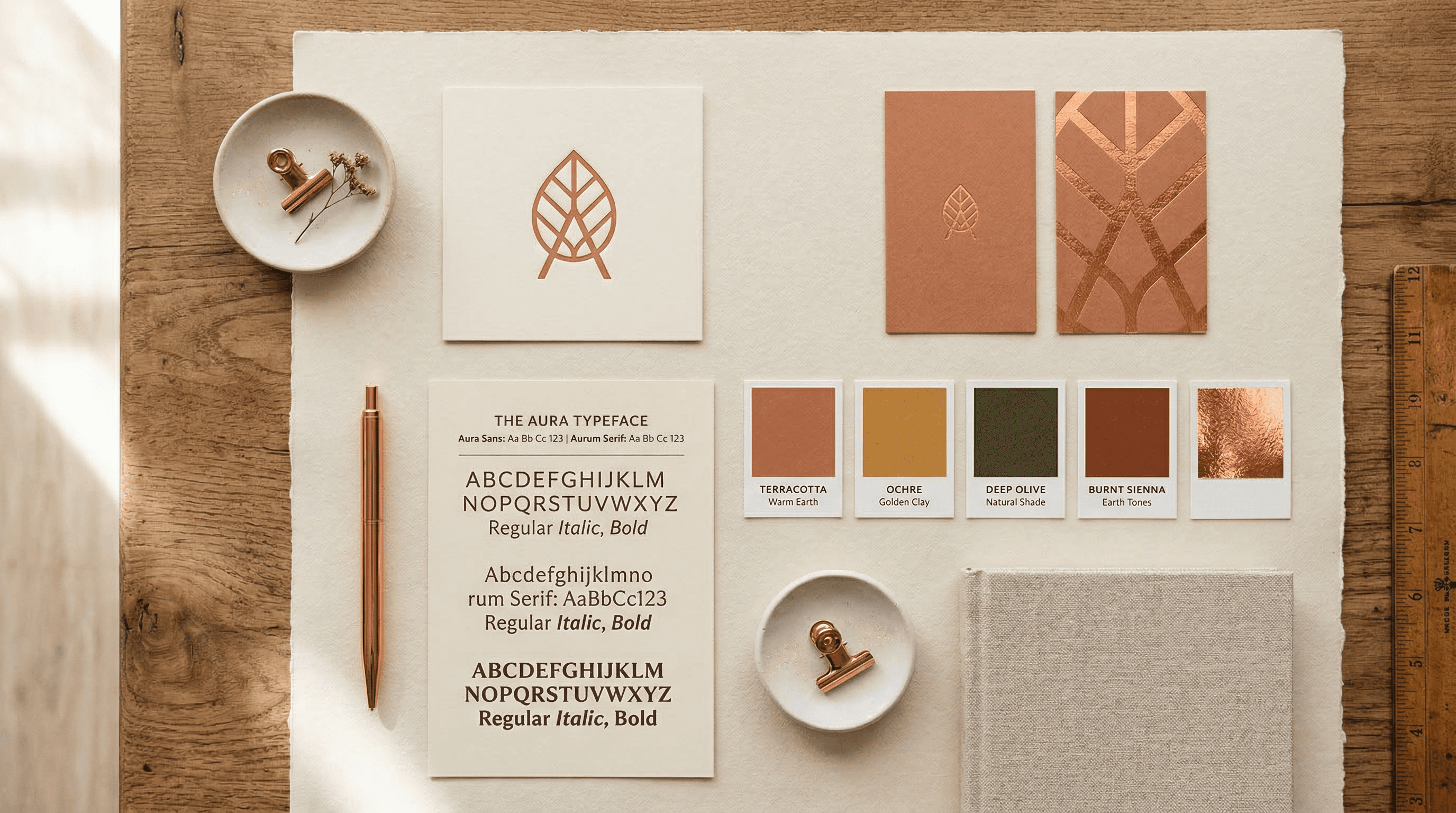
Brand identity is the silent salesperson of every business. Before a visitor reads a single word on your website, they have already formed an impression based on your logo, your colours, and the feel of your typography. Get it right and you look credible, established, trustworthy. Get it wrong and you look like you threw something together over a weekend — because, in most cases, that is exactly what happened.
The problem is not that business owners do not care about branding. It is that professional brand identity work has historically been expensive and slow. A design agency will charge between £2,000 and £10,000 for a brand identity package, with delivery timelines of two to four weeks. For a small business launching a website, that timeline and cost are often prohibitive. So they skip it, pick a template, choose colours that “look nice,” and move on. The result is a website that works but does not feel like it belongs to anyone in particular.
ThemeSmith takes a different approach. Every site build includes a complete brand identity — logo, colour palette, typography system, and brand guidelines — generated as part of the pipeline. It is included on every plan at no extra cost. There is no add-on to purchase, no upgrade tier to unlock. If you are building a site with ThemeSmith, you are getting a brand.
The four-step brand pipeline
ThemeSmith's brand generation is not a random colour picker bolted onto a website builder. It is a structured pipeline with four distinct stages, each informed by the outputs of the previous one.
Step 1: Business understanding. The pipeline starts by analysing everything you have told the platform about your business — industry, services, target audience, competitive positioning, and tone of voice. A physiotherapy clinic and a craft brewery need fundamentally different visual identities, and the system understands why. This contextual analysis drives every downstream decision.
Step 2: Palette generation. The AI generates a complete colour system tailored to your industry and brand personality. This is not five random hex values. The palette includes primary, secondary, and accent colours with light and dark mode variants, delivered in hex, RGB, and HSL formats. Contrast ratios are validated against WCAG accessibility standards. The colour system is encoded as design tokens, meaning every colour reference across every page of your site resolves to a single source of truth.
Step 3: Typography selection. The pipeline selects a heading and body typeface pairing based on your industry, tone, and the palette it just created. These are not arbitrary choices from a dropdown. The system evaluates readability at different sizes, optical weight balance between the heading and body fonts, and stylistic coherence with the colour palette. Each pairing comes with defined font weights, sizes, and line-heights for every breakpoint — mobile through desktop — ensuring text reads well on any screen.
Step 4: Logo creation. The final step generates a logo in three variants: a wordmark (the business name set in a distinctive typeface), a monogram (an abbreviated symbol or initials), and a favicon (the small icon that appears in browser tabs and bookmarks). The logo is delivered in SVG for web use, PNG at multiple resolutions for social media and email, and a complete favicon package for browsers and devices. Three variants, multiple formats, production-ready.
Brand guidelines in one page
Alongside the visual assets, ThemeSmith generates a single-page brand reference document. It covers logo usage rules (minimum sizes, clear space, what not to do), colour specifications with exact values, the full typography hierarchy from H1 through body text, and tone of voice guidance derived from your business description. This is the same deliverable an agency would produce as a multi-page PDF — condensed into a practical, always-accessible reference.
This matters more than most people realise. A brand identity without guidelines is just a collection of assets. Guidelines are what ensure consistency — across your website, your social media, your email signatures, your printed materials. ThemeSmith generates them automatically because consistency is too important to leave to chance.
Design tokens: how consistency actually works
The brand kit does not exist in isolation. It feeds into a design token system that governs every element of every page on your site. When the pipeline generates a new page, it references the same brand tokens — the same colours, the same font stack, the same spacing rhythm. The result is a site that feels cohesive, not a patchwork of independently styled pages.
This architecture also means that brand changes propagate automatically. If you update your primary colour through the visual editor or through The Forge, every page on your site reflects the change immediately. No manual search-and-replace across templates. No risk of one page still showing the old blue while the rest have moved to green. The token system handles it.
Bring your own logo
Not every business is starting from scratch. If you already have a logo you love — perhaps from a designer you worked with years ago — you can upload it during onboarding. The brand generation pipeline adapts around your existing asset, extracting colours and stylistic cues from your logo to inform the palette and typography choices. Your logo stays; everything else is built to complement it.
This flexibility is deliberate. Brand identity generation should be additive, not prescriptive. If you have strong opinions about your brand colours, use them. If you want the AI to handle everything, it will. The system meets you where you are.
Everything is editable
Generation is the starting point, not the final word. Every element of the brand identity — logo, colours, fonts, guidelines — can be modified after the fact through the visual editor or by asking The Forge in plain language. Want to shift your accent colour from copper to teal? Done. Prefer a serif body font instead of sans-serif? The system will re-pair and validate the change.
Importantly, the AI validates edits against your brand guidelines before applying them. If a proposed colour change would create an accessibility contrast violation or clash with your existing palette, the system flags it. You are free to override the suggestion, but at least you are making an informed decision rather than introducing an invisible problem.
How it compares
Versus agencies. A professional brand identity from a design agency typically costs £2,000 to £10,000 and takes two to four weeks. You get excellent work from talented designers, but the cost and timeline put it out of reach for many small businesses. ThemeSmith delivers a comparable set of assets — logo variants, colour system, typography hierarchy, brand guidelines — included in every plan, generated in minutes.
Versus DIY tools.Platforms like Canva offer logo makers and palette generators, but they are disconnected tools. You create a logo in one place, choose colours in another, pick fonts in a third, and then manually apply them across your website with no guarantee of consistency. ThemeSmith's brand identity is integrated into the site generation pipeline. The palette that feeds your logo is the same palette that styles your homepage hero, your contact form, and your footer. Integration is the difference between a brand kit and a collection of files.
Versus doing nothing. The most common alternative to professional branding is no branding at all — a default template with default colours and a text logo in whatever font the builder offered. This is the path of least resistance, and it shows. Visitors notice when a website lacks visual identity, even if they cannot articulate why. It reads as impermanence, as a business that might not be around next year. A coherent brand identity, even an AI-generated one, signals professionalism and permanence.
Brand identity as foundation, not afterthought
The most important thing about ThemeSmith's approach is sequencing. The brand identity is not generated after the website — it is generated first, and the website is built on top of it. Every page, every section, every element inherits from the brand kit. This is how professional agencies work: identity first, then design, then build. ThemeSmith automates that sequence so that every business gets the benefit of disciplined design process, regardless of budget.
For businesses that want to see what AI-generated brand identity looks like in practice, explore the brand identity feature or browse the full feature set to understand how brand generation fits into the broader platform.