Glossary
Website words, in plain English.
Hosting, domain, SSL, credits, structured data: the words you meet when you get a small business website. Each one explained in a few sentences, with what it means for your site, and what ThemeSmith does about it where we do.
You don't need to know any of them to get a website. You describe your business in a chat, we build it, and after launch a change is a message.
A four-page website, home, services, about and contact, is £74 to build, once. Hosting is free for the first month, then £15 a month, which covers around ten everyday changes.
What does a four-page website cost, all in?
Two sites built on ThemeSmith, each with four pages. The build is paid once; after that the plan is the only monthly bill.
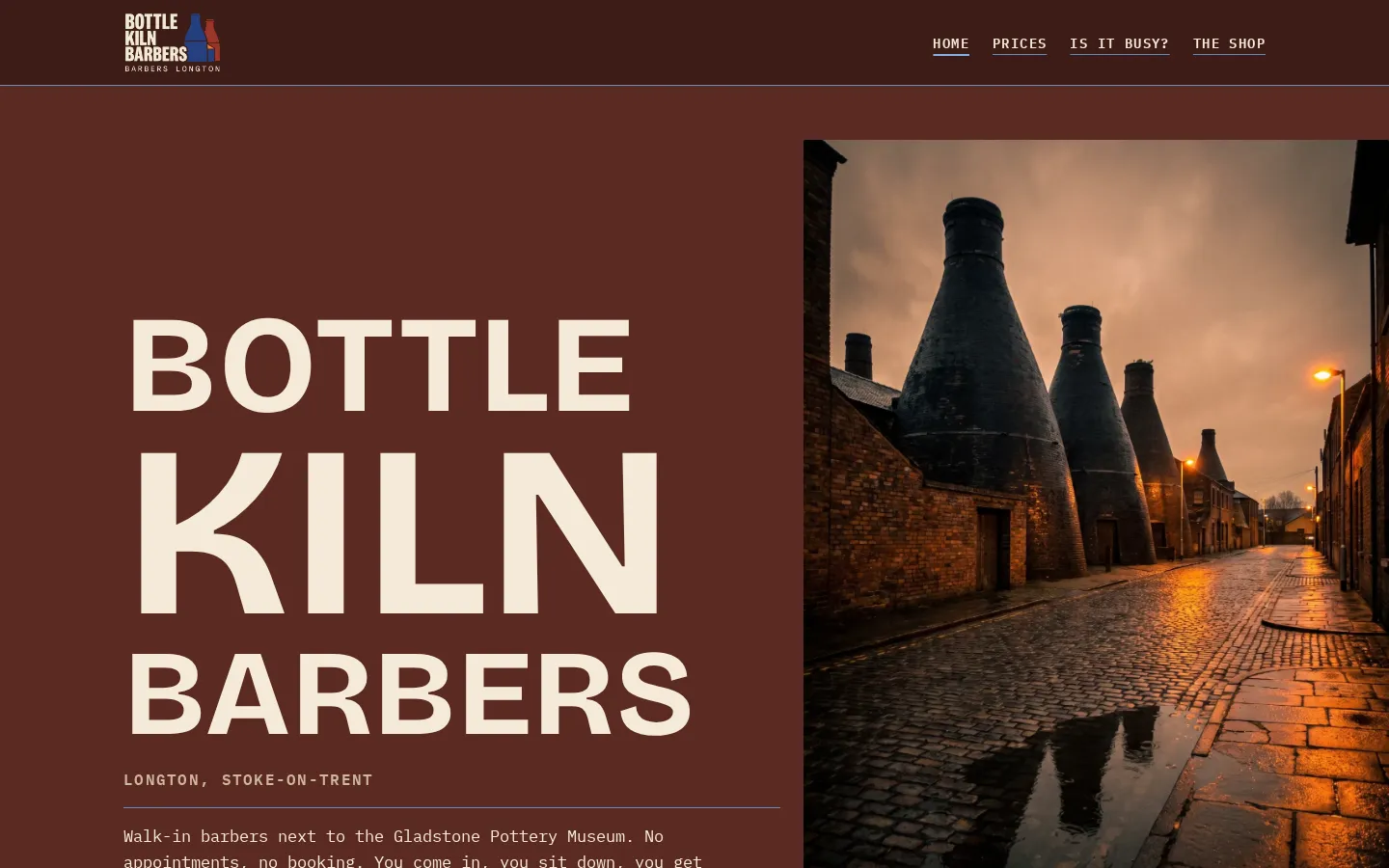
Bottle Kiln Barbers
£29 for the first page and £15 for each of the other three. Hosting is free for the first month, then £15 a month on Starter.
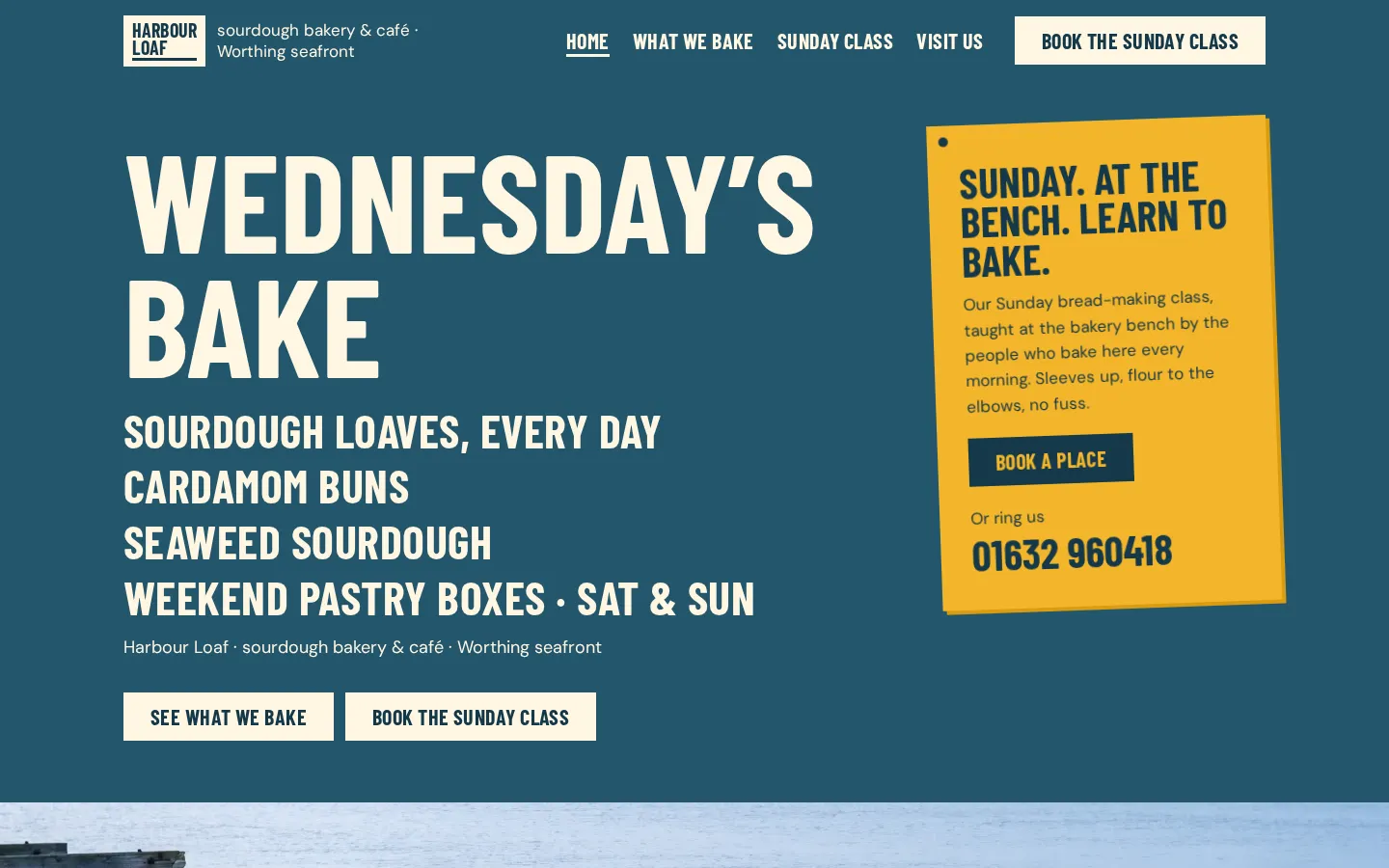
Harbour Loaf
The same sum: four pages, £74 once. Both logo designs, the photos and the words were made as part of the build.
In a normal month, the £15 Starter plan covers the hosting and around ten everyday changes: new hours, a price, a photo. A page added later is £15. Your domain is the one thing on top: connect one you already have, or buy one in your dashboard, where each name shows its yearly price before you pay.
See the full price list →Every term, A to Z.
Thirty-one terms, grouped below by where you meet them. Jump to a group, or open the full list.
All thirty-one terms
- Accessibility
- Adding a page
- Approval
- Backups
- Business plan
- CDN (content delivery network)
- Change by message
- Credits
- Dashboard
- Design direction
- Design tokens
- DNS
- Domain
- Enquiry form
- Generative engine optimisation (GEO)
- Home page
- Hosting
- Lighthouse score
- Logo designs
- Meta description
- Page
- Photos and copy
- Price changes
- Privacy page
- Quality checks
- SEO (search engine optimisation)
- SSL certificate
- Starter plan
- Structured data
- Top-up
- Web application firewall
Building your website
What do the words in your build mean?
From the quote page, where you choose your pages and see the price, to the moment you approve your home page. These are the words that come up in the chat and in your dashboard while the site is being made.
- Page
One screen of your website with its own address: your home page, a services page, a contact page. On ThemeSmith you choose how many you want on the quote page and the total adds up in front of you: £29 for the first page, £15 for each one after, up to eight. Home, services, about and contact, the usual four, come to £74.
- Home page
The first page most visitors see, and the one that sets the look of everything after it. ThemeSmith builds your home page first, in the design direction you chose, and it arrives in about twenty minutes. Nothing else is built until you've approved it.
- Design direction
A complete look for your site, typefaces, colours, layout and tone, worked up from what you told us about your business in the chat. Two or three directions come back and you pick one. The whole site is then built in the direction you picked.
- Approval
Your say that the home page is right, before the rest of your pages are built. Before you give it you can ask for up to five changes and one complete rethink, all included in the build price. Once you've approved, the rest of your pages follow about ten minutes later.
- Logo designs
The marks drawn for your business as part of the build. Two logo designs come with every build and you choose one. For more choice, add two more for £10 or four more for £15 when you order.
- Photos and copy
The pictures and the words on your pages. You don't need to bring either to start: both are made for you from what you say in the chat. You can add your own photographs or wording later, by message.
- Privacy page
The page that tells visitors what information your site collects, what it's used for and who to contact about it. If your site collects any personal information, a contact form for instance, UK data protection law expects you to explain what you do with it. Every ThemeSmith site includes a privacy page at no charge; it doesn't count towards your page total.
- Enquiry form
The form a visitor fills in to reach you: their name, how to get back to them, and what they want. On every ThemeSmith plan, enquiries from your form are emailed to you, every one, so you answer them from your inbox like any other message.
- Quality checks
Checks run on every ThemeSmith site before anything goes live, both the first build and every change made afterwards. A change you asked for by message goes live once it has been through them. They're part of every plan rather than something you ask for.
- Design tokens
The named values a site is built from: its colours, type sizes, spacing and corner radii, each stored once and used everywhere. If the accent colour is a token, changing it in one place changes every page that uses it. It's how a site stays consistent as pages are added, and why one change can be made across a whole site at once.
Keeping it online
What keeps your website online and safe?
What hosting is actually made of. Every ThemeSmith plan includes the hosting, certificate, firewall and backups described here; you don't buy them separately.
- Hosting
The computers your website lives on and the service that keeps them running, so your pages are there whenever someone types your address. On ThemeSmith, hosting is free for the first month, then £15 a month on Starter or £39 a month on Business, with no contract and no setup fee. You can cancel from your account.
- Domain
Your website's address: the part people type, like yourbusiness.co.uk. You rent it by the year, and it can point at whichever host your site is on. On ThemeSmith you can connect a domain you already have, or buy one from your dashboard, where each name shows its yearly price before you pay.
- DNS
The directory that tells browsers which computers hold the site at your address. When a website moves to a new host, the DNS record is what changes; the address itself stays the same. Connecting a domain you already own to a new site means updating this record.
- SSL certificate
The certificate that encrypts what passes between a visitor's browser and your site, shown by the padlock and the https at the start of your address. Without one, browsers warn visitors that a site isn't secure, and a form on it isn't safe to fill in. Every ThemeSmith site has one, on every plan, at no extra cost.
- CDN (content delivery network)
A network of servers around the world that keeps a copy of your site close to whoever is looking at it, so a page arrives quickly whether the visitor is in Walsall or in Wellington. ThemeSmith hosts every site on a global network of this kind, on every plan. It's part of the hosting rather than something you set up.
- Web application firewall
A filter that sits in front of your website and turns away traffic trying to do it harm: bots probing for weak spots, floods of fake requests, attempts to abuse your forms. Ordinary visitors pass straight through. It's included on every ThemeSmith plan.
- Backups
Saved copies of your site that let it be put back the way it was. ThemeSmith keeps a versioned backup of every change made to your site, on every plan, so each earlier version is kept rather than overwritten.
After launch
What do the words in your plan mean?
Once your site is live it's looked after on a monthly plan. These are the words on the pricing page and in your account.
- Change by message
How your site is changed after launch. You ask in your dashboard or on WhatsApp, in your own words: new opening hours, a price, a photo, a new section. We make the change and put it live. Changes come out of your plan's credits; on Starter that's around ten everyday changes a month.
- Credits
How your plan pays for changes after launch. In plain terms: Starter gives you around ten everyday changes a month, Business around thirty. The sums behind that: an everyday change, new hours or a price, is about 15 credits, and Starter includes 150 a month; Business includes 500. A question is about 3 credits; a new section about 75. Credits you don't use roll over to the next month.
- Top-up
Extra credits bought outside your plan, for a month when you have more to change than usual. A top-up of 125 credits is £12; 600 is £50; 1,100 is £90. Top-up credits never expire.
- Starter plan
The £15-a-month plan, after your free first month: one live site and 150 credits a month, around ten everyday changes. Like every plan it includes hosting on a global network, SSL, a firewall, versioned backups, your own domain connected, enquiry forms that reach you, quality checks and email support. No contract; cancel from your account.
- Business plan
The £39-a-month plan: up to three live sites and 500 credits a month, around thirty everyday changes. The two plans differ only in how many sites you run and how many credits you get each month; everything else is the same.
- Dashboard
Your account on ThemeSmith. It's where you ask for a change by message, connect a domain or buy one, and manage your plan, including cancelling it. WhatsApp is the other way to ask for a change; the dashboard is where everything about your account lives.
- Adding a page
A new page on a site that's already live: a page for a new service, say, or a seasonal offer. It costs £15, plus a few credits to plan it with you by message. You ask the way you ask for any change, in your dashboard or on WhatsApp.
- Price changes
What happens if a plan price goes up. You get thirty days' notice, and if you're already a customer you keep the price you joined at.
Being found
What do the search words mean?
The words you'll meet when you ask why a site does or doesn't show up in Google. None of them are ThemeSmith's; they're the web's.
- SEO (search engine optimisation)
Making it easy for Google and the other search engines to understand what your site is about, so it shows up when someone nearby searches for what you do. Most of it is unglamorous: a clear title on each page, headings that say what's on it, your trade and your town written out, pages that load quickly on a phone. There's no switch for it; it's how the pages are written.
- Meta description
The sentence or two a search engine shows under your page's title in its results. It has little effect on where you rank, but it's often the reason someone clicks your result rather than the one below it. Each page has its own.
- Structured data
Notes written for machines and added to a page, telling search engines exactly what the page describes: a business, its opening hours, a set of questions and answers. It's how Google can show your hours or your answers in the results themselves, before anyone clicks. The notes are usually in a format called JSON-LD; visitors never see them, and neither do you.
- Lighthouse score
Google's free tool for scoring a web page out of 100 in four areas: performance, accessibility, best practices and SEO. Anyone can run it on any page from the Chrome browser. A high score doesn't bring customers by itself, but a low one usually means something is slowing visitors down or shutting some of them out.
- Accessibility
Whether everyone can use your site: someone using a screen reader, someone who can't use a mouse, someone reading a phone in bright sun. In practice it means text with enough contrast, pictures with a written description, and a site you can get around with the keyboard alone. It's one of the four things a Lighthouse score measures.
- Generative engine optimisation (GEO)
Writing and arranging a site so that AI assistants such as ChatGPT can read it accurately and quote it when someone asks them a question. It comes down to the same things as good SEO: plain facts in plain text, with the business's name, place, hours and prices written out rather than locked in a picture. It adds to SEO rather than replacing it.
Tell us about your business. We build your website.
Describe your business in a chat, choose a design direction, and see your home page in about twenty minutes. After launch, changes are a message.
£29 for your first page, £15 for each one after; four pages come to £74. Hosting is free for the first month, then £15 a month. No contract; cancel from your account.