A website for your trade.
How soon, how much, and can I trust you in my house.
Whatever the trade, a customer arrives with the same three questions. Most trade websites answer them with a phone number and a list of services. We design and build your website around your own answers, host it, and change it when you send us a message from the van.
£29 for your first page, £15 for each one after, paid once. Hosting is free for the first month, then £15 a month.

A plumbing firm whose site opens with an exact arrival time, so the first question is answered before anyone rings.
An example we built to show the work. Not a customer.Seven trades, one pattern
What 5,013 trade websites put on the front page.
We read the front pages of 5,013 UK trade websites in August 2026: plumbing and heating, electrical, building, garden and landscape, cleaning, locksmith, and garage and mechanic firms. We recorded what each front page said and offered; other pages were not read. The figures describe those sites, not every business in each trade. How each trade was counted is in its own page, linked below.
1 in 6 at most showed a price, in any trade where we could count it.
It ranged from 2.2% of builders to 16.3% of locksmiths. Meanwhile nearly every site named the area it covers. The answer customers can find is where you work; the answer they wanted first, what it will cost, is usually missing.
Garages are left out of the price count: their price field also caught cars for sale, so it would overstate them.
| Trade | Front pages read | Showed a price | Online booking | Named their area | Named who built the site | |
|---|---|---|---|---|---|---|
| Plumbing and heating | 1,179 | 12.0% | 12.0% | 7.9% | 88.5% | 45.1% |
| Electricians | 1,132 | 4.8% | 4.2% | 6.8% | 83.6% | 39.5% |
| Builders | 827 | 2.2% | 1.0% | 7.1% | 93.7% | 47.6% |
| Garages and mechanics | 690 | not counted | 37.7% | 7.2% | 93.8% | 49.0% |
| Cleaners | 588 | 10.2% | 14.1% | 10.2% | 94.4% | 31.1% |
| Gardeners and landscapers | 517 | 5.8% | 4.1% | 5.0% | 92.6% | 36.6% |
| Locksmiths | 80 | 16.3% | 3.8% | 26.3% | 96.3% | 31.3% |
"Showed a price" is a price for work in the front page's price field; for gardeners it is any figure there, and for locksmiths, entries that read as money. "Named who built the site" means the front page credits a web designer or a website builder, usually in the footer. Read the method on each trade's page before quoting a figure.
1.0% to 37.7%offered online booking.
Garages lead because an MOT is a fixed slot on a known day. Builders barely use it, because nobody books an extension online. Offer booking where the job has a set length and a set price; for everything else, say what you need to quote and how soon you reply.
5.0% to 26.3%offered WhatsApp.
Locksmiths use it most. For any trade it is good for the photograph that saves a wasted visit. Say who reads the messages and when, and keep an urgent job on a line someone answers.
31.1% to 49.0%named who built the site.
Many trade websites were made by someone else and left. That works until the prices change, the van number changes or the person who built it moves on. Decide now who will keep yours accurate.
How much
Every trade prices a different unit. Name yours.
The few front pages that did show a price were not just braver. They said what the money buys: a half hour, a job with its certificate, a project with its weeks on site. A figure without its unit leaves the customer guessing, which is why most firms leave it off. These are real UK front pages from the scan, described without naming the firms.
Plumbing and heating
The half hour, by time of day.
A London emergency plumber publishes one labour rate per half hour, daytime and night-time, including VAT, and states an arrival time. The customer can do the sum before they call.
Websites for plumbersElectrical
The job, with its certificate.
A Dorset electrician prints a starting price for each main job, an EV charger, an EICR, a rewire, and says certificates are issued the same day. Each job reads like a product with a price and a piece of paper at the end.
Websites for electriciansBuilding
A band, with the weeks on site.
A London loft specialist prices four kinds of conversion as ranges, gives each one a duration, and says what the price includes. A homeowner can see which band they are in before the first visit.
Websites for buildersGarden and landscape
The visit, as a crew.
A West London firm prices maintenance as a two-gardener, two-hour minimum booking, not as an hour. An hour, a crew visit, a square metre and a project band are four different answers; say which one is yours.
Websites for gardenersLocksmith
The call-out, before the van moves.
A Teesside firm says non-destructive entry comes first and the call-out price is agreed before anyone sets off. Only 3.8% of the locksmith front pages we read said that. It is the sentence a locked-out customer most needs.
Websites for locksmithsCleaning
The clean, by what is in it.
A Birmingham end-of-tenancy firm prices by the property and lists what is included: the rooms, the appliances, the carpets. An hour is not a tenancy clean, and the page makes the difference plain.
Websites for cleanersOne thing nearly every trade got wrong: whether VAT is in the figure. Say it, every time, next to the price.
How soon, and who comes
Answer the other two questions in plain words.
How soon.
Say how quickly a call or a message is answered, and what happens when the diary is full. If you do emergency work, say the hours you really cover and what the night-time charge is. If you don't, say so: a template's "24/7" is a promise a one-person firm cannot keep at three in the morning.
For planned work, give the weeks. The London loft firm above gives every kind of conversion its own duration, an answer most of the building sector leaves open.
Who comes to the house.
Say whether the person who quotes is the person who turns up, and show them. Make the credential that matters in your trade easy to check. For gas work it is Gas Safe registration, which a customer can look up on the public register. For notifiable electrical work in England and Wales, most electricians belong to a competent person scheme such as NICEIC or NAPIT. For a cleaner who holds keys, say how your staff are vetted and how keys are kept.
Then say how you treat the house: dust sheets, shoe covers, what gets moved and who tidies up. It is the detail people remember after the job.
Your trade
Each trade has its own page, research and example.
Every page below is built around one trade: what its customers ask, what the front pages in our scan did and didn't say, and an example site we built for a fictional firm in that trade.
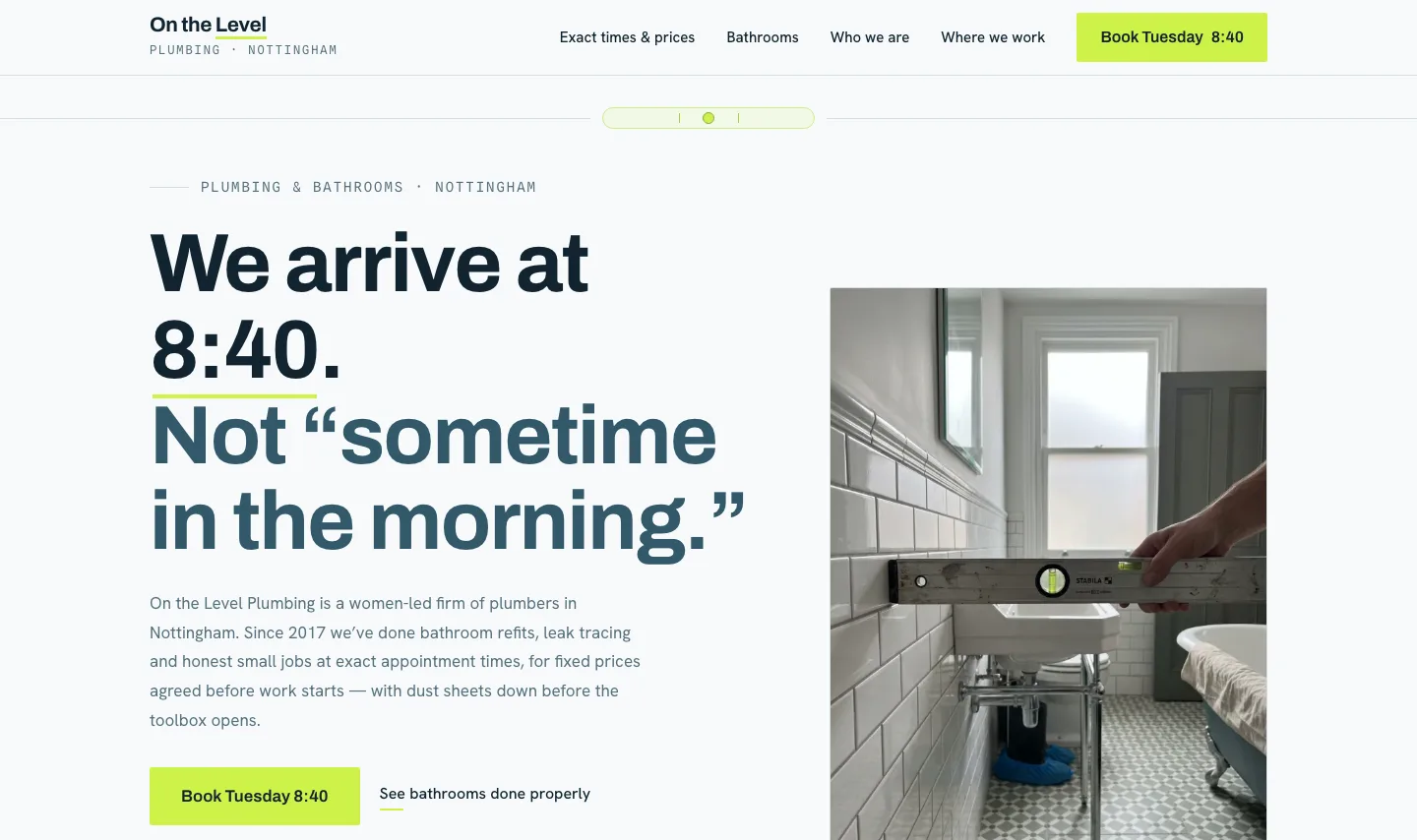 PlumbersOn the Level · Nottingham
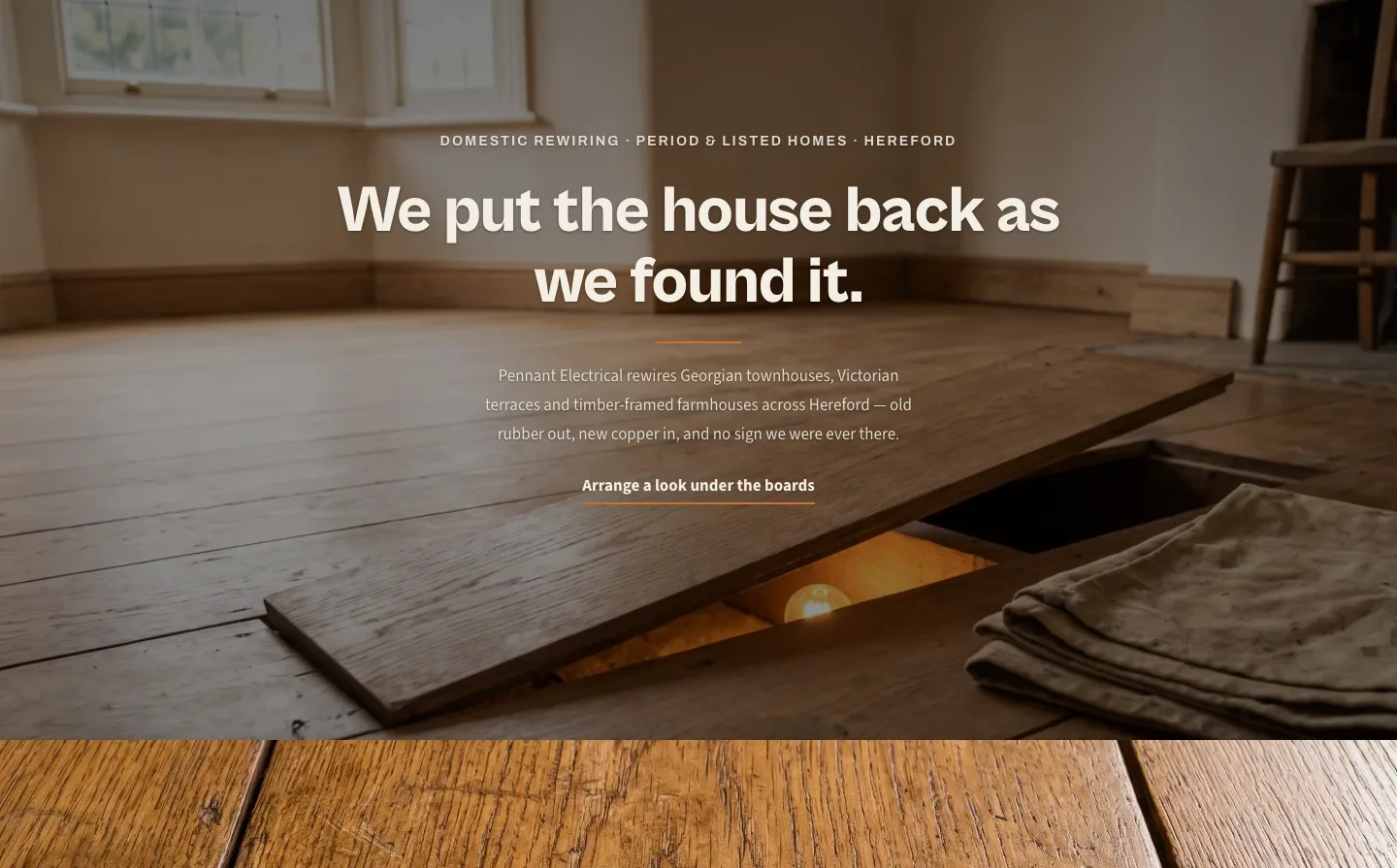 ElectriciansPennant Electrical · Hereford
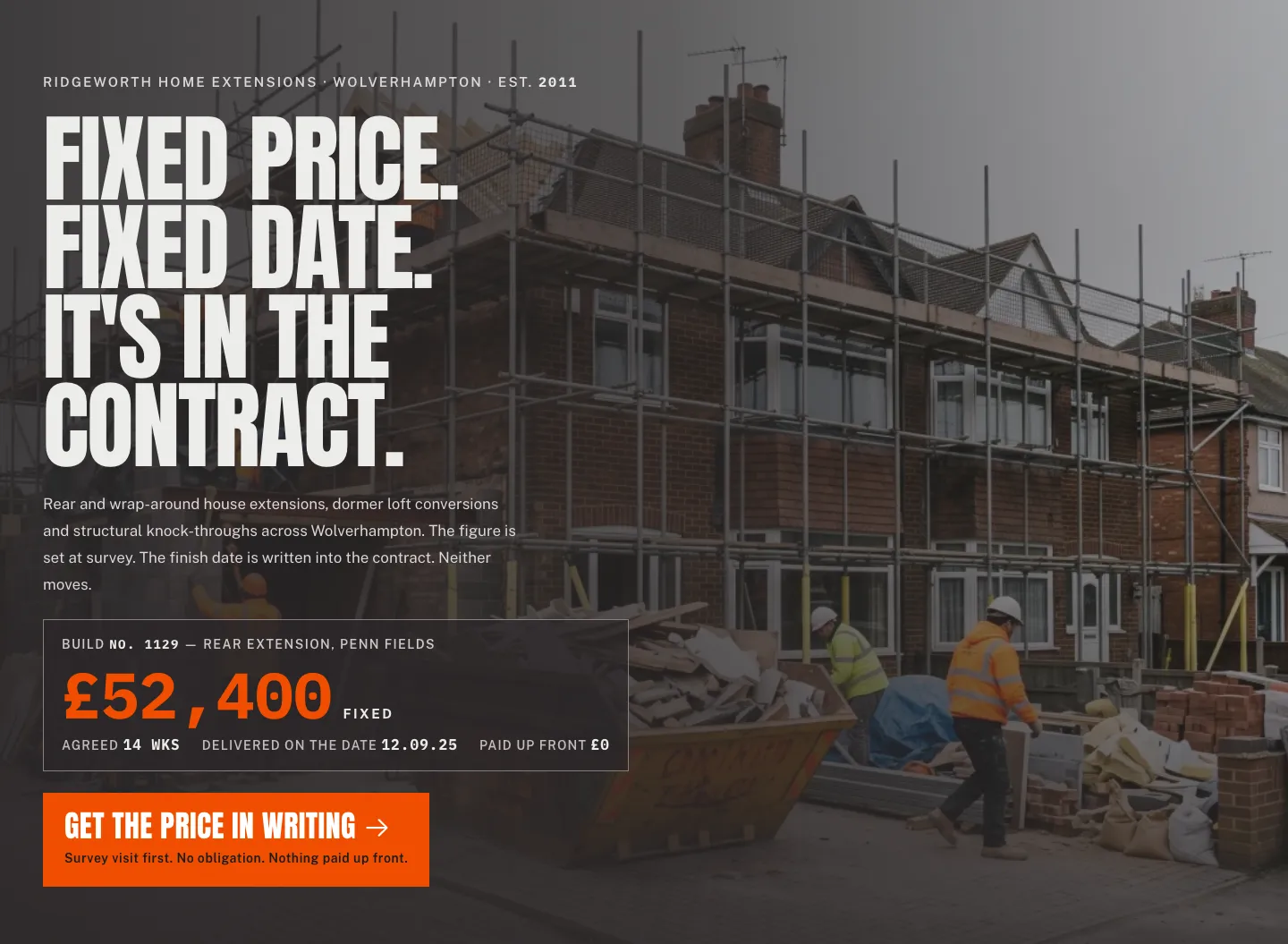 BuildersRidgeworth Home Extensions · Wolverhampton
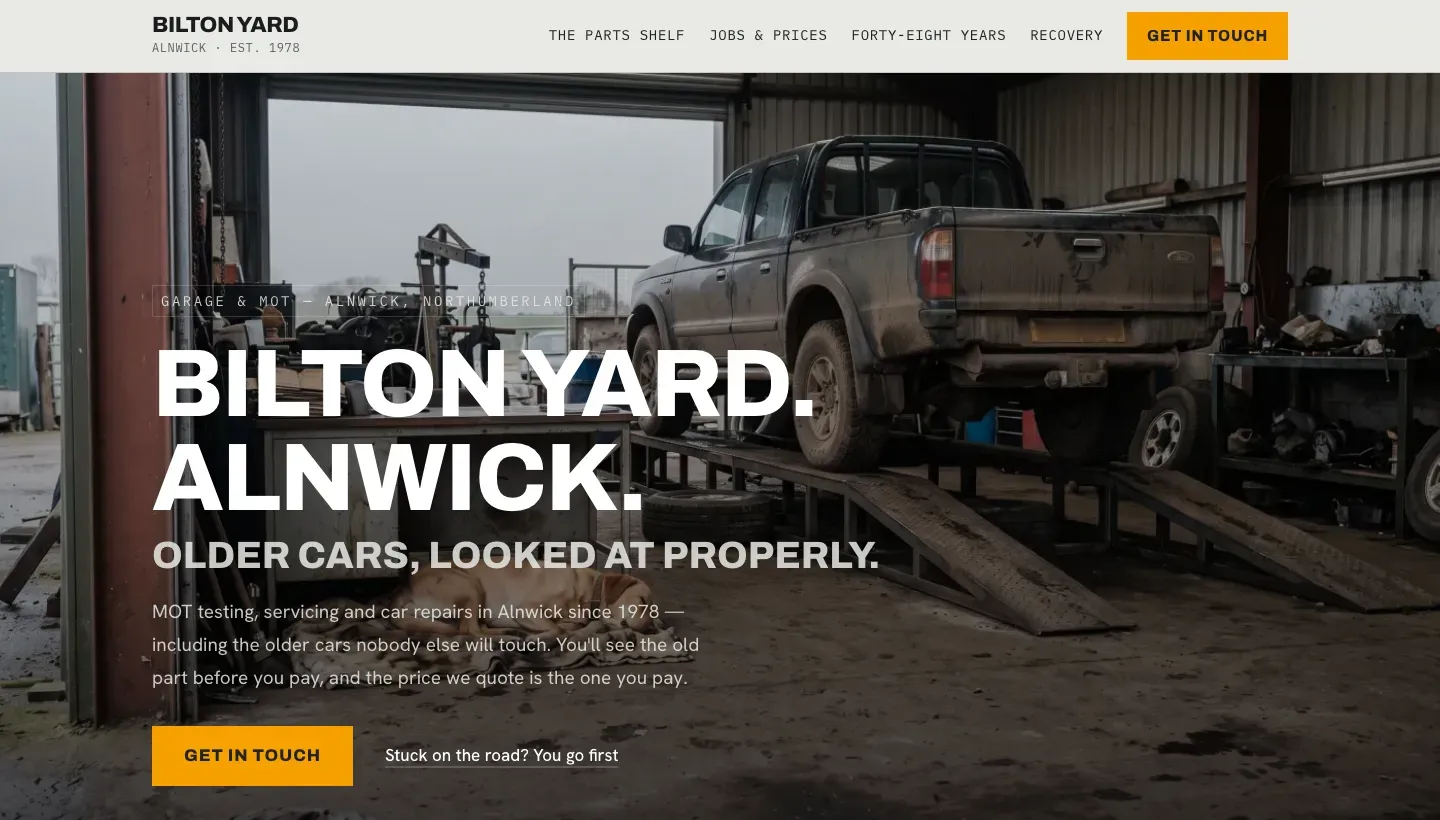 Garages and mechanicsBilton Yard
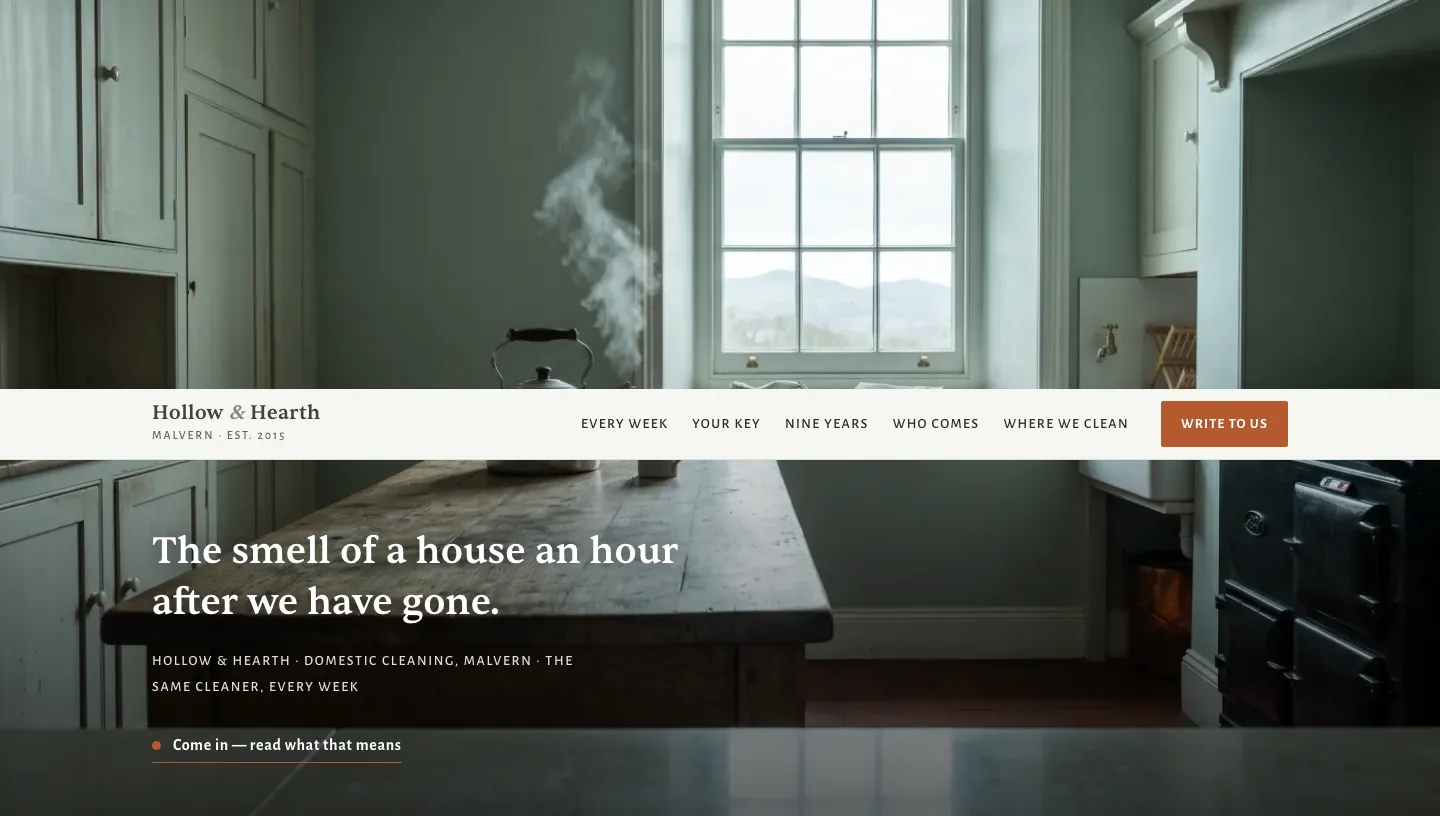 CleanersHollow and Hearth
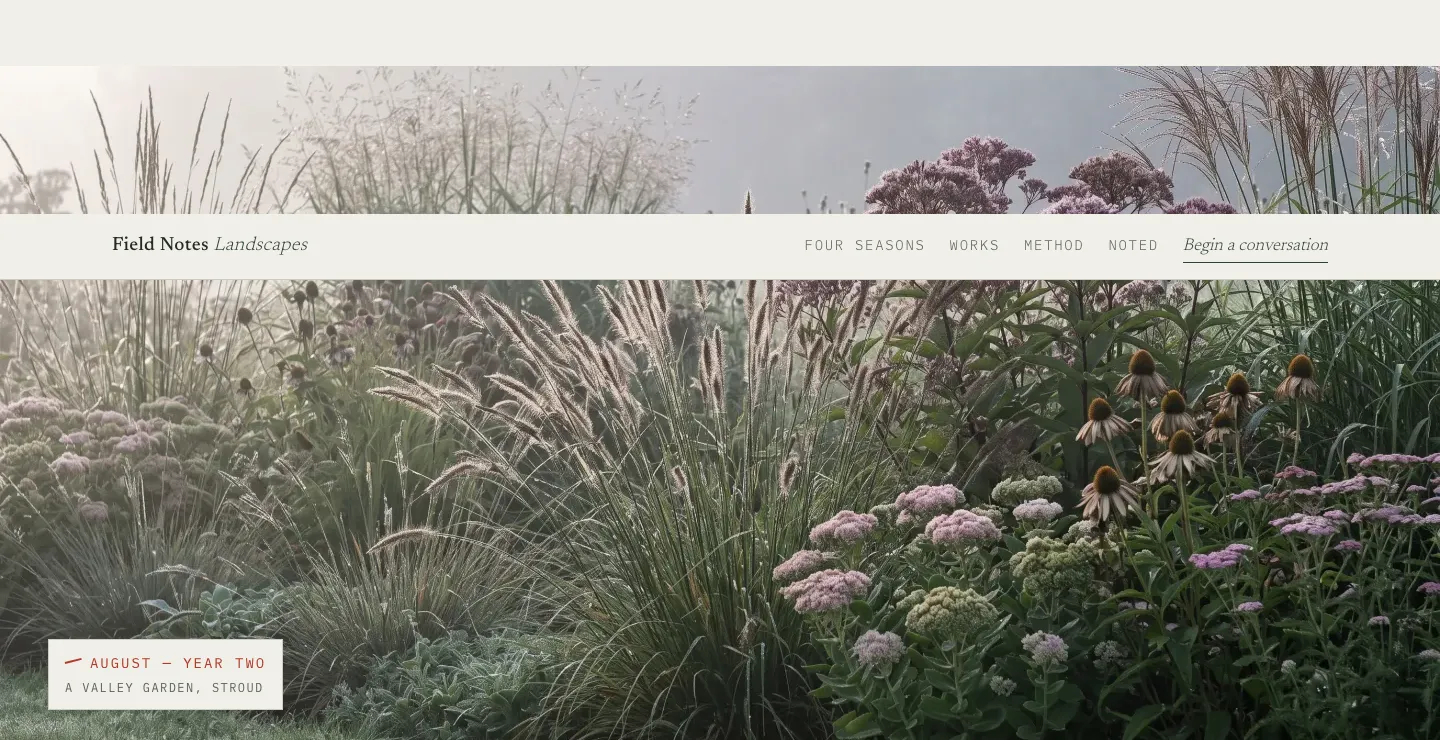 Gardeners and landscapersField Notes Landscapes
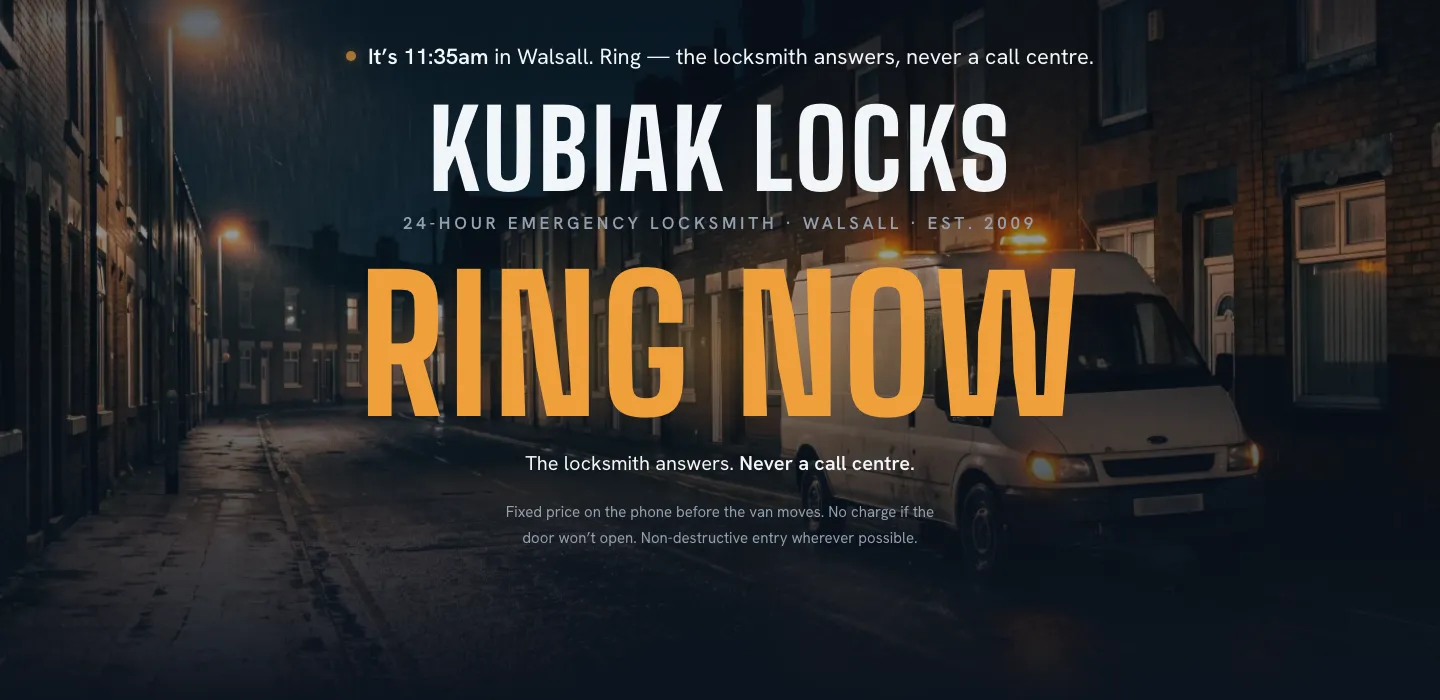 LocksmithsKubiak Locks
Every example is a fictional business we built to show the work. Another trade? See every business type, or tell us yours when you start; the site is built from what you tell us, not from a trade template.
How it works for a trade
Built from a chat. Changed by a message.
Before
Tell us the jobs you want more of.
Describe the business in a chat, on the site or on WhatsApp: the work, the area, how you price and how people reach you. We play it back so you can correct it. The words, the photographs and two logo designs are made for you.
The first look
Approve the home page first.
Choose one of two or three design directions. Your home page is ready to look at in about twenty minutes, and nothing else is built until you approve it. Up to five changes and one complete rethink are included before you do.
After launch
Send the change from the van.
New prices, new areas, a photo of the finished job: message us in your dashboard or on WhatsApp and we put it live. About ten small edits a month are covered on Starter, about thirty on Business.
The build is a one-off cost. Hosting and changes are monthly.
Start with a single page if that's all the business needs, and add pages as it grows.
Monthly plans
Changes by message use credits from your plan, and unused plan credits roll over.
The build, paid once
1 page
3 pages
4 pages
5 pages
£29 for the first page, £15 for each one after, up to eight; a privacy page is free. Hosting is free for the first month. A page added later is £15.
No contract and no setup fee. Your domain is in your name. Cancel from your account.
See my website priceQuestions tradespeople ask
Before you have your website built.
Is a one-page website enough for a trade business?
Often, yes. One page can carry your work, your area, how you price, who comes to the house and how to reach you. Add a page when one kind of job needs its own explanation, such as boiler work, extensions or end-of-tenancy cleans.
Should I put prices on my website if every job is different?
Put the unit and the starting point: the half-hour rate, the call-out, the price of a standard job, or the band a project usually falls in. Then say what moves a job up or down and what you need to see before you quote. Always say whether VAT is included.
Can I change my prices and areas myself?
You don't need to. Send the change in your dashboard or on WhatsApp and we put it live; most small edits are live in a minute or two. They come out of the credits in your monthly plan.
Do I need photos and a logo before I start?
No. Photographs and words are made for you from what you tell us, and two logo designs come with every build. Your own photos of real jobs are worth adding later, with the customer's permission.
Will a new website get me to the top of Google?
We don't promise rankings. Every site is built ready for Google, with titles, descriptions, a sitemap and business structured data on every page. On your own domain we register it with Google Search Console and show you your search results in your dashboard.
Can I keep my domain?
Yes. Connect a domain you already have, or buy one in your dashboard; each name shows its yearly price before you pay. Either way it is registered in your name.