A website for plumbers.
Show them how you work before you arrive.
A customer with a leak needs your area, your availability and what the visit will cost. Someone planning a bathroom needs to see your work. A letting agent needs to know what reaches the property file after you leave. We design and build your plumbing website around the jobs you want, then host it and help you keep it current.
From £15/mo, plus a one-off build pack from £29.

An exact appointment is the opening idea. The bathroom work gives the promise something to stand on.
This is a live example of our work, not a customer business.Before the phone rings
The phone number is only the start of the answer.
We read the front page of 1,179 UK plumbing and heating websites in August 2026 and recorded what each one said and offered. Other pages were not read. The figures below describe those sites, not the whole trade.
1.8% showed an hourly or call-out rate.
A leak does not leave much time for comparing firms. A customer wants to know what they are agreeing to when you send someone out. Put the first charge, what it covers and how further time is billed beside the phone number. Say whether VAT is included. If diagnosis and repair are charged separately, explain that before the call.
46.5%mentioned emergency call-outs.
An emergency label needs working hours and an honest response arrangement. Say whether the number reaches your own team, an answering service or voicemail after hours. If you do not run an overnight service, make that clear. A small firm should not have to keep an impossible promise because a website template supplied it.
45.7%named Gas Safe.
For a business doing gas work, make the registration check easy to find. Name the registered business and the engineer where relevant, and link to the public register. Some firms in our sample do no gas work; this figure does not tell us whether businesses were working legally.
7.9%offered WhatsApp.
It can be useful for a leaking fitting, a boiler display or a cramped space under a basin. Ask for a photograph and the postcode, and say when someone reads the messages. Keep the urgent phone route separate. Do not let an unanswered message look like a booked visit.
54%served homes and businesses.
Those buyers need different information. The homeowner wants the appointment and the scope of the job. The agent may need tenant access, a purchase-order reference, an invoice and the safety record. Give each a route that explains what happens next, rather than sending everyone through a blank contact box.
Built around the buyer
Plumbing website examples should show the work you want more of.
These are example builds for fictional businesses. Both are one-page sites, with very different buyers and different reasons to get in touch. The design follows that difference; neither asks the visitor to work through a catalogue of everything a plumber might do.
The homeowner
On the Level makes the appointment part of the design.

The Nottingham example is a women-led plumbing firm doing bathrooms, leak tracing and small jobs. Its opening names an exact arrival time, 8:40, and carries that idea through to the booking button. The spirit level is a visual thread through the page, connecting the firm's name with straight tile runs and the care taken over a refit.
That is a choice from this fictional brief, not a promise every plumber should copy. What is useful is the connection: a customer who has had to take time off work can see what this firm intends to do differently. Your own site should make an equally clear promise that your diary can support.
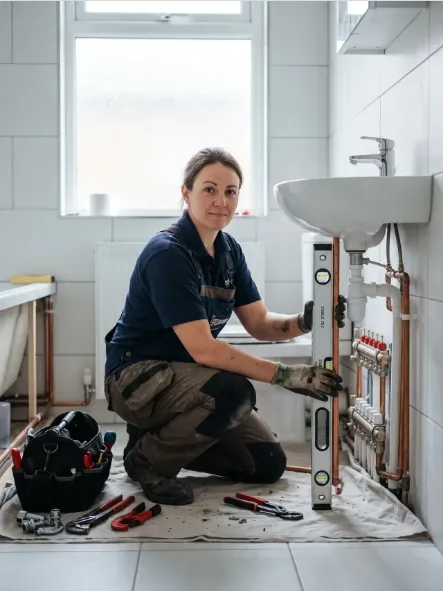
The bathroom examples then explain work a finished-room photograph cannot show. The Victorian terrace is about tanking, falls and setting out the tiles. The family bathroom in a 1930s semi deals with reachable isolation valves and ventilation. The accessible adaptation describes how the room is fitted to its user. Those details give someone comparing quotations more to judge than a row of attractive sinks.
The page also explains how the home is treated, with shoe covers and dust sheets. On your real site, use photographs of your own people and work, with permission. Describe the disruption, who handles it and what the customer needs to do before you arrive. A bathroom refit involves living in the house while the work happens.
The landlord and managing agent
Fenwick puts the landlord's file in the foreground.

Fenwick Compliance Plumbing is our fictional Basingstoke example for landlords and managing agents. Its opening looks like a renewal register, with property references, due dates and visits already booked. The design is about the thing the buyer has to keep track of, rather than a boiler photograph with a list of services underneath.
The services are organised as documents and records: landlord gas safety records, servicing, risk assessments and the paperwork around planned and reactive work. The access section explains tenant contact and how an unsuccessful visit is recorded. That is a different enquiry from a homeowner asking for a replacement tap.
This is a design example, not a credential check. A real gas business must also make its Gas Safe registration verifiable. The useful idea here is to explain who arranges the visit, what the agent receives and how the next renewal is handled. Make each commitment match the service you actually provide.
What the real sites get right
The strongest sites make the terms easy to compare.
These are real UK front pages from our scan, described without naming the firms. Their prices and response promises belong to those businesses. Copy the way they explain the service, rather than adopting terms you cannot offer.
A heating firm prices the everyday jobs.
A family-run firm puts fixed prices for a boiler service, a landlord gas safety certificate and a plumbing fix beside its booking route. It also says its engineers are directly employed. The visitor can establish the cost of a familiar job and who will arrive without writing an enquiry. If you have repeatable work with a clear scope, give it the same clarity.
Another shows ranges instead of hiding behind a quote.
A heating and plumbing firm publishes separate ranges for repairs, servicing and emergency repairs, with VAT treatment stated. A range admits that jobs differ while still giving the customer something useful. Say what puts a job towards either end, and which facts or photographs you need before narrowing it down.
An emergency plumber explains the unit of time.
A London firm charges by the half hour, with different daytime and night-time rates including VAT. Its booking and WhatsApp routes sit alongside that explanation. The important detail is the unit: an hourly figure, a minimum visit and an out-of-hours charge are not interchangeable. Write the calculation in the order the bill is built.
A boiler installer separates the guarantees.
An installer gives starting prices, offers a site survey and explains its own labour-and-parts cover separately from the manufacturer's warranty. A customer can see what happens before work starts and who stands behind it afterwards. Name the conditions of each guarantee, including servicing requirements, instead of allowing a long boiler warranty to imply cover for everything.
The site, job by job
Give each kind of job enough room to be understood.
A plumber website can start as a single useful page. Add separate pages when a reader needs a different explanation, examples or enquiry route. The right number follows the work you actually do. A bathroom customer and a landlord should not have to pick their way through the same service list.
Finding the firm
Home: tell them whether this is the right firm.
Name your main work, the area you cover and how to reach you. Put the work you want near the top: planned bathrooms, everyday repairs, boiler work or managed properties. Show the person or team who will visit. If urgent work is a genuine part of the service, its phone number, hours and charging arrangement need to be easy to find on a phone.
Booking a visit
Repairs and call-outs: explain the visit.
List the small jobs you are happy to take, including the ones people hesitate to call about. Explain whether you charge for diagnosis, the minimum charge, parts and further labour, and how you approve extra work. Separate an appointment request from a confirmed booking. A contact form should not tell someone help is on the way when nobody has checked the diary.
Checking the engineer
Boilers and heating: make the registration check straightforward.
For gas work, Gas Safe is the credential a customer should be able to check immediately. Link to the registered business and explain that the engineer's ID card shows the work they are qualified to do. A manufacturer installer badge is a different thing. Distinguish servicing, repair and replacement, and say what a survey or quotation includes. Do not add a gas page if you do not do gas work.
Planning the room
Bathrooms: show the room and the work behind it.
Use a completed job with a short account of the starting room, what changed and what you were responsible for. Explain who handles tiling, electrics, waste removal and making good, where those are part of the job. For adaptations, describe how you establish the user's needs and the layout. Photographs of falls, pipework and preparation can explain a quotation better than another close-up of a new tap.
Keeping the record
Landlords: describe the record and the renewal.
Use “landlord gas safety certificate (often called a CP12)” so the owner recognises the service, and distinguish the gas safety check from boiler servicing. Explain tenant access, missed visits, how the record is delivered and whether you manage reminders. Keep the property and billing details together in the enquiry. Landlords have annual gas safety duties; your website should be clear about the part you undertake, rather than suggesting all their responsibilities pass to you.
Checking the patch
Areas and contact: help someone check the practicalities.
List the places you can actually serve and any difference between planned work and urgent visits. State hours in ordinary words, including what happens when you are closed. If an access problem, parking restriction or flat number changes the visit, ask for it. Avoid pages for neighbouring towns that say the same thing with the place name changed; useful local detail comes from real work and real coverage.
If heat pumps are part of your work, give them a proper explanation and make the relevant MCS certification checkable. For the Boiler Upgrade Scheme in England and Wales, link to GOV.UK for current eligibility. WaterSafe and approved-contractor schemes are voluntary; name the approvals you hold without presenting them as requirements for every plumber.
Check the official sources: Gas Safe Register, HSE landlord guidance, WaterSafe Register.

Useful before you choose a builder
Make the next enquiry easier, whatever you build with.
Match the website to the way the phone is answered.
Use the same business name, service area, hours and contact number on your Google Business Profile and the site. If calls divert while you are on a job, say what happens. Test the number from a phone and send a message through the form yourself. Check the reply as well as the notification: it should tell the customer what to expect, without inventing an arrival time.
Keep a usable record of your jobs.
With permission, photograph the room before work, the important preparation and the finished result. Keep a note of the problem and what you did, so the website can explain the job later. Avoid showing addresses, personal possessions or documents without agreement. For an agent's site, an anonymised sample record can be useful; a tenant's name, key-safe code or live certificate should not be public evidence.
Ask for reviews after a real visit.
Give the customer a direct link to the place you collect reviews. Use their words with permission and keep the source identifiable. Do not write the review for them or turn a comment about a tidy bathroom into a claim about technical work they could not inspect. When a genuine review mentions punctuality, clear pricing or care in the house, let that detail speak for itself.
Keep the offer narrower than the service directory.
Remove work you no longer take, qualifications that have lapsed and availability you cannot maintain. A page saying “no call-out charge” still needs to explain when labour starts being charged. A free quote needs a clear boundary between a survey and paid fault-finding. Keep these distinctions visible as the business changes, not tucked into a document someone finds after booking.
Website design for plumbers
A builder can suit a simple business. We can do the work with you.
A website builder for plumbers can be a sensible choice if your work, patch and hours are stable and you have time to write and maintain the site. A plumber website template supplies places for text and photographs. It cannot decide which calls you want, what your minimum charge covers or how you handle tenant access.
We write a brief with you, design and build the site, then look after updates, fixes and ongoing improvements for a monthly fee. You check the work before it goes live. For plumber website design, the starting point is your jobs and the people booking them, not a layout to fill.
The build is a one-off cost. Hosting and ongoing work are monthly.
Start with the work you do today. Add pages as the business needs them.
Monthly plans
Edits with your assistant use credits.
One-off build packs
1 page
3 pages
5 pages
Each includes 30 days of Forge edits after the build and is paired with your first month on a plan. Add pages any time, priced per page; you see the price before you pay.
Cancellation takes two clicks from your account. The site keeps running until the end of the billing period. Your domain stays yours, and if you leave we send a static snapshot for another host. Failed builds are not charged; a person follows up the next working day. There is no introductory rate that runs out.
Get startedQuestions plumbers ask
Before you have your website built.
Can I start with a one-page plumber website?
Yes. Both examples here do that. Start with enough space to explain your work, coverage, prices and contact route. Split out a service when its customer needs more detail, rather than buying pages simply to make the site bigger.
Should I publish prices if every job is different?
Publish what you can define: a standard job, the visit charge or the basis for labour. For work that needs a survey, explain what you need to quote and what might change the price. Always state whether VAT is included.
Do all plumbers need to show Gas Safe registration?
No. It is relevant to gas work, not every plumbing job. If you do gas work, make the registration check easy and accurate. Do not use a borrowed badge, or suggest registration covers work outside the engineer's qualifications.
Should customers call, book online or send a photograph?
Choose for the job. An urgent problem needs a route someone monitors. A bathroom enquiry can use photographs and a description. A landlord enquiry needs property and access details. Make clear when an enquiry becomes an agreed appointment.
Will a new website put me at the top of Google?
We do not promise a ranking. Clear service pages, accurate coverage and evidence of your work give people useful information. Keep the business profile and website consistent. There is no honest position guarantee to put in a website design quote.
Can I add boiler or landlord pages later?
Yes. Pages can be added on any plan and are priced per page. You see the price before you pay. Start with the work you already do and add a page when the service and its details are ready.