for uk physiotherapy practices
Website for physiotherapists that answers the morning phone calls.
Who will I see, and are they registered? What does the first assessment cost? Do I need a GP letter? Will my insurer pay? Can I get into the building? Your reception answers these every morning. Of 151 UK physiotherapy front pages we read, most leave several out. We write a brief with you, build a site that answers all of them in about half an hour, then look after it.
from £15/mo about half an hour to a first build cancel in two clicks your domain stays yours
what patients are trying to find out
Seven questions a person in pain asks before they book. How often the front page answered.
We read the front page of 151 UK physiotherapy practice websites in August 2026 and recorded what each one said and offered. Every figure on this page is of those sites.
-
What does the first appointment cost?
13.9%
of 151 front pages showed any price
Where a price did appear it was usable: “£70 for the initial 50 minute consultation”, “£60 – 60 mins follow up”. Copy the shape, the number, the minutes and which visit, and put it beside the booking button.
-
Do I need a GP letter?
8.6%
said patients could self-refer, or that no GP referral was needed
A self-pay patient can book a private physiotherapist without one. Write that in a line of its own, near the button, and keep it apart from the insurance line.
-
Will my insurer pay?
33.1%
mentioned health insurance
A separate question, and it lives in the policy. Name the insurers you bill and tell insured patients to bring their authorisation. “All major insurers” collects patients you then cannot bill.
-
Who will I see, and are they registered?
27.2%
mentioned HCPC registration · 25.8% mentioned the CSP or MCSP
Both are facts about the person, not the practice. Put HCPC beside each clinician, with a name the public register can be checked against, and MCSP only next to members. A footer logo with no name cannot be checked.
-
Do you deal with my problem?
11.8
services listed per front page, led by techniques: acupuncture 35%, sports massage 28%, shockwave 23%, Pilates 15%
Lead with what hurts. Put each technique under the physio who uses it, with a line on whether it is inside the fee. A patient in pain should not have to choose a treatment before anyone has assessed them.
-
Can I get into the building?
96.0%
named their town, so location is not the gap
Someone with a new hip or a back that has stopped them driving needs the ground floor, the lift or the stairs, the walk from the car and, if you visit, the postcodes you cover. Home visits were on 12% of the sites we read.
-
When are you open, and how do I book?
89.4%
offered a phone number · 69.5% offered online booking
Keep the phone, for case managers, older patients and insurers that will not go through a widget. Then write the real week: the Thursday late clinic, the Saturday morning. “Appointments available” tells a shift worker nothing.
physiotherapy website examples · one we built
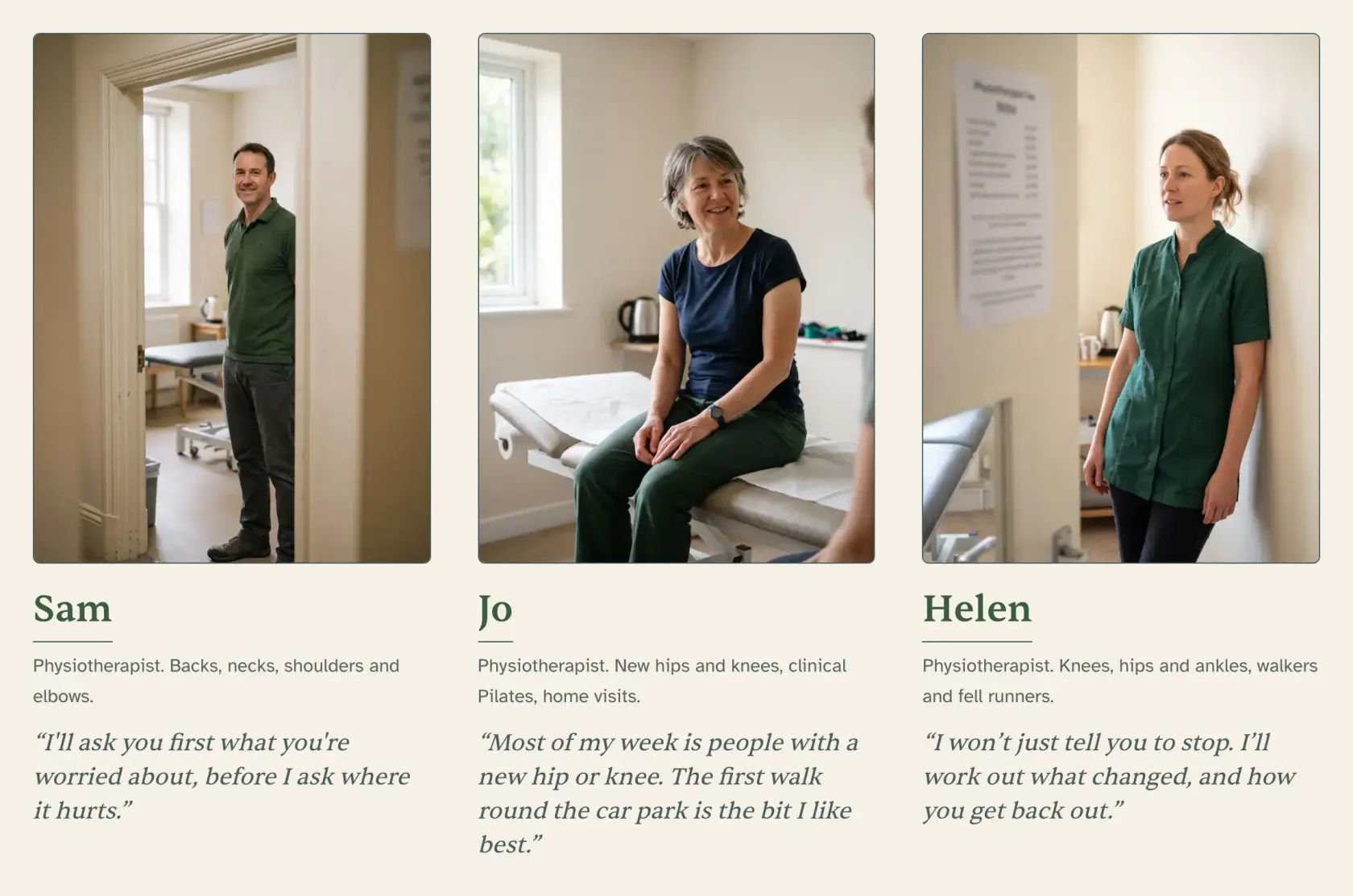
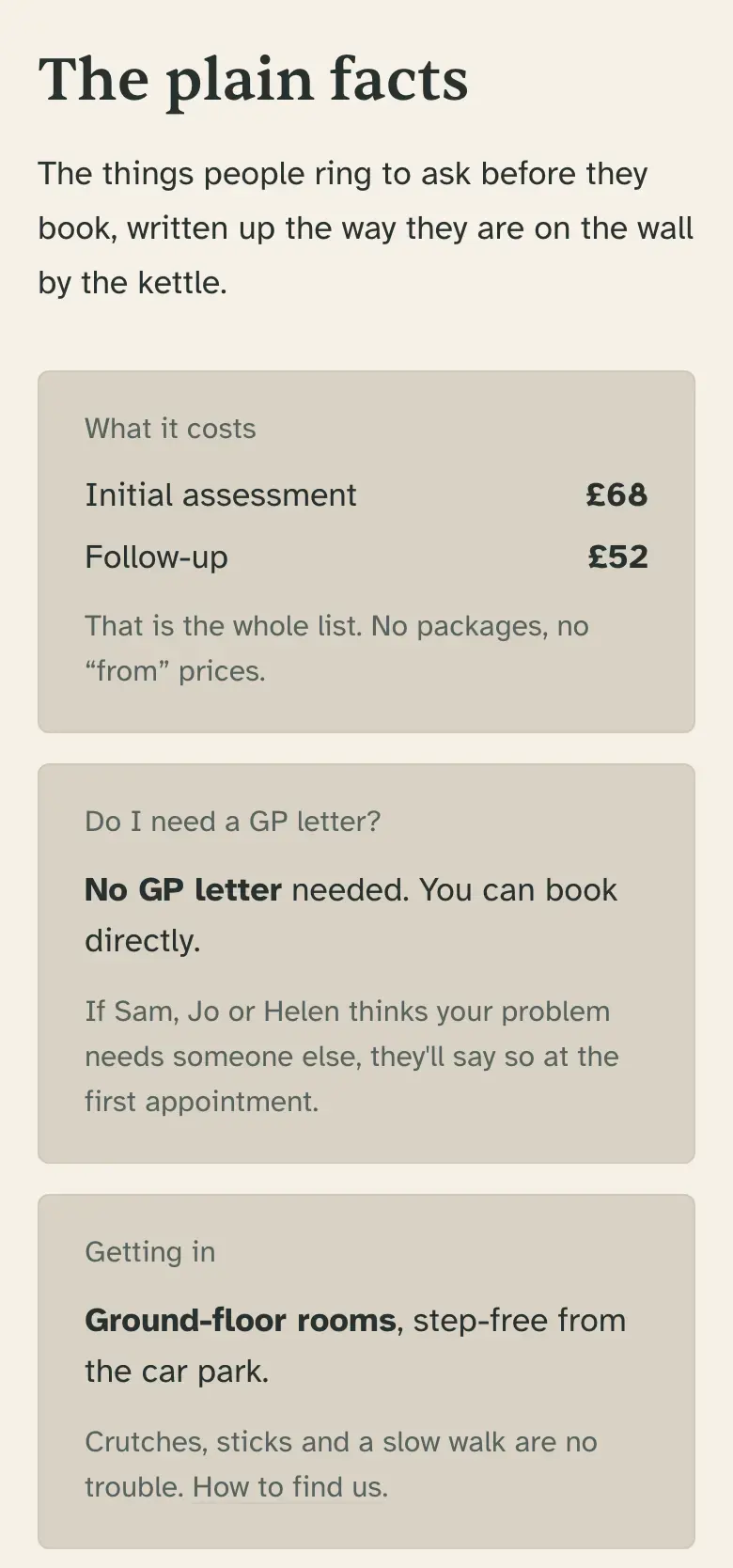
Tanpit Physiotherapy, Kendal. Six pages, three names, every reception question answered on the first screen.
An example build for a fictional practice, made from a realistic brief. It is not a customer. Sam, Jo and Helen have worked together since 2016. The brief came from the morning phone calls (do I need a GP letter, how much is it, is it upstairs, do you take my insurance) and from reviews that were about being listened to rather than any treatment.
the six pages, left to right · each frame is the top of that page
-
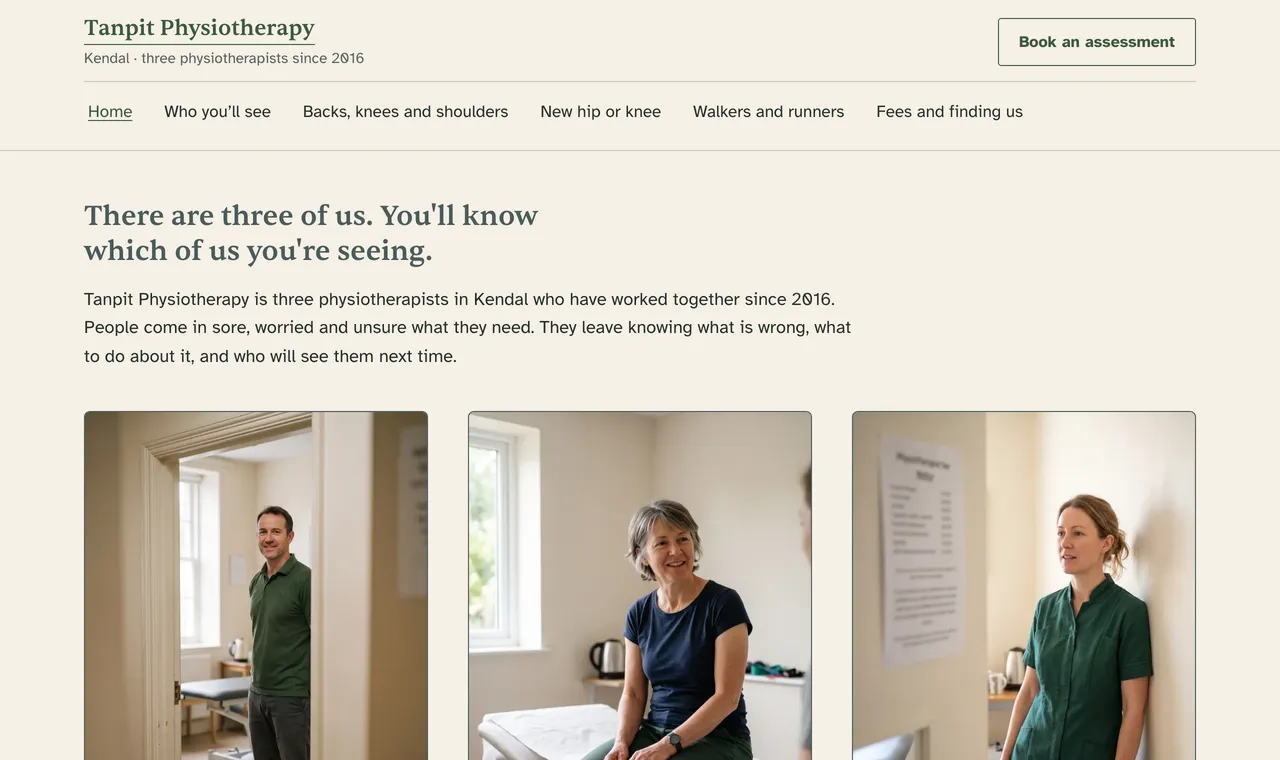
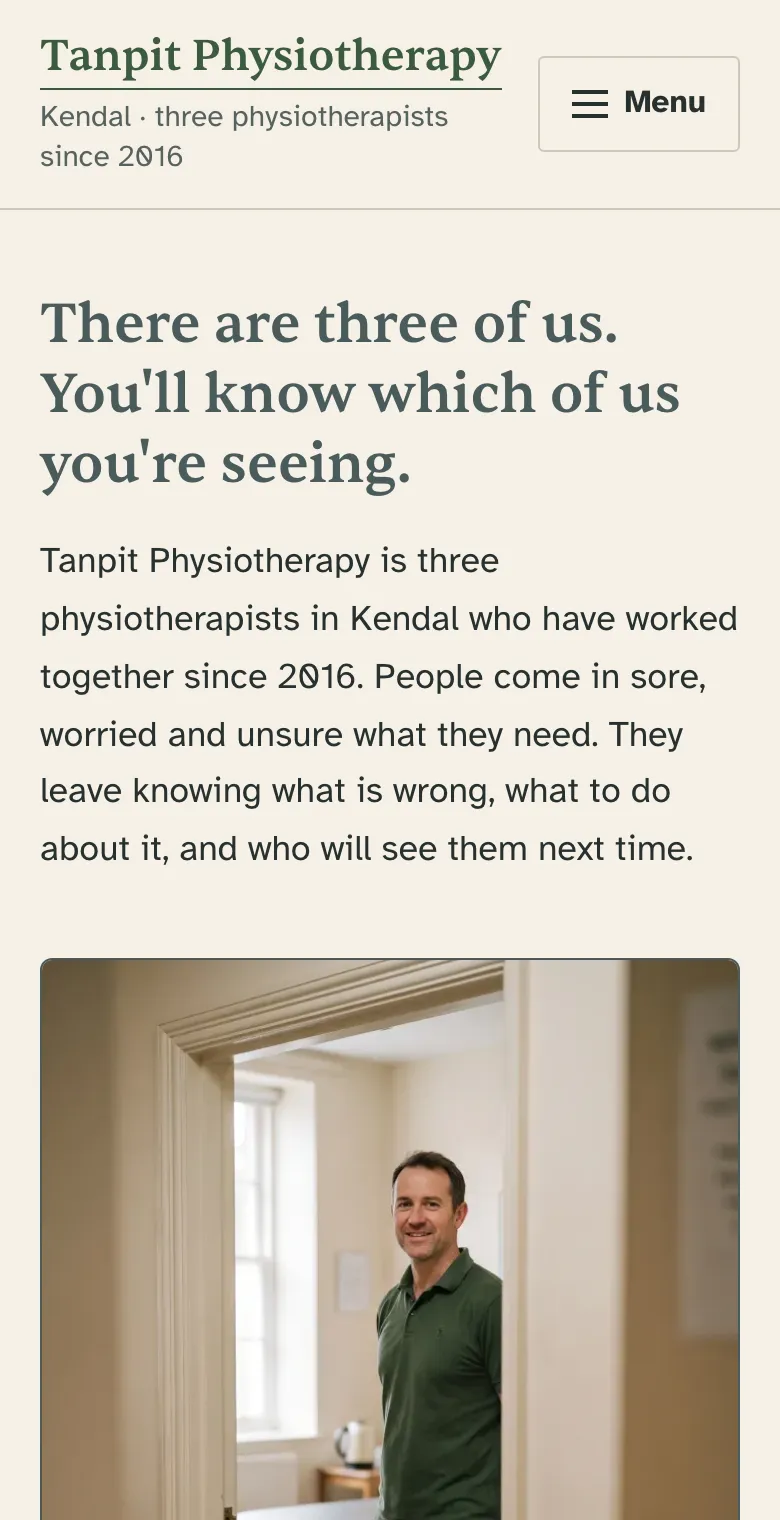 01 Home Three physiotherapists, named, before any technique. (opens in a new tab)
-

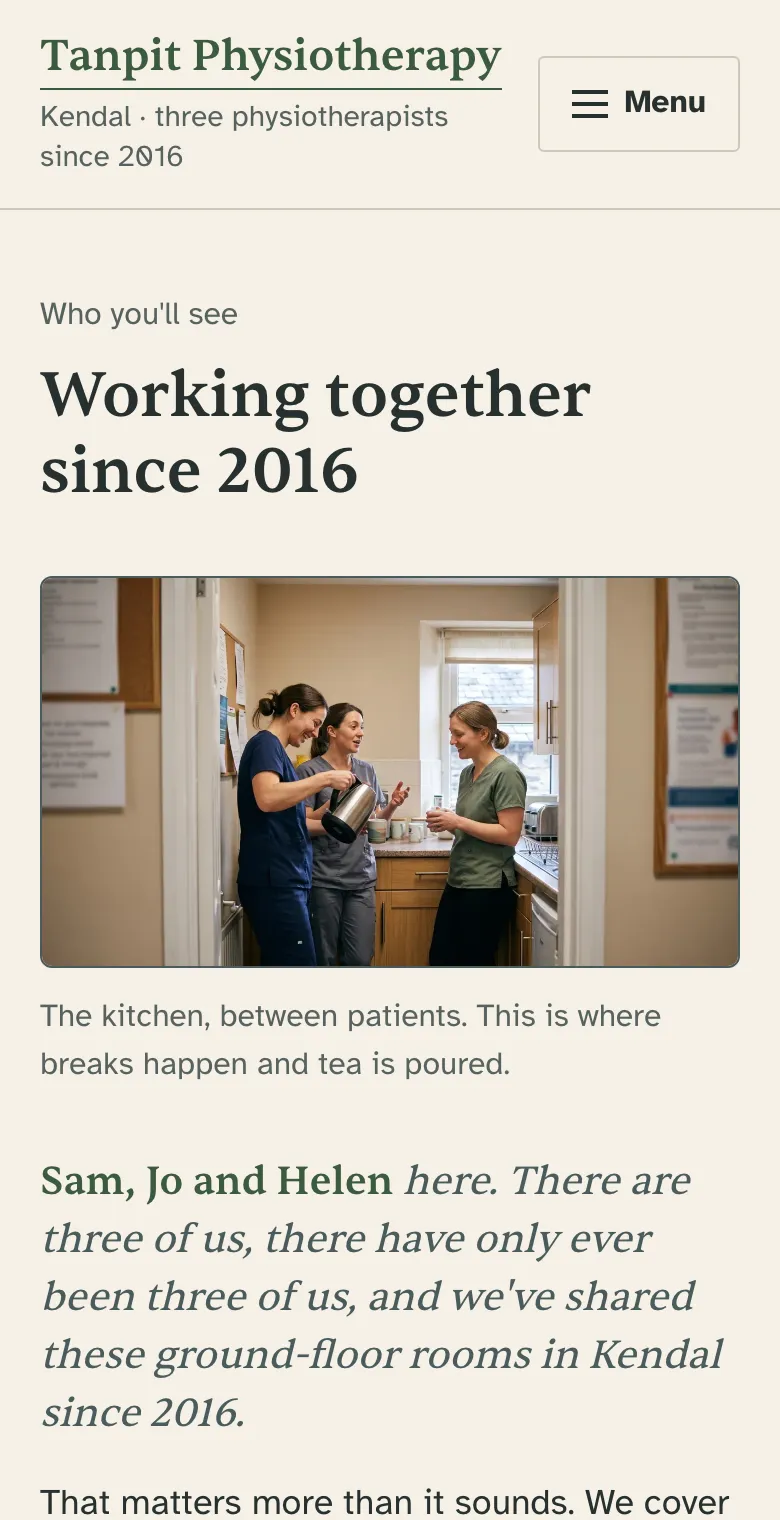 02 Who you’ll see How each of them starts an assessment, and when they are in. (opens in a new tab)
-
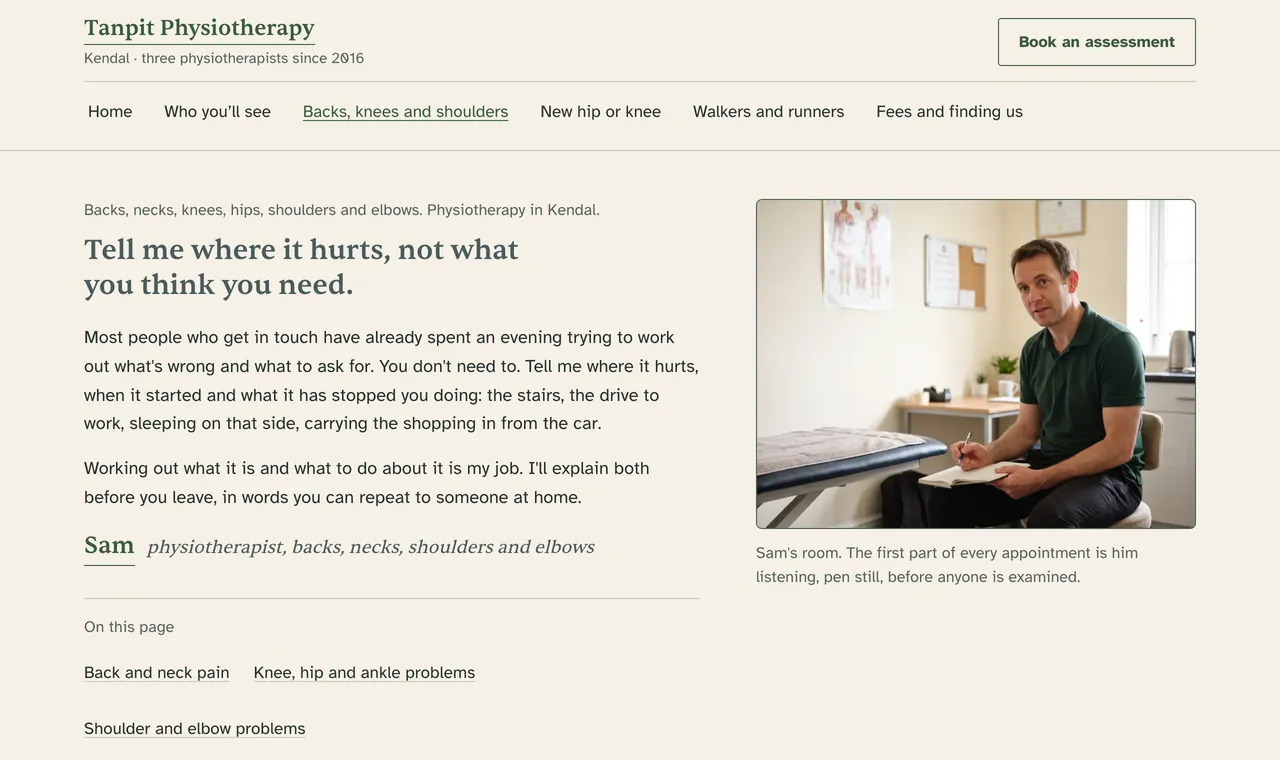
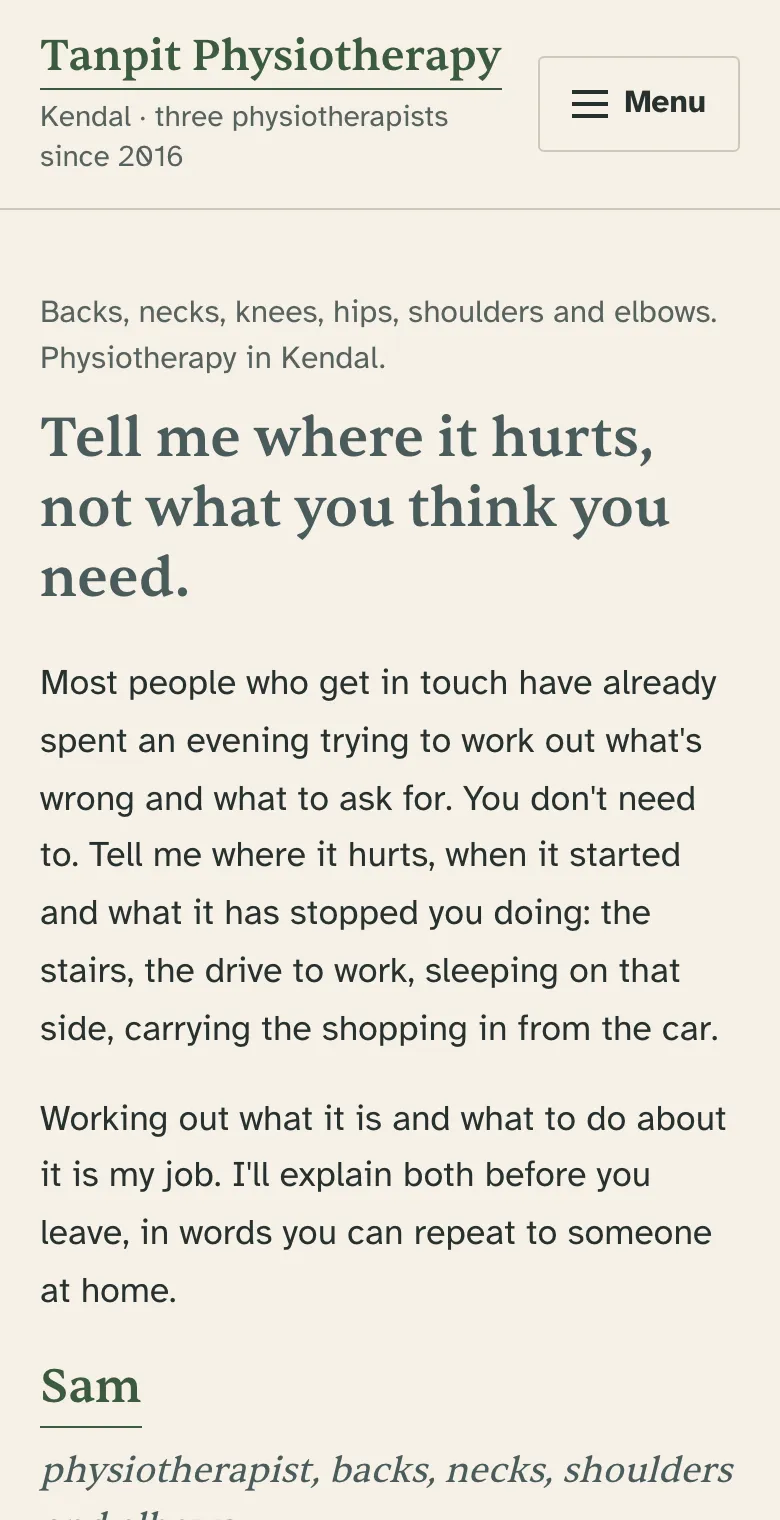 03 Backs, knees and shoulders The problem first. The technique later, under the physio who uses it. (opens in a new tab)
-
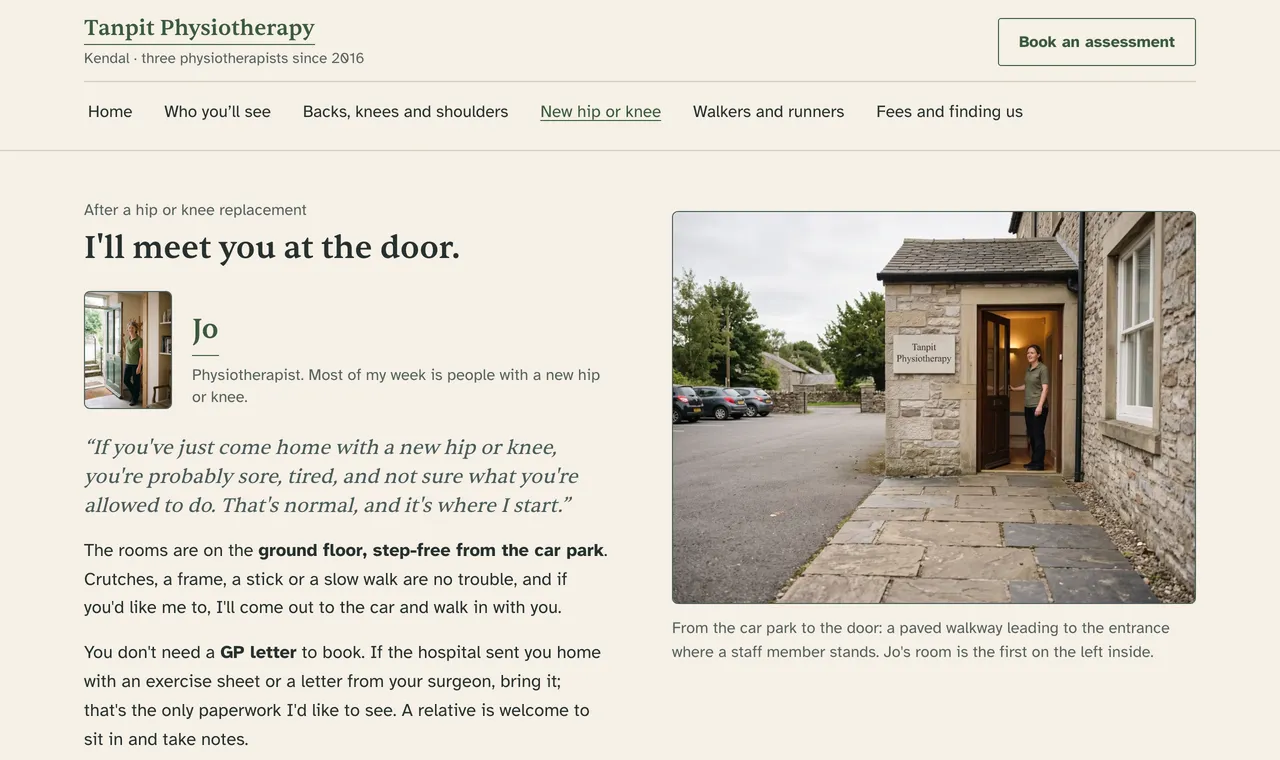
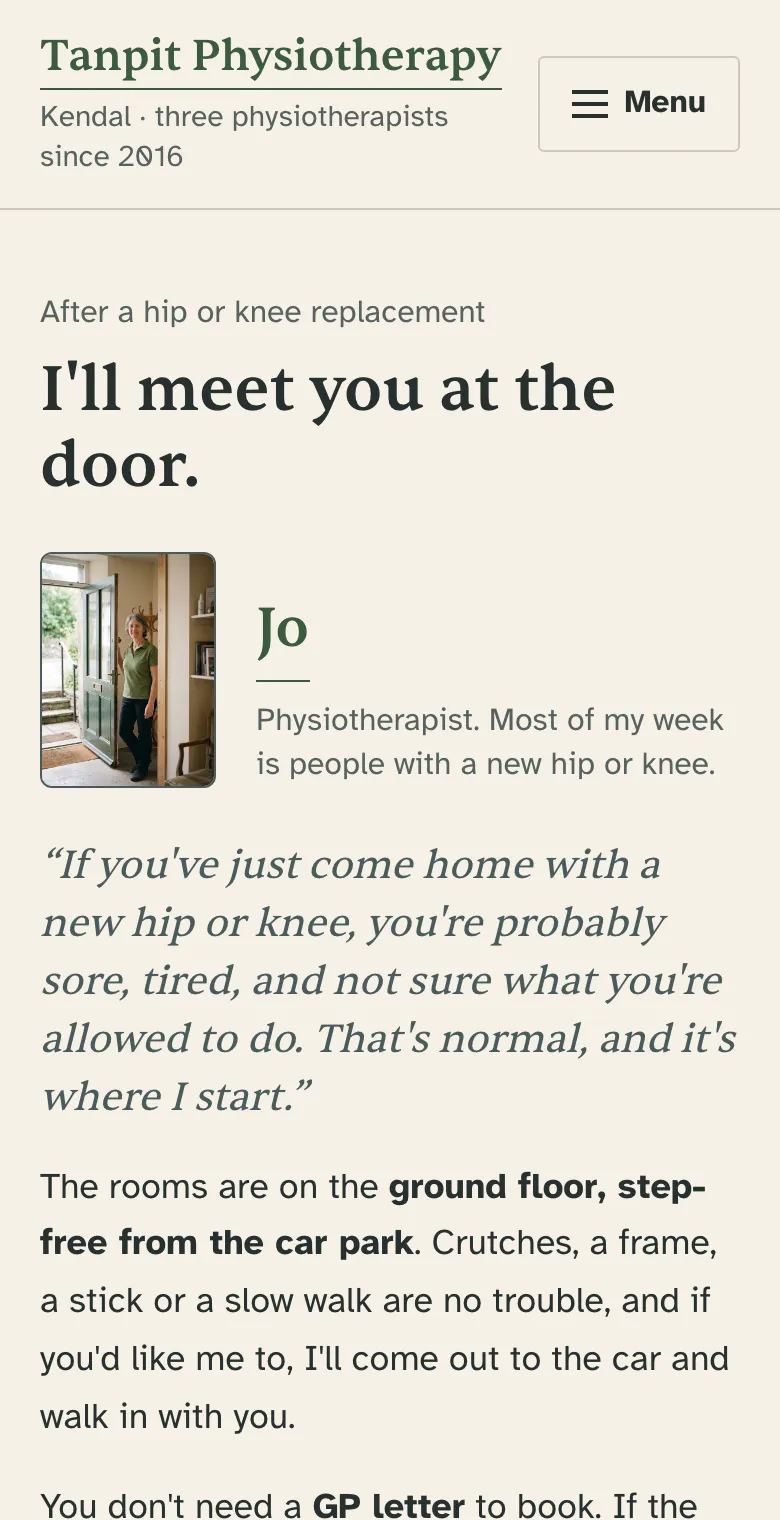 04 New hip or knee Jo, the door, and the first weeks at home. (opens in a new tab)
-
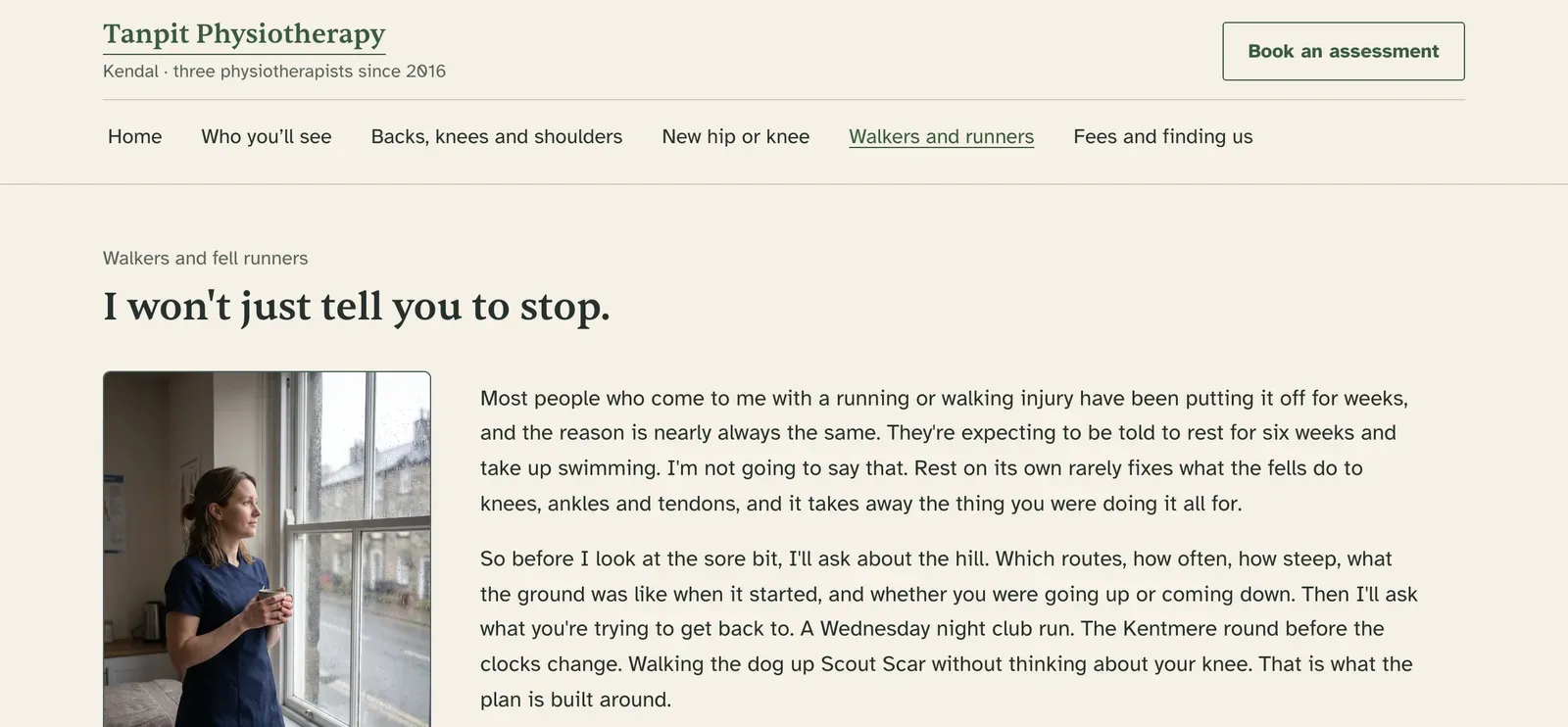
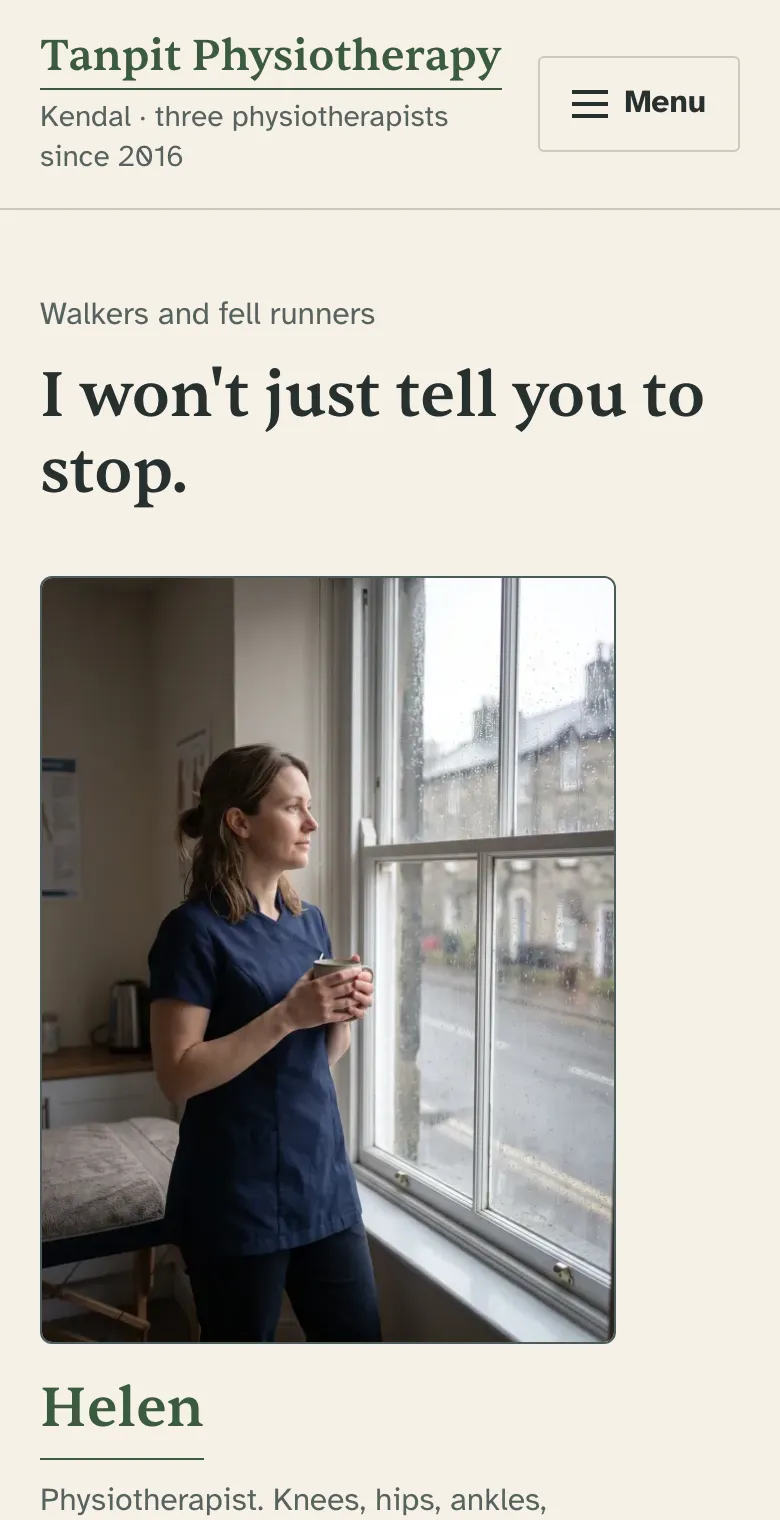 05 Walkers and fell runners Helen’s page. The hill she will ask about, then the plan. (opens in a new tab)
-
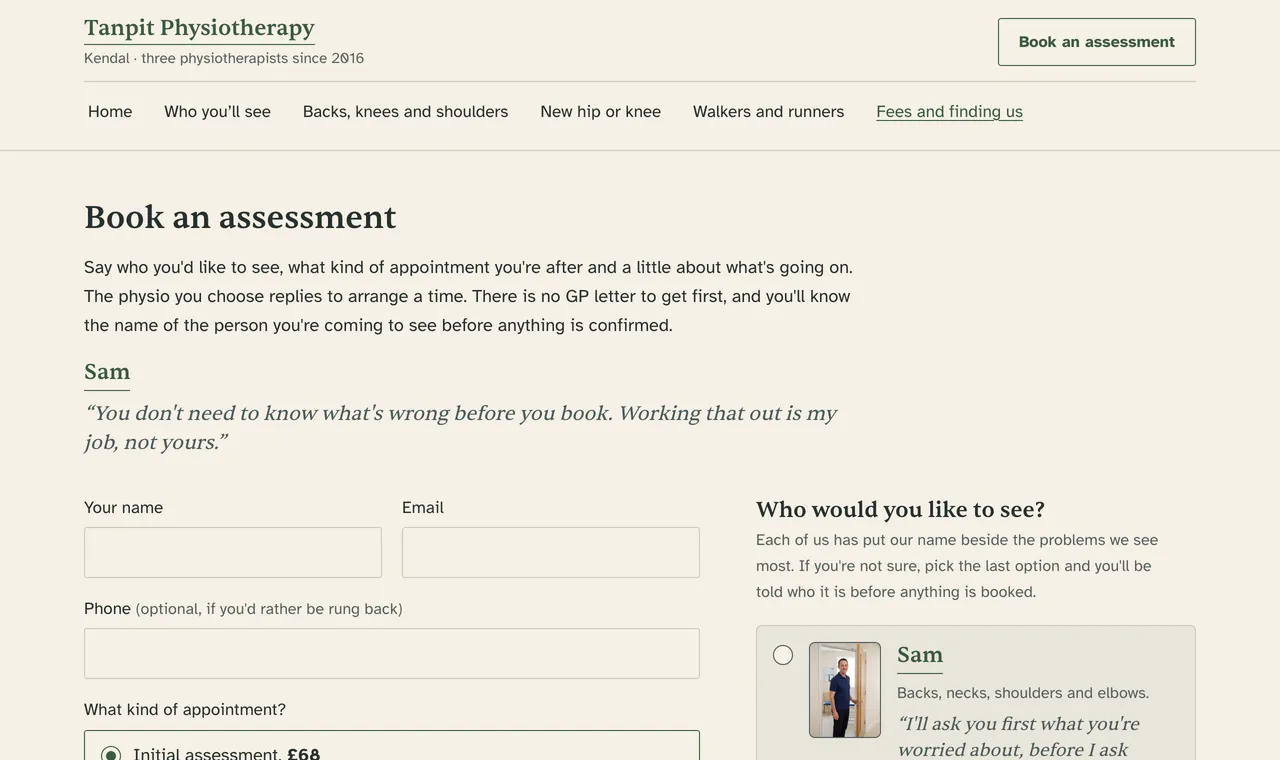
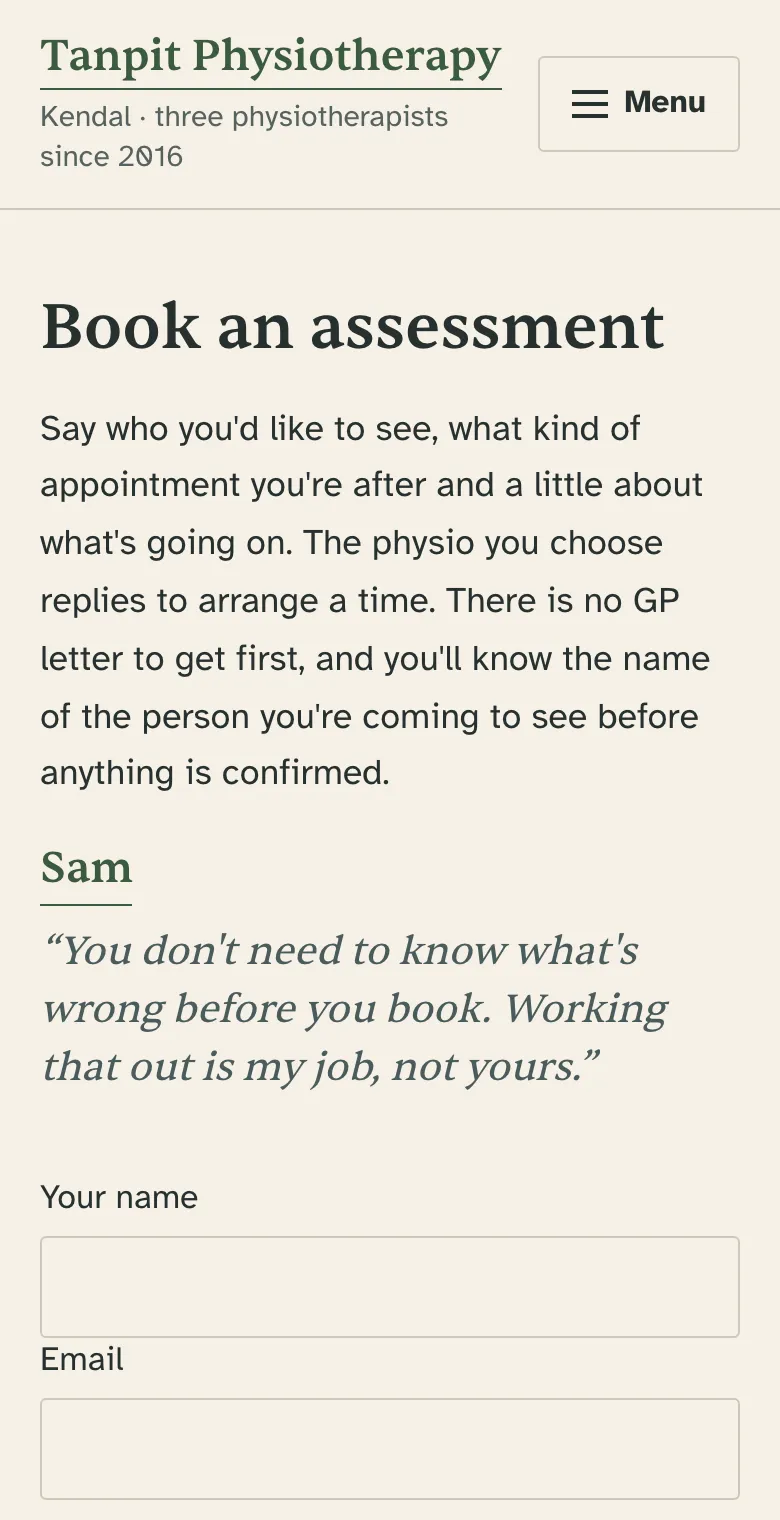 06 Fees and finding us Every fee with its length, the step-free route in words, then a form that names Sam, Jo or Helen. (opens in a new tab)
The decisions that followed, and why they fit a physiotherapy practice
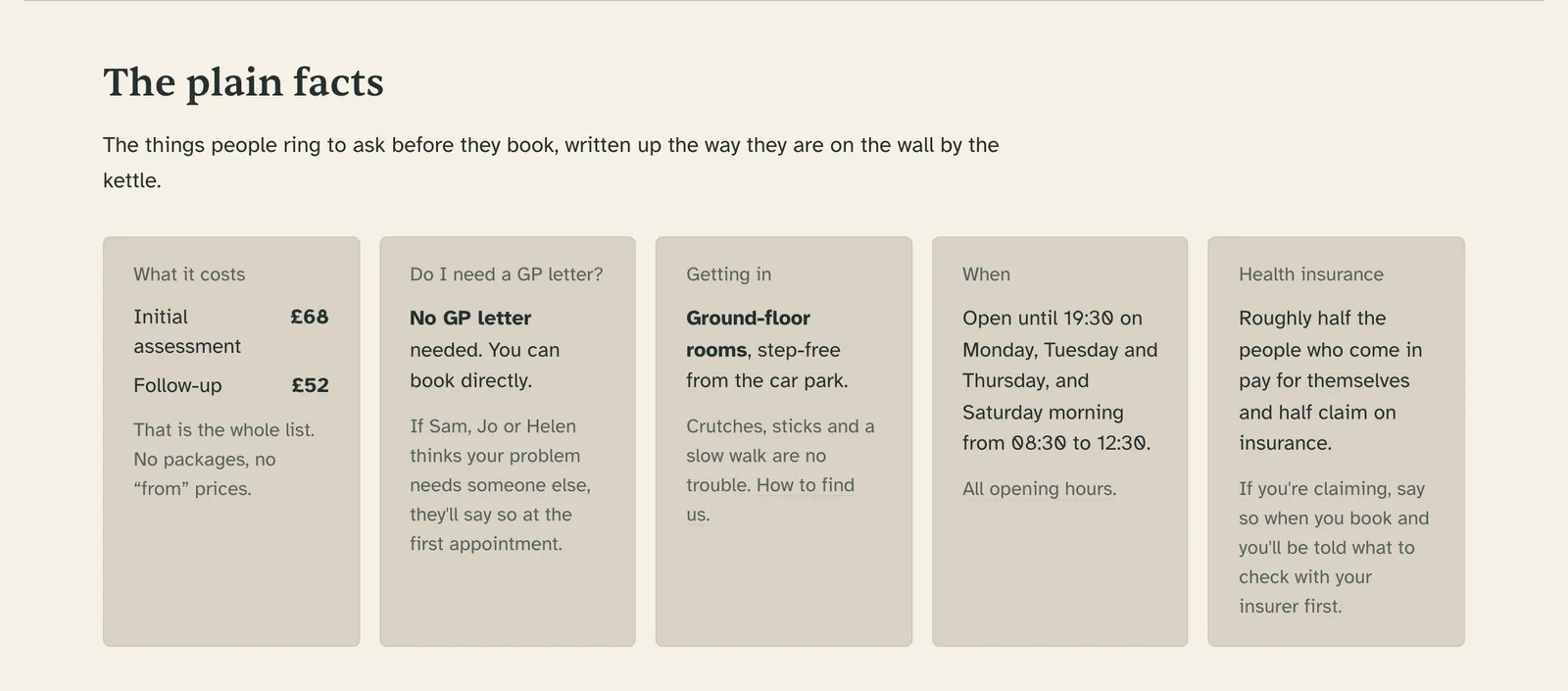
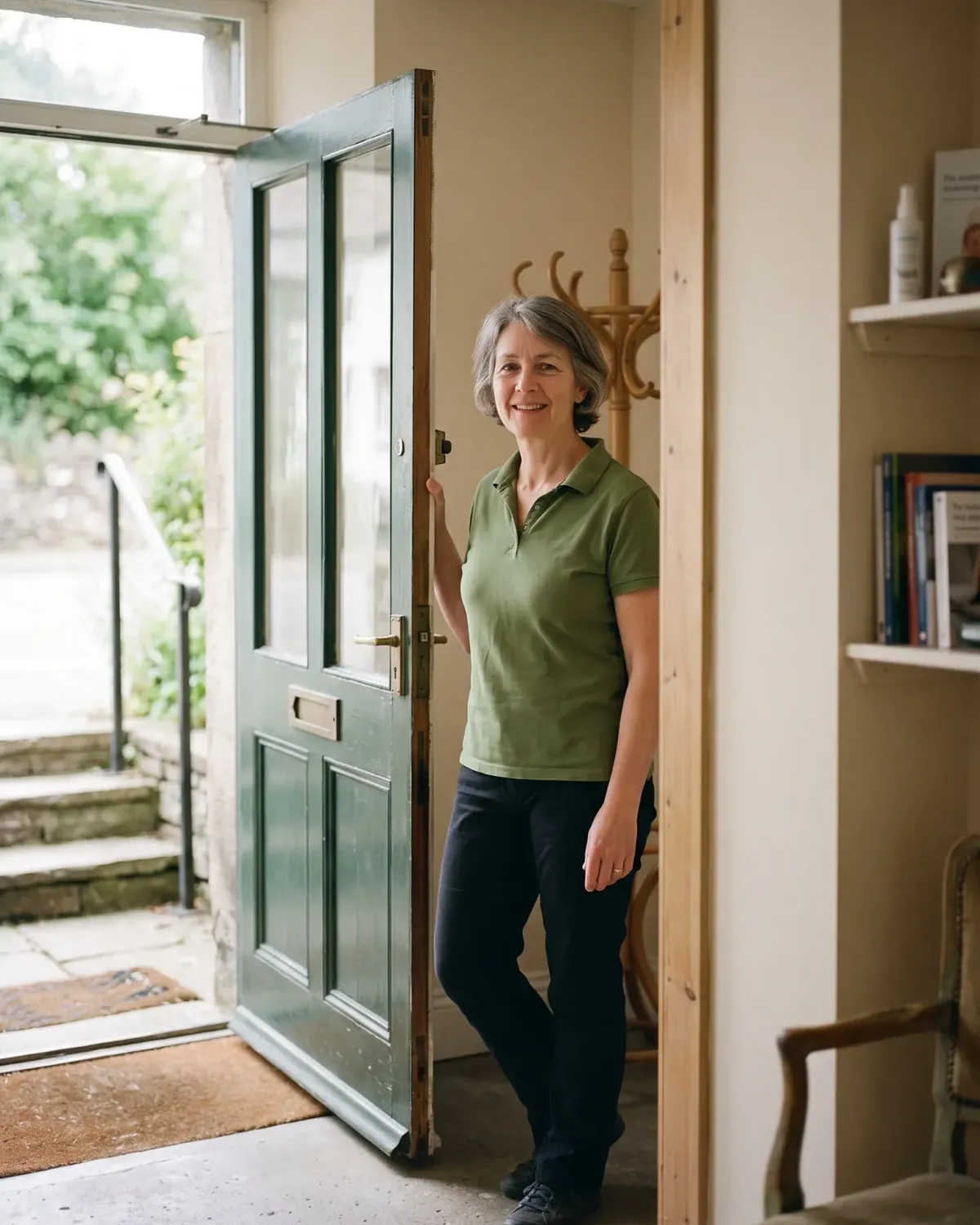
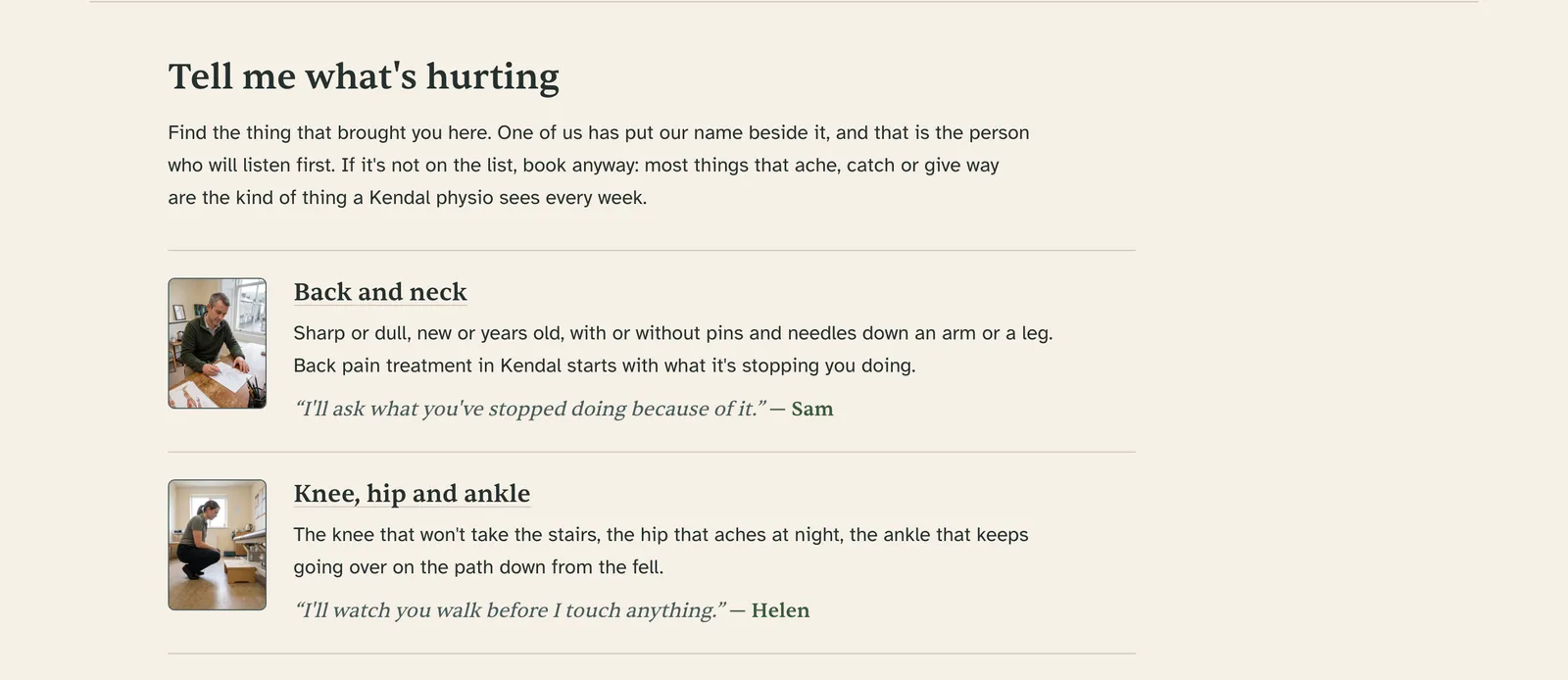
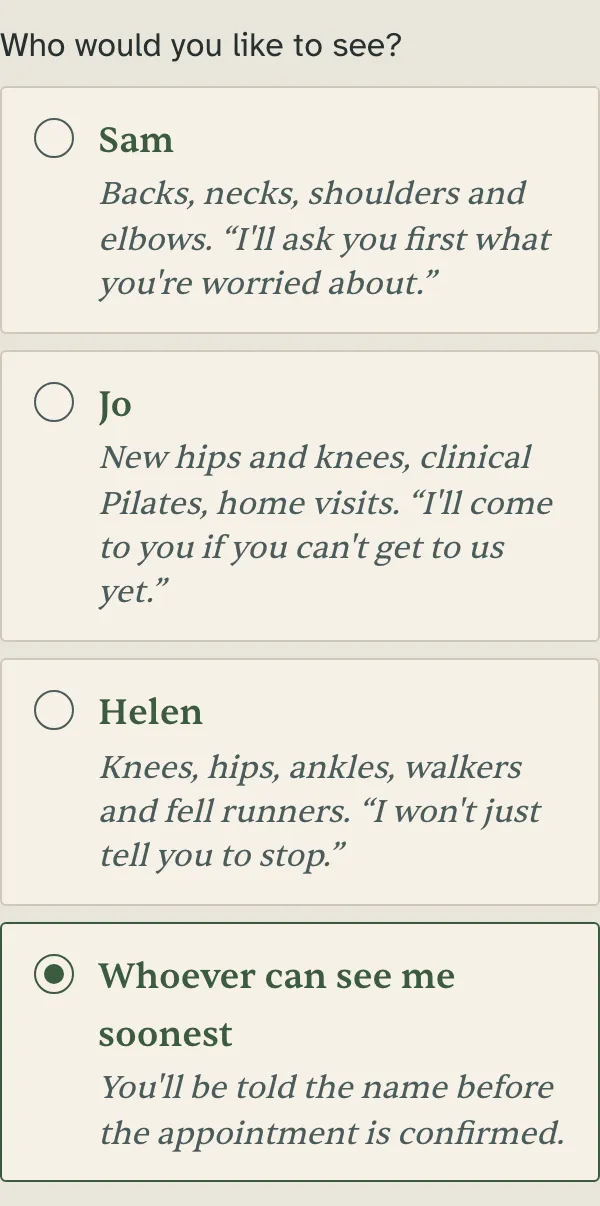
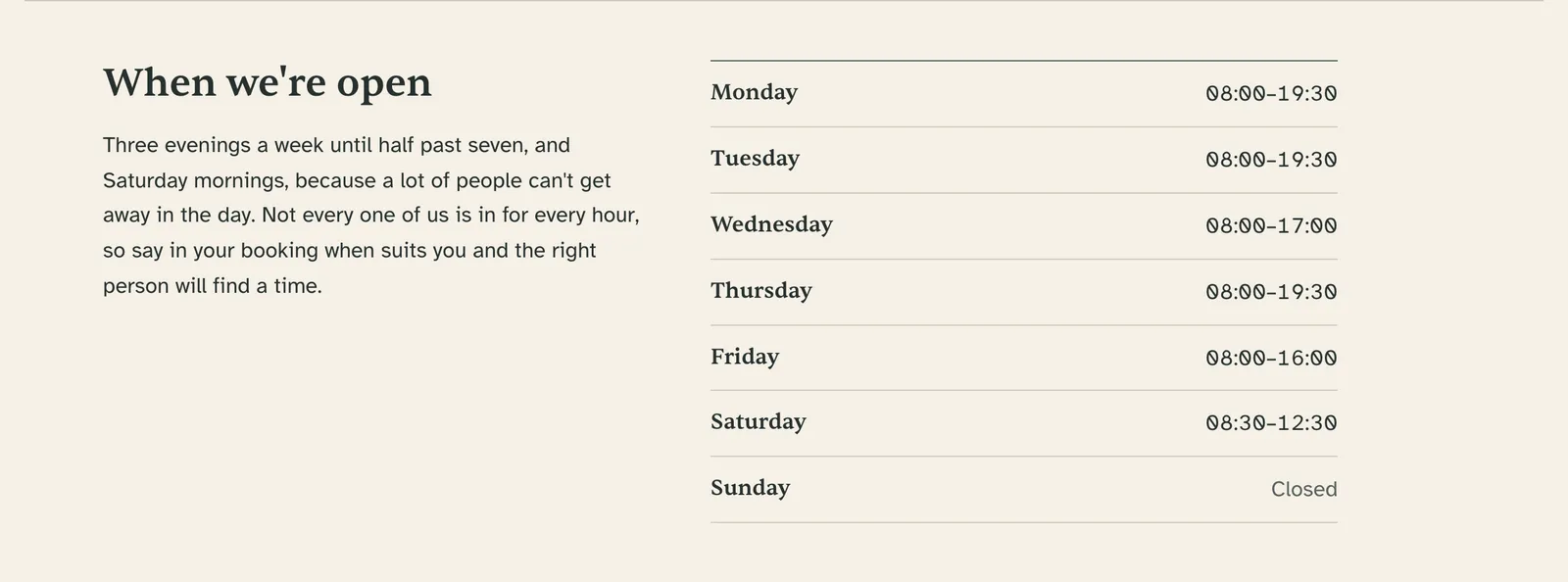

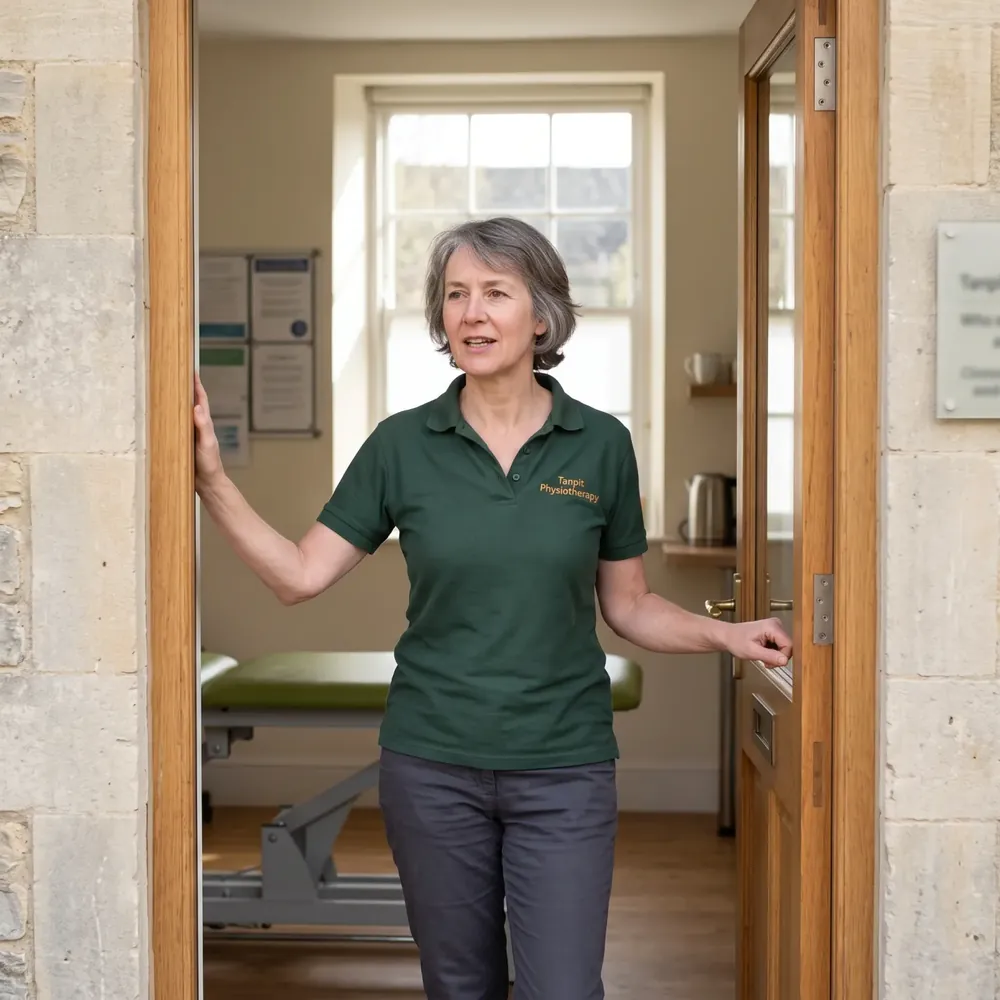

The design is called Three Names on the Door: warm paper and limestone with moss green and slate, Sentient for headings and Atkinson Hyperlegible for the text, so the fee and the access line stay readable on a phone. The example does not print an HCPC number and does not name insurers. A real practice site should do both, beside the person and by name.
what the best ones do
Four of the 151, unnamed, each doing one thing worth copying.
-
01 · West Yorkshire
Conditions as the menu
“In pain or injured in Leeds & Bradford?”
A three-location clinic lists back, neck, shoulder, knee, hip, ankle and foot, and running injury instead of techniques. The assessment card says no GP referral is required, and each specialist service carries the qualification of the person delivering it: ultrasound by an HCPC-registered physiotherapist, injections by an independent prescriber.
-
02 · South-east London
Self-pay first, postcodes listed
“Self Pay – book appointment here”
A long-established practice opens its header with that line. Home visits are listed by postcode, so a reader in SE21 knows at once that they are covered. Women’s health and paediatric physiotherapy each have a route of their own.
-
03 · South of England
Sorted by who is buying
“Who we help”
A home-visit physiotherapy and occupational therapy service arranges its menu by buyer: individuals and families, case managers, care homes, solicitors and insurers. Prices are a top-level menu item and the first paragraph says the team is HCPC-registered. If your buyers are not all patients, this is the front door to copy.
-
04 · Hampshire
Hours as a sentence
Late evenings Mondays and Thursdays, early evenings Tuesdays, Saturdays.
A clinic writes its hours up front in plain words. A working patient sees the Thursday late clinic straight away, before trying to book.
the site, page by page
A website for a physiotherapy clinic needs six pages. Add a seventh only for a reader the six do not serve.
Six pages cover a straightforward musculoskeletal practice. Women’s health, children, neurology or hydrotherapy each have their own practical questions (a chaperone, a parent in the room, a hoist, the pool) and will not be found as a line halfway down a technique list.
-
01
Home
Each physio by name with the problems they lead on. The assessment fee and follow-up fee, with minutes. “No GP letter needed.” The insurers you bill, and the authorisation line. Ground floor, lift or stairs, and parking, or the postcodes you visit. Hours in words. One button, “Book an assessment”, and a second, “Using insurance? Call”, if insured bookings come by phone.
-
02
Who you’ll see
One block per clinician: a photo in their own room, the problems they see, HCPC registration checkable on the public register, MCSP only if they are a member, and one sentence in their own words about how an assessment starts. A qualification that changes what can be booked, such as independent prescriber for injections, sits on that person.
-
03
Problem pages
Built around what hurts: back and neck; knee, hip and ankle; shoulder and elbow; a new hip or knee; walking and running. Each names the physio who leads, says who it is for, and describes the assessment: what is worrying them, how they move, an explanation, and what happens next, including exercises agreed in the room and sent afterwards. No recovery times and no session counts.
-
04
Other readers, only if the work is real
A daughter booking for a parent, a care home, a case manager, a solicitor or an insurer wants the area you cover, the team’s registration, whether you visit, the fee, and how to refer. If you do that work, give it its own route. The same goes for women’s health, children, neurology and hydrotherapy.
-
05
Fees and finding us
Every fee with its length, including call-out if a visit costs more. One sentence on cancellation, because people in pain miss appointments and should see the rule before they book. Insurance in full. Hours. The walk from the car and the step-free route in words a person on crutches can use, with the map underneath.
-
06
First visit
Short, beside the button or on the fees page. Clothes they can move in: shorts for a knee or hip, a loose top for a shoulder. Bring scans and letters if they exist, the authorisation code if claiming, a list of medicines. One line saying their exercises are sent to them afterwards. On pain, describe the process; do not write that treatment will not hurt.
Two sector points before you publish
Regulation. The CSP’s published position is that most self-employed physiotherapists and small physiotherapy practices in England do not currently need to register with the Care Quality Commission, because physiotherapists are regulated by the HCPC. Registration may be needed where doctors or nurses are part of the practice or in formal partnership with it, and Wales, Scotland and Northern Ireland have their own bodies. Check your own position before putting any inspectorate’s logo on the site.
Privacy. The booking form collects health information. Your privacy notice has to cover it, and the form should ask for the problem in a line or two, not a history.
what to take off
2.6%
of the sites we read offered a guarantee of some kind. Do not add one. A promise about a result, or about a set number of visits, is a claim you would need evidence to defend.
Good is a named physio, the fee with its minutes, separate lines for the GP letter and the insurer, and a true line about the stairs. Check your own site for each of these.
- Acupuncture, shockwave, tape, massage and Pilates set out as equal cards, asking the patient to choose a technique before anyone has assessed them.
- “Chartered clinic”, or a CSP mark in the footer meant to cover associates and the reception desk.
- A headline that promises a return to sport in a number of weeks, or that the pain will be sorted. If a sentence would need a study to defend it, describe the visit instead.
- A public page of exercises filed by condition, which reads as a plan for a patient you have not met.
- One booking button for self-pay and insured patients, which sends the wrong paperwork to the wrong person.
- Specialist pages for work you do not do, or real specialist work on the same small card as sports massage.
- A map pin and no word about the stairs.
- A leaver still listed under a protected title.
worth doing whatever you build with
Four things that help before a line of the site is written.
-
Match your Google Business Profile to the site
The primary category is physiotherapist; add a second only if someone on the team holds that title and does the work. Same hours as the site, including the late clinic, the same booking link, and the assessment fee in the description. When the fee changes, change the profile the same day.
-
Photograph the route in
The door from the car park, the step or the lack of one, the treatment room, and each physio as they look at work, rather than a stock model on an exercise ball.
-
Ask for reviews and reply plainly
Thank the reviewer. Do not add a claim about the result, and do not repeat a diagnosis the patient has posted.
-
Label the buttons for the two kinds of patient
“Book an assessment” for self-pay, and “Using insurance? Call” with the number where the form cannot take an insured booking. Put the phone number in the header, and name the exercise app if you use one.
builder, template, or someone to do it
11 of the 151 practices we read were sole practitioners. For the rest, the site keeps changing.
One person, one room, one assessment fee, one follow-up, hours that hold still: a website builder is a fair way to do this, if you write the fee, the GP-letter line, the insurance line, your HCPC registration and the stairs as they are, and resist the row of service cards it hands you. A physiotherapy template has the same limit. It does not know that one of you visits a run of postcodes, that another sees fell runners, or that the Thursday evening clinic is why a teacher can come.
Having someone build the site and then look after it earns its fee when more than one physio is on the door, when the buyers are not all patients, or when prices and people keep changing.
-
01
A brief, with you
Who books, what they ask first, which physio sees which problem, what you charge, and what you will not claim. The brief decides the site.
-
02
Designed and built in about half an hour
A working site, and you are the first person to see it. No template to pick and no layout to argue with before you have seen a site.
-
03
Looked after, for a monthly fee
Updates, fixes and ongoing improvements. When a physio leaves or a fee changes, the site changes with it.
Starter
£15/mo
One live site, kept current. For the one-room practice.
- 1 live site
- 150 credits a month
- Your own domain
- Add pages any time, priced per page
Business
£39/mo
Room for more sites and more work. For several physios on the door.
- 3 live sites
- 500 credits a month
- Everything in Starter
- Move up or down any time
The build, once
Packs cover the build itself, paired with your first month of whichever plan keeps it live. Each ships 30 days of Forge edits after the build, long enough to settle in. After that, staying is your call.
- £291 page
- £593 pages
- £895 pages
A six-page clinic site is the five-page pack plus one more page. Pages are added any time and priced per page; you see the price before you pay.
- Two-click cancel. From your account, any time. The site keeps running until the end of the billing period.
- Your domain stays yours. The content, the brand and the domain are yours from day one. If you leave, we send you a static snapshot to put on any host.
- A failed build is not charged. A support ticket opens and a person follows up the next working day to put it right.
- One price. No introductory rate that runs out. The price you sign up at is the price you pay.
questions practices ask
The ones that come up before every build.
Should we publish our fees?
Yes: assessment and follow-up with the minutes, beside the booking button, and anything extra on the fees page. Of the sites we read, 13.9% showed any price. Where they did, the shape that worked was a number, a length and which visit: “£70 for the initial 50 minute consultation”.
What do we say about GP letters and insurance?
Keep them separate. Self-pay patients can book without a GP letter; an insurer may still want a referral or an authorisation code, depending on the policy, and the same insurer can sell both kinds of plan. Name the insurers you bill.
Where do HCPC and “chartered” go?
Beside the person, with a name the public register can be checked against. The titles physiotherapist and physical therapist are protected. MCSP and “chartered” apply to individual CSP members, not to the business.
What can we write about a condition?
The problem in the patient’s words, who sees it, and what the assessment involves: what is worrying them, how they move, an explanation, and what happens next. No recovery times, session counts or lines about what treatment will fix.
Patients ask why physio hurts, or why tape works. Should the site explain?
On pain, describe the process: you explain each test, you work within what they can tolerate, and they can ask you to stop. Do not promise it will not hurt. On a technique, name it under the physio who uses it, say whether it costs extra, and present it as something discussed after assessment, not as something that fixes a condition.
Do we need a page of exercises?
No. You need a sentence saying exercises are agreed at the appointment and sent to that patient. A public library filed by condition reads as a plan for someone you have not met.
A builder, a template, or someone to do it?
A builder is a fair way to put up one stable person, one fee and one set of hours, if you write the fee, the GP-letter line, the insurance line, your HCPC registration and the stairs yourself. A template will not know that one of you visits a run of postcodes. Having the site built and then looked after earns the fee when more than one physio is on the door, when the buyers are not all patients, or when prices and people keep changing.