A website for gardeners and landscapers.
Say what the money buys, and which month the photograph is.
A maintenance round and a design-and-build practice are different businesses. One sells time, a lawn programme, or a square metre. The other sells a drawing and a garden that still has to look like itself in January. We read 517 UK front pages. Thirty showed a price, and those prices did not share a unit.
From £15/mo, plus a one-off build pack from £29.

August of year two, on one valley border. The same planting is also shown in March, June, October and January.
This is a live example of our work, not a customer business.What the front pages charge
The price has to name its unit.
We read the front page of 517 UK garden and landscape websites between 25 and 27 August 2026. Other pages were not read. The figures describe those sites, not the whole trade. The set is gardeners, grounds and garden maintenance, lawn care, and design-and-build landscaping. Tree surgeons, fencing-only firms, driveway specialists and garden centres were left out.
1.4%, 7 of 517, state the time the money buys.
Of the 517 front pages, 30 had any figure in the prices field. That is 5.8%. We read all 30. Twenty-eight name a price for work. They do not share a unit. Seven state an hour, a block of hours, or a minimum booking of two gardeners for two hours.
Five of those price fields say plus VAT or excluding VAT. That is 1.0% of the 517. One says the price includes VAT (0.2%). The word VAT appears on 94 front pages (18.2%). Most of those pages still show no price. Mentioning VAT is not the same as pricing the job.
- 7 of 517
Time
An hour, a block of hours, or two people booked for two hours. This is the only group that says how long the money covers.
- 4 of 517
A month of lawn care
Four separate sites publish the same four steps: from £10, £15, £20 and £25 a month. Same ladder, four businesses. A customer still needs to know what each step includes.
- 1 of 517
A treatment
From £22 a treatment. A treatment is not a month, and it is not an hour. The page has to say which it is.
- 2 of 517
A square metre, installed
Two price fields lead with an installed price per square metre. A rate per square metre and a price for the whole drive are not the same sentence.
- 14 of 517
A project, a package, or finance
A project band, a design package, a "from" figure, or finance for an installation. Two of those fourteen name no unit at all: "from £20" and "from £30".
- 2 of 30
Not a price for the visit
One of the thirty figures is bags of feed. One is only the fee for a manufacturer's guarantee. They sit in the prices field. They are not a quote for the garden.
South London prints two hourly rates.
A maintenance round says £36.50 per hour, says the work is costed at £36.50 +VAT, and also says it is costed at £32.50 +VAT. There is a free garden consultation, and no fixed-term contract. The page does not say how long a typical garden takes. The area named is South London and Bromley.
West London prices a crew, not an hour.
Garden maintenance starts from £208.00 excluding VAT. The minimum booking is two gardeners for two hours. The page says the firm was established in 1995, names LANTRA, and offers a 5-year guarantee against faulty workmanship in the landscaping department. It claims awards from the Association of Professional Landscapers and the Society of Garden Designers. Those are the page's claims. The areas run across west and central London, including Barnes, Battersea, Putney, Chelsea, Chiswick, Clapham and Richmond.
The Cotswolds prints more than one band.
A design-and-build firm says projects from £40,000, "typically £40,000 to £100,000+", and also £35,000 to £100,000+ and £50,000 to £100,000+, on the same front page. The area runs through Gloucestershire, including Cheltenham, Gloucester, Tewkesbury, Cirencester, Stroud and named Cotswold towns. The accreditations field includes the Chartered Institute of Horticulture and the British Association of Landscape Industries.
Nottingham prices the square metre, with VAT in.
The prices field says "prices from £15". On the front page the price is calculated on the square metre and includes VAT. The firm names treatment programmes, and claims BASIS, BASIS Lawn Assured, and City & Guilds PA1 and PA6. That is the page's claim. The area is Nottingham, Newark, West Bridgford and named suburbs.
An Edinburgh garden-care firm, not one of those four, charges £50 an hour including VAT for one horticulturist. It says cheaper day rates exist, and it does not show them. The area is the city centre and most of Edinburgh.
An hour, a two-person booking, a month, a square metre and a project band are different answers. A price you cannot reconcile is not yet a price. 157 of the 517 (30.4%) offered a free quote, estimate, survey, consultation or site visit. A free look still needs a unit for the work that follows.
One border, four months
Show the garden in the month you will be judged on.
Field Notes Landscapes is an example build for a fictional studio in Stroud. It is not a customer. One border is photographed from the same viewpoint. October and January are part of the design on that page, not a gap in the diary.
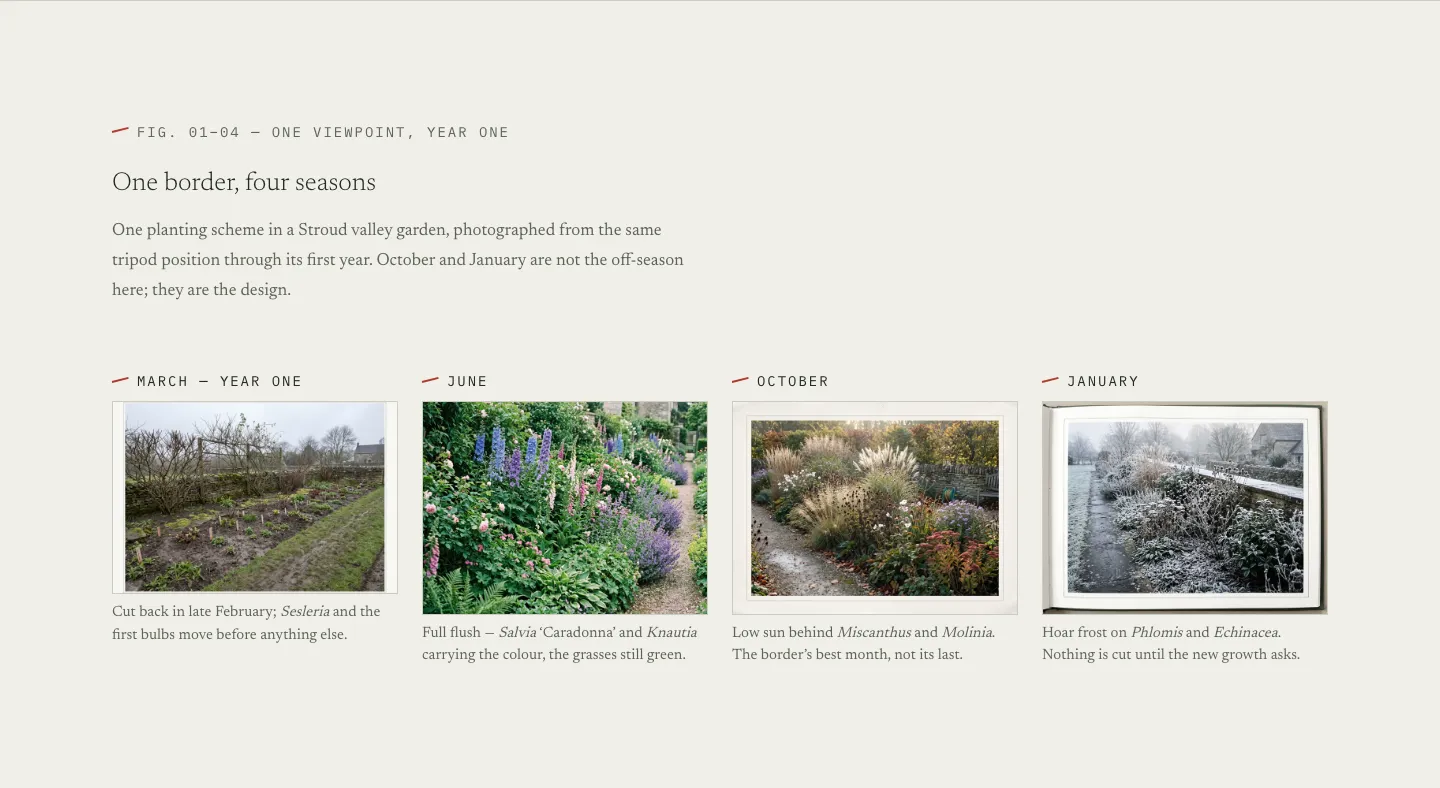
01March, year one
Bare soil, cut back, with Sesleria and the first bulbs.

02June
Salvia 'Caradonna' and Knautia. The grasses are still green.

03October
Miscanthus and Molinia. The example calls this the border's best month, not its last.

04January
Hoar frost on Phlomis and Echinacea. Nothing is cut until the new growth asks.
The Stroud example says a third of every scheme is chosen for the winter skeleton, and that nothing is cut in autumn. The planting plan is drawn at 1:50, and the client keeps it. The method is to draw before you dig: a measured drawing before anything is priced or dug, then the build, a first year of tending, and a return in year three. A terrace in the example is reclaimed limestone laid to falls of 1:80. That is drainage, not a planning claim.
The page says the firm was established in 2021, and states £5m public liability. Hours are Monday to Friday, 08:00 to 16:30. The form asks for a name, an email, where the garden is, and a few words. There is no privacy page. It also does not mention a tree preservation order, a waste carrier registration, a pesticide certificate, or whether VAT is included. Those are gaps in the example. The invented review score on that site is not a customer, and it is not repeated here.

The same camera, in July and in January. Seasonal care on wet clay, not a design-and-build studio.
Fictional example. Not a customer, and not a review.Ash & Alder is the other example: seasonal garden care in Ludlow, on south Shropshire wet clay, since 2013 in the copy. Plans are drawn for the fifth summer, in pencil, to scale. Any plant that fails in its first year is replaced free. If a garden does not need them, the page says they say so. The year's work runs from beds and mulch in March, staking in May, weekly edges in July, and hedges in September once nests are empty, to seedheads left until February. Leaves are carted. The page does not mention a waste carrier registration.
Hours are Monday to Thursday, 07:30 to 17:00, and Fridays until 16:00. The area is Ludlow, the Corvedale, the Teme valley, the Clee Hills and Mortimer Forest. A privacy page says ThemeSmith stores the form submission so the business can read it, and does not use the enquiry to market to the sender. The word VAT does not appear on the home page. A gardener's website that only shows July is missing half the job.
Before anyone rings
The phone number is not the whole answer.
Most of these front pages can be called. Far fewer tell you what the call is agreeing to. A form is not a confirmed visit.
91.9%published a phone number.
475 of the 517. Put it where a thumb can find it. Next to it, say the unit of the price and the hours you actually answer. 409 (79.1%) also published an email address.
4.1%offered online booking.
21 front pages. A contact form is more common: 243 of the 517 (47.0%). Say when someone reads it. Ask for the postcode, the month they have in mind, and whether they want a regular cut or a build. 26 (5.0%) offered WhatsApp. An unanswered message is not a booked day.
92.6%named where they work.
479 of the 517. Name the places you will actually travel to, and any month you do not. A page of swapped town names is not a patch.
50.5%work for homes and for businesses.
261 of the 517. Domestic only was 91 (17.6%). Commercial only was 27 (5.2%). The field was blank on 138 (26.7%). A household and a grounds contract do not need the same next step. Say which you want.
90 of the 517 (17.4%) mentioned insurance or public liability. If you state a sum, as the Stroud example does with £5m, say what it is. Do not borrow a figure you do not hold. The size labels in this read are not a headcount, so they are not used here as "most firms are small". An emergency field was filled on 20 front pages (3.9%). That is not a count of round-the-clock cover.
The work itself
Say which of the jobs you actually do.
On the front-page text, hard landscaping was more common than a maintenance round. Fencing-only firms and driveway specialists were not in this set. A gardener's own page still often mentions both.
Hard landscape is already on the page.
Paving, a patio or decking appeared on 303 of the 517 (58.6%). A driveway, resin or block paving appeared on 165 (31.9%). Fencing appeared on 247 (47.8%). If you lay patios and you do not build drives, say so. If a dropped kerb is someone else's application, say that too.
Design and maintenance are different buyers.
Design, or a planting plan, appeared on 241 front pages (46.6%). Garden or regular maintenance appeared on 156 (30.2%). The Stroud example sells a drawing and a return in year three. The Ludlow example sells the year's tasks. A site that leads with both, and explains neither, makes the customer guess.
A long service list is not an offer.
These front pages listed 12.3 services on average. Fencing, landscaping and garden design were the strings that came up most often. A customer comparing you with a neighbour needs the job you want this season, not every job the trade can name.
Templates are what the search offers.
189 of the 517 (36.6%) credited another web agency or builder. People looking for a gardener website, or a landscaper website, are offered templates, builders and "near me". A template supplies a gallery. It does not decide your unit, your months, or the jobs you refuse.
Checked 6 October 2026
The rules change with the nation, and with the job.
England, Scotland, Wales and Northern Ireland are not one rule. The lines below are the official pages we read. They are not a reason to add a badge you do not hold.
Trees, in England.
A tree preservation order prohibits cutting down, topping, lopping, uprooting, wilful damage and wilful destruction without the local planning authority's written consent. In the Secretary of State's view, cutting roots needs consent too. The GOV.UK guidance was published on 6 March 2014. It cites Part VIII of the Town and Country Planning Act 1990 and the Town and Country Planning (Tree Preservation) (England) Regulations 2012, in force 6 April 2012.
In a conservation area, a tree that is not already under an order needs a section 211 notice six weeks before certain work, unless an exception applies. The authority can allow the work sooner. A notice is not required where the diameter does not exceed 75 millimetres, or 100 millimetres where the only purpose of cutting down or uprooting is to improve the growth of other trees. Diameter is measured over the bark at 1.5 metres. A multi-stem tree is not exempt if any stem exceeds that minimum. There are further exceptions. Do not tell a customer that every twig needs a notice.
An order is for what may ordinarily be called a tree. It does not normally include shrubs. A hedge that has become a line of trees can. Countryside hedgerows are a different regime. Do not paste the English wording onto a job in Scotland, Wales or Northern Ireland. Three of the 517 front pages (0.6%) mentioned a tree preservation order or a conservation area.
Green waste, in England.
Register if the business transports waste, buys, sells or disposes of waste, or arranges for someone else to do that. GOV.UK says you can get an unlimited fine if you do not register. Registration is usually free if you only transport waste you produce yourself. Otherwise it costs £191.02. Upper tier is renewed every 3 years at £130.25. Changing what the organisation does costs £49.62. A new registration, including from sole trader to limited company, costs £191.02. Those are the England figures on that page. Northern Ireland, Scotland and Wales have their own processes, linked from the same page.
A gardener taking a customer's green waste away is transporting waste as part of the business. That page does not offer a garden-waste exemption. The public register is the check. Fifteen of the 517 front pages (2.9%) mentioned a waste carrier or a waste licence. The Ludlow example carts leaves and does not mention a registration. That is a gap in the example, not a claim that registration is optional.
Sprays, for professional use.
Users of plant protection products authorised for professional use need a certificate of competence. HSE guidance on the Plant Protection Products (Sustainable Use) Regulations 2012 (S.I. 2012/1657, in force 18 July 2012) lists recognised certificates, including City & Guilds and Lantra. It is not one PA code. Do not write "you must have PA6" as if that were the only legal requirement. A buyer has to make sure the end user holds an appropriate certificate, or is under direct supervision while training.
In Great Britain, register professional use with Defra within 3 months of starting. Defra also collects the information for Scotland and Wales. Using a product only in your own home garden does not require that registration. Northern Ireland uses DAERA. Twenty-two of the 517 front pages (4.3%) mentioned a pesticide certificate, NPTC, or a PA code. The Nottingham page's PA1 and PA6 line is that page's claim, not the whole test.
Drives and patios, in England.
The Planning Portal is a guide, not a legal opinion. For a house, not a flat or a maisonette, and not where a condition or an Article 4 direction has removed the rights: no planning permission if a new or replacement front-garden driveway of any size uses a permeable or porous surface, or if the rainwater is directed to a lawn or border to drain naturally. If the area is more than five square metres, permission is needed for traditional impermeable surfacing that does not drain to a permeable area.
Fences, walls, gates and a dropped kerb are separate. The Portal describes driving over a pavement without a dropped kerb as illegal. The dropped-kerb application goes to the local authority. Away from the front garden, there is no restriction on the area of hard surface at or near ground level, but significant embanking or terracing might need an application. Wales may differ. Further reading is the front-garden surfacing guidance. Six of the 517 front pages (1.2%) mentioned planning permission or permitted development. Paving, a patio or decking was on 303.
These checks did not find a protected title, or a statutory register you must join, in order to trade as a gardener or landscaper. That is not a claim that no rule applies to the work.
BALI membership is by application. It is not a requirement to trade. Twenty-two front pages (4.3%) mentioned the British Association of Landscape Industries. The Association of Professional Landscapers, a specialist group of the Horticultural Trades Association, is also voluntary. Twelve front pages (2.3%) mentioned it. The APL's joining page says it is the only landscaping scheme operator of TrustMark, and that members are inspected and follow a customer charter. A footnote on that page limits the TrustMark line to Accredited and Professional Gardener membership. TrustMark appeared on 3 of the 517 front pages (0.6%).
Website design for gardeners
A template will not choose the unit for you.
A website builder can suit a round whose offer rarely changes, if you have time to write it and keep it current. It will not decide whether you sell an hour, a crew booking, a month of lawn care, or a project band. It will not decide which month you are willing to show.
We write a brief with you, design and build the site, then host it and help you keep it current for a monthly fee. You check the work before it goes live. The starting point is the jobs you want, and the people booking them.
The build is a one-off cost. Hosting and ongoing work are monthly.
Start with the work you do this season. Add a page when the next job needs its own explanation.
Monthly plans
Edits with your assistant use credits.
One-off build packs
1 page
3 pages
5 pages
Each includes 30 days of Forge edits after the build and is paired with your first month on a plan. Add pages any time, priced per page. You see the price before you pay.
Cancel any time, in two clicks from your account, under Settings, then Cancel. We don't make you call or fill in a form. The site keeps running until the end of the billing period. No exit fees. Your domain stays yours. If you leave, we send a static snapshot of the HTML, and you can put it on any host. You're not charged for a failed build; a human follows up the next working day to put it right. There is no introductory rate. If we change a price, we tell you at least 30 days before.
Get startedQuestions gardeners and landscapers ask
Before you commission the site.
Can I start with a one-page gardener website?
Yes. Both examples here are short sites. Start with the work you want, the area, how to reach you, and the unit of the price. Add a page when a patio customer, or a grounds contract, needs a different explanation.
Should I publish prices if every garden is different?
Publish the unit you can stand behind. An hour, a minimum crew booking, a price per treatment, a price per square metre, or a project band are all clearer than a blank enquiry form. If two figures are on the page, they have to agree. Say whether VAT is included.
Do I need BALI or APL membership to have a proper site?
No. Both are voluntary. If you are a member, say so in a way a customer can check. If you are not, do not borrow the badge. The site still has to explain the work, the area and the price.
What should the site say about taking green waste away?
If you carry a customer's waste, say whether you are registered, and link the public register. The England rules and fees are on GOV.UK. Scotland, Wales and Northern Ireland are separate. Do not invent an exemption for garden waste.
What should I say about trees and front gardens?
In England, ask about a tree preservation order and about conservation areas before any tree work, and say that you do. A hedge is not automatically a tree. For a new or replacement front-garden drive, the Planning Portal sets out when a permeable surface, or drainage to a border, matters, and when a dropped kerb is a separate application. Do not copy the English wording onto a job in another nation.
Will a new website put me at the top of Google?
We do not promise a ranking. People search for a website for gardeners, a gardener website, and a landscaper website. What helps them is a page that names your work, your patch, your prices and the month in the photographs. There is no honest position to sell inside a design quote.
Can I add a lawn programme or a patio page later?
Yes. Pages can be added on either plan, priced per page, and you see the price before you pay. Add the page when you know the unit and the photographs, not before.