A website for builders.
Show the figure, the weeks, and who applies for what.
Someone hiring you for an extension will live in the house while you build it. They need a price they can read, a programme, and a plain account of planning, building control and the party wall. We design and build that site with you, then host it.
From £15/mo, plus a one-off build pack from £29.

The first screen is a contract, not a list of trades.
A design example. Ridgeworth is not a customer.What we read
Eighteen sites published a price. The other 809 did not.
We read the front page of 827 UK general building, extension, loft and renovation firms on 25–27 August 2026. Glazing, scaffolding, kitchens, groundworks and volume housebuilders were left out. These figures are that sample, not the whole trade. Other pages were not read.
2.2% showed any price.
That is 18 of the 827 front pages. All 18 used a pound sign. Four of the price fields mention an extension. Three mention a loft. Four mention VAT.
These are the lines on the contract, and how often the front pages we read contain them.
Building control, named on the page
7.4%Party wall, named on the page
2.7%Planning permission, permitted development, or an application
14.0%VAT, inside the price field
0.5%Staged payment, in the payment options
1.0%A phone number
95.4%Of the sites we read. The phone number is already there. The contract usually is not. Page text mentions the word VAT on 19.6% of sites, and “including VAT” on 0.4%.
Builder website examples
One fictional firm, written as a contract.
Ridgeworth Home Extensions is an example build for a fictional firm in Wolverhampton, established 2011 in the story. It is not a customer. The prices, dates, guarantees and “ninety builds a year” are part of that fiction. They are not ThemeSmith results, and they are not a quote you should copy.
The opening is one finished job, with the figure still on it.
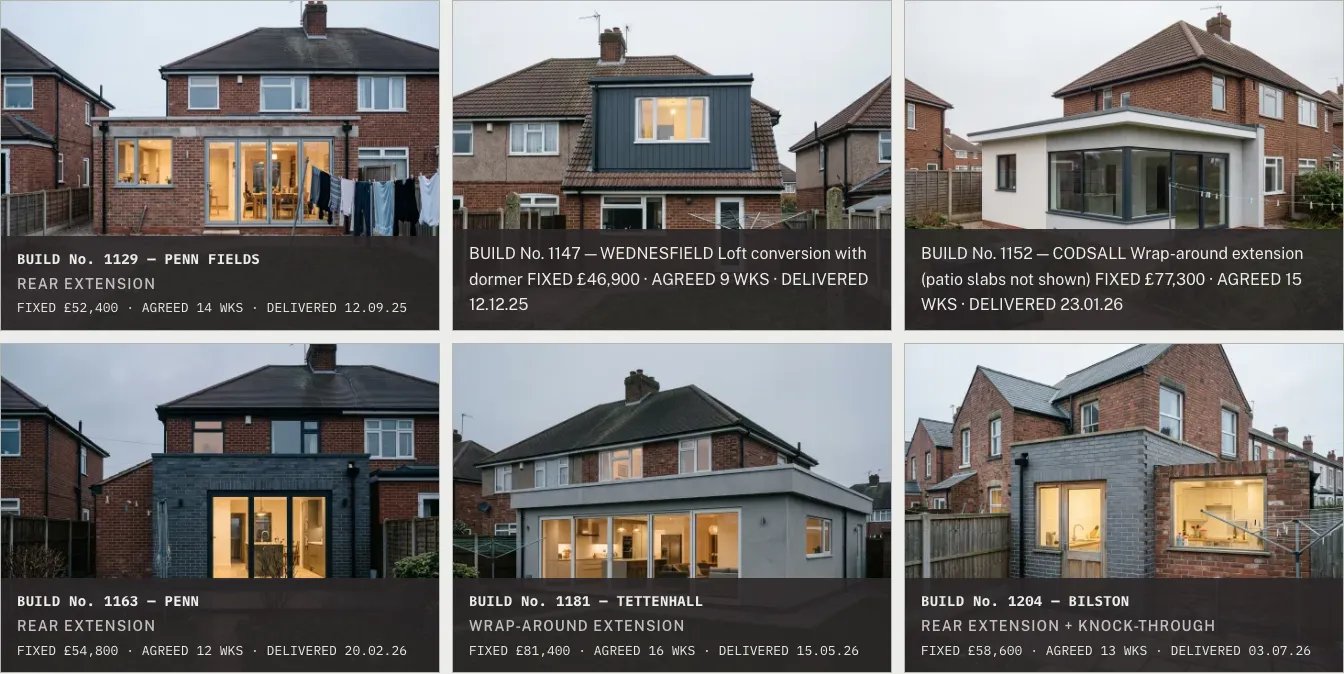
Build No. 1129 is a rear extension in Penn Fields: £52,400 fixed, 14 weeks agreed, delivered 12.09.25, nothing paid up front. Under that, the page draws a wrap-around, then walks the build from scaffold to scaffold down.
Six clauses follow. The price is fixed before a spade goes in. The finish date is in the contract. Payment is staged, after the customer has seen the stage finished: foundations, shell, watertight, fit-out. Nothing is paid before work starts. The story includes a 10-year structural guarantee and £10 million of public liability. Four crews, and the job does not sit in a queue.
The price board is three from-prices: a single-storey rear from £48,000 over 10–12 weeks, a wrap-around from £74,000 over 14–16 weeks, a dormer loft from £42,000 over 8–10 weeks. Double-storey work, garage conversions and a knock-through on its own are priced at survey. None of those figures says whether VAT is included.

Show which week the house is opened, and which week it is watertight.
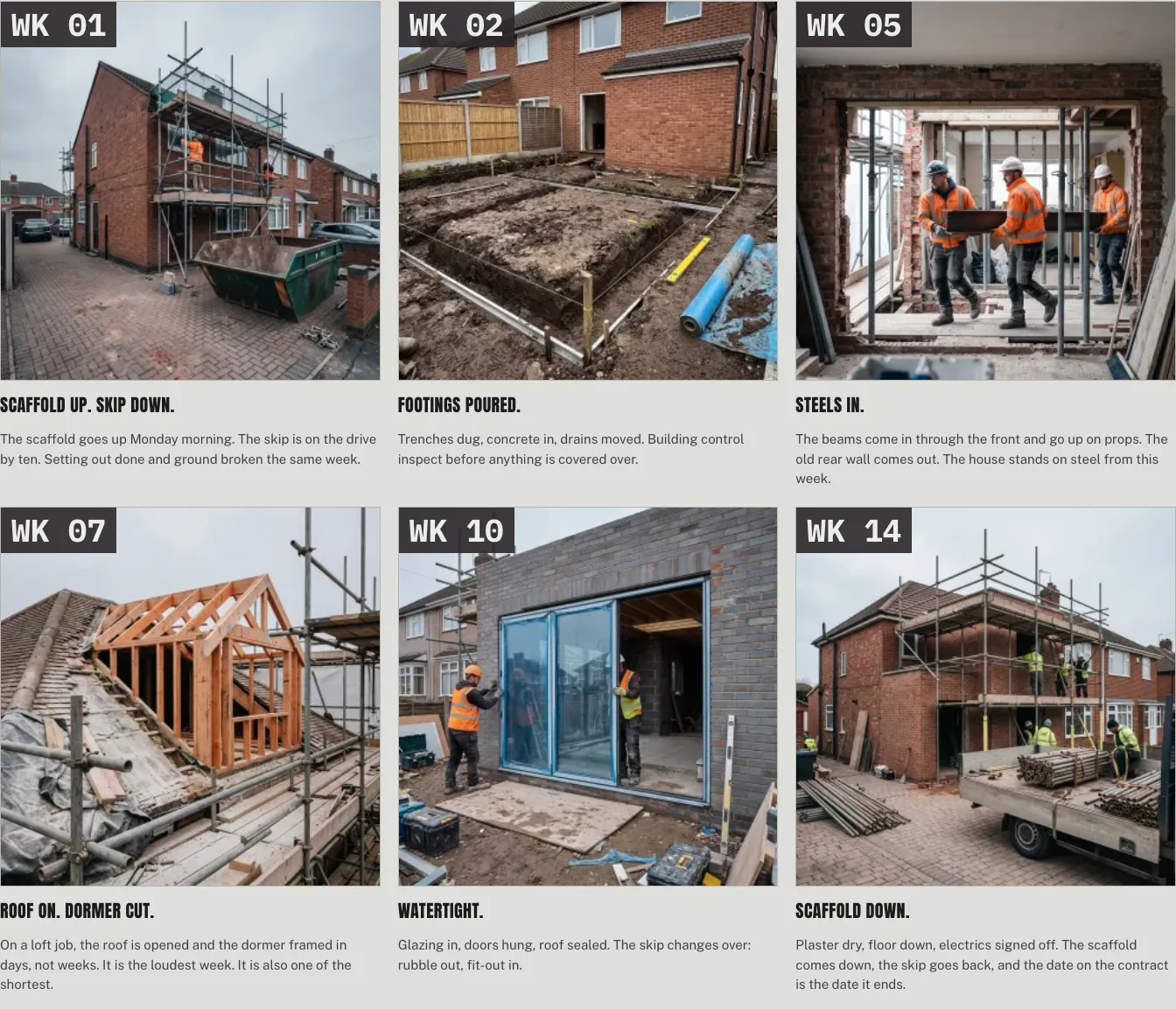
Foundations in weeks 01–03, and building control inspects before anything is covered. Steels in 04–06, with a structural engineer. Then the roof, watertight, and fit-out. The labels fill in order when motion is on. With motion off, or with no JavaScript, every week stays visible.
- WK01 Scaffold and skip
- WK02 Footings, building control
- WK05 Steels
- WK07 Dormer
- WK10 Watertight
- WK14 Scaffold down
Ridgeworth’s programme, not a duration we promise for your jobs.
Do not copy the parts that overclaim.
The page source carries a rating of 3.9 from 612 reviews. Nothing on the visible page supports it. We do not show that rating, and it is not evidence about ThemeSmith or about a real builder.
One line says planning applications and building-control sign-off are handled in-house and included in the figure. Preparing an application is a process. Sign-off is the building-control body’s decision. A rear or wrap-around extension often needs a party-wall notice, and the example never mentions the party wall or the domestic-client duties under CDM 2015. It never mentions TrustMark or the Federation of Master Builders. Use the shape of the page. Write your own clauses from what you actually offer.
What the real sites get right
Four front pages that price a scope, not a mood.
These are real UK sites from the same 827. The firms are not named, and they are not ThemeSmith customers. Their figures belong to them. Several also promise a planning or building-control outcome. That part is not a model. A completion certificate is issued by the building-control body.
South-west London and Surrey: the professional costs are their own lines.
Typical projects from £120,000. A 30m² rear extension is shown at £72,000–£125,000 over 12–16 weeks. The calculator is described as a ballpark. The fixed itemised quote follows a free visit of one to two hours. A 10-year warranty on structural work, and £5 million public liability. VAT is not stated. A rating on the page is left off here.
- Rear extension, 30m²
- £72k–£125k
- Design, architectural and structural
- from £3,500
- Building control and party wall
- from £1,600
- Sliding or bifold doors
- from £4,500
A London loft firm: four types, each with a band and a duration.
The page names London by quadrant, not by a smaller patch. It says the bands include materials, labour and standard finishes. It also describes telling the neighbour, appointing a party-wall surveyor, and writing the agreement, plus a 10-year workmanship warranty. It claims a percentage increase in the home’s value. That claim is theirs. VAT is not stated.
- Velux, 6–8 weeks
- £30–45k
- Dormer, 8–10 weeks
- £45–65k
- Hip-to-gable, 10–12 weeks
- £50–70k
- Mansard, 12–14 weeks
- £65–85k
North-east London, and further across the city: a guide budget per job.
The same front page records two extension figures, from £50,000 and from around £80,000. Lofts from £50,000. A full renovation from £35,000. Kitchens from £15,000 and from around £20,000. Bathrooms from £10,000 and usually from around £12,000. Guarantee lengths differ by job: 10 years on an extension or loft, 2 years on a bathroom or a kitchen, 1 year on decorating. Insurance up to £10 million. No accreditation was recorded. VAT is not stated.
- House extension
- from £50,000
- Extension, the other figure
- around £80,000
- Loft conversion
- from £50,000
- Full home renovation
- from £35,000
East and south-east London: a band, and weeks where they have them.
Lofts over 6–10 weeks, garage conversions over 4–6 weeks. Recent jobs are given as 10, 14 and 12 weeks. The accreditation field names Checkatrade, the FMB, TrustMark and TrustATrader. A fixed-price guarantee and a 25-year structural warranty are the firm’s own statements. The page says most of its lofts do not need planning permission. Permitted development has limits. A directory score on the page is not repeated here. VAT is not stated.
- Loft
- £35–65k
- House extension
- £45–120k
- Full refurbishment
- £30–150k
- Garage conversion
- £18–35k
The website, page by page
Build the pages around the jobs that take months.
A focused building company website can be one long page, which is what the example is, plus a privacy page. Split a service onto its own page when the scope, the weeks or the permissions are different. Extensions were on 86.7% of the front pages we read, loft conversions on 51.9%, a garage conversion on 21.6%. The average services list ran to 13.6 items. A list that long needs a route, not another heading.
Home
Say what you build, where, and how a figure is reached.
Name the work you want more of. Rear extensions, dormers and knock-throughs are different purchases. Put the patch in words a neighbour would use. 93.7% of the sites we read already name an area. If you publish a from-price, put the scope beside it and say whether VAT is included. If the figure only exists after a survey, say that, and say what the survey costs. One west London page charges £75 for the visit. A free quote, estimate, survey, or no obligation is mentioned on 36.0% of the front pages we read. That is not most of them.
The job
Write what is in the figure, and what is not.
Steels, the kitchen, decorating, making good the garden, and the skip are the lines people argue about later. The south-west London page above prices design on one line and building control with the party wall on another. That is more useful than “from concept to completion”. If subcontractors do the electrics, the plastering or the roof, say who employs them. 11.6% of the pages mention subcontracting at all.
The weeks
Give a programme the household can plan around.
A duration without a sequence is a slogan. Say when the house is opened, when it is watertight, and which rooms stay usable. The loft page above pairs each type with a week range. Publish the ranges you can stand behind.
The money
Say when you are paid.
Only 1.0% of payment options in the sample mention a staged payment, and 0.7% mention a deposit. The strings that do exist are specific: nothing up front, or a percentage to book the start date, then weekly or fortnightly. Write your own rule. A fixed price was named on 2.1% of front pages. If the price can move for something you could not have seen, say what that something is. Do not borrow another firm’s “unforeseen” clause.
Permissions
Separate planning, building control and the party wall.
They are three different regimes. Agreeing one does not clear the others. Say which of them you prepare, which you notify, and which a surveyor or a designer is brought in for. Do not write that permission or sign-off is included. You can say you make the application and attend the inspections. You cannot sell the decision.
The enquiry
Ask for the address, the job, and the timing.
The example asks what they want built and whether they want a start or only a figure. Email is optional on that form. Of the sites we read, 83.4% show an email address, 44.7% a contact form, and 7.1% WhatsApp. Online booking is on 1.0%. An extension is not a slot in a calendar. Ask for a survey, and say you will confirm it.
Words that have a legal meaning
Get the permissions and the badges right.
Your customer does not need a lecture. They need your real arrangements, in words that match the rules. Checked against the official pages on 6 October 2026. Where a fee or a grant was not on the page, it is not here.
Building regulations are not planning permission.
You may need both. The Building Regulations 2010 cover the construction and extension of a building. An ordinary house extension is not a higher-risk building under the Building Safety Regulator. The application can go to the council or to a registered building-control approver. A competent person scheme can cover some specified work. It is not a way to skip building control for the whole extension. Membership of a scheme is voluntary. Scotland and Northern Ireland run different systems. Do not describe the English route as if it applied there.
Permitted development is a grant with limits.
In England, some house extensions are allowed without a planning application if the limits and conditions are met. The Planning Portal is an introduction, not the decision on a particular house. Wales can differ. Article 4 directions, conditions and conservation areas can remove the rights. Flats and maisonettes are outside them. A certificate of lawful development can confirm the position. Listed-building consent and building regulations can still apply. Do not write “no planning permission required” as a blanket line.
The party wall is its own Act.
The Party Wall etc. Act 1996 applies in England and Wales, not in Scotland or Northern Ireland. It covers a new wall on the boundary, work to an existing party wall, and some excavation near a neighbour. Notice for work to an existing party wall is at least two months before the planned start. Notice for a new wall on the boundary is at least one month. There is no right to build astride the boundary without the neighbour’s written agreement. Surveyors do not have set charges in the official booklet, so do not invent a fee. Only 2.7% of the front pages we read mention a party wall.
On a home, the client duties usually pass to you.
Under CDM 2015, a domestic client is someone having work done on their own home, or a family member’s home, not as a business. With one contractor, that contractor carries the client duties. With more than one, they pass to the principal contractor, unless a designer has agreed in writing to carry them as principal designer. Say this in your own words if it is how you work. Do not quote a notification threshold that is not on the page you checked.
TrustMark and the FMB are choices, not a licence to trade.
TrustMark is a voluntary quality scheme. It is not a legal requirement to work as a builder. The FMB is a trade association and a TrustMark scheme provider. Membership is by application. Of the sites we read, 12.5% have an FMB or “master builder” string in the accreditations, and 4.0% name TrustMark. Put your real membership on the page, with the name you are allowed to use. Do not imply every builder has to have either.
Say whether VAT is included. Do not guess the rate.
VAT on building work depends on what the work is. GOV.UK lists different treatments for the first sale of a new home, for some conversions that add a dwelling, and for some renovations of homes that have been empty. That is not a rate for a typical extension to a house someone is living in, and this page does not state one. If you publish £48,000, say whether VAT is in it. Four of the 827 price fields do. The Ridgeworth figures do not.
Builder website design
A template can hold the trades. It will not write the contract.
People searching for a website for builders, builder website design, or a building company website are also offered website builders and templates. A template will not decide whether the figure includes the steels, the kitchen, VAT, or the party-wall surveyor. Of the sites we read, 47.6% already credit another firm with the website. Check that you can change the price, the programme and the permission wording without rebuilding the page.
With ThemeSmith, we write the brief with you, design and build the site, and host it. Later edits with your assistant are paid in credits. Bring the jobs you want, the areas you cover, how you take payment, your real memberships, and photographs you have permission to use. We will not invent reviews, a star rating, or a promise that planning or building control will say yes.
The build is one-off. Keeping it live is monthly.
Choose the plan for your websites and ongoing work, and the build pack for the pages you need.
Monthly plans
Edits with your assistant use credits. Move tiers any time.
One-off build packs
1 page
3 pages
5 pages
Each includes 30 days of Forge edits after the build, paired with your first month on a plan. Add pages any time, priced per page. You see the price before you pay.
Cancel in two clicks from your account. Your site stays live until the billing period ends, your domain stays yours, and we send a static snapshot if you leave. Failed builds are not charged; a person follows up the next working day. There is no introductory rate that runs out.
Get startedQuestions builders ask
Before you commission a builder’s website.
Do I have to publish prices for an extension?
No. You can explain that the figure is set at survey, and say what that visit costs. If you do publish a from-price or a band, keep the scope next to it and say whether VAT is included. Of the front pages we read, 2.2% showed any price at all.
Can extensions, lofts and smaller jobs share one site?
Yes. Give each a route, because the weeks, the permissions and the figure are different. A knock-through is not a wrap-around. The example keeps them on one page and still separates the price board from the programme.
Can the site say I will get planning permission?
No. You can say you prepare the drawings and the application, and you can explain permitted development as a possibility with limits, not as a promise. Building-control sign-off is the building-control body’s document. The example overclaims on that line. Do not copy it.
Where do TrustMark and the FMB belong?
On the page, if you are actually a member, in the form the scheme allows. Neither is a requirement to trade. We will not add a badge you do not hold. Checkatrade and Which? Trusted Trader are the same: your real listing, or nothing.
Can I start with one page and add a price board later?
Yes. Pages can be added on any plan, priced per page, with the price shown before you pay. The example is a single main page plus a privacy page. A firm with several quite different jobs may want the three-page or five-page pack.
Will a new website bring more enquiries?
We do not promise rankings, enquiry volumes, or that a job will be consented. The work is to make the figure, the weeks and the permissions readable, and to give the right person a way to ask for a survey.
Is Ridgeworth a real customer?
No. It is an example build for a fictional business. The builds, the prices, the dates and the guarantee are invented for the demonstration. The rating in its page source is not shown here and is not a review of ThemeSmith.