A website for personal trainers.
Say what the hour costs, and who else is in the room.
A person choosing a trainer wants the price of a session, whether they have to join, who else will be in the room, and what the first hour actually is. We design and build your website around those four answers, then host it and help you keep it current.
From £15/mo, plus a one-off build pack from £29.

The first screen names the hour and who is in it.
This is a live example of our work, not a customer business.Of the sites we read
Most front pages never show a session price.
We read the front page of 48 UK personal-training websites between 25 and 27 August 2026 and recorded what each one said and offered. Other pages were not read. The figures below describe those sites, not every personal trainer in the UK. Where a figure comes from page text, it includes reviews and footers.
8.3% showed a session, hour or class rate.
Four of the 48 had a session, hour or class rate in the prices field. Eleven front pages, 22.9%, showed some price. The other seven were a course, a challenge, a 30-day start, an assessment, a monthly figure in dollars, memberships and a day pass, or tickets and shop items. Publish the figure for one hour if you sell hours.
A free consultation, taster, intro, trial, first session or assessment appeared in the page text of 18.8% (9). Inside the prices field, free, taster or consultation appeared once, 2.1%. If the first hour is free, put that beside the session price, and say whether anything is owed afterwards.
37.5%offered online booking.
Eighteen front pages had a booking route. A phone number was on 64.6% (31), email on 58.3% (28) and a contact form on 47.9% (23). If the button holds an hour, say so. If it only sends a request, say that, and say when you reply.
10.4%named any accreditation.
Five front pages put an accreditation in that field. CIMSPA was in the field once, 2.1%. The words "level 3" appeared in the page text of 10.4% (5). If you hold a qualification, put it in your own sentence near the price. The title is not protected. CIMSPA’s postnominals, such as MCIMSPA, are.
50.0%listed nutrition or diet.
That is the services list, 24 of 48. A looser pass over the page text finds nutrition, diet plan or meal plan on 75.0% (36). Use the services figure when you decide what to claim. Trainers can talk about food within their scope. A diet for a medical condition belongs with a registered dietitian.
35.4%mentioned rehab or injury.
Seventeen front pages used those words in the page text. The services list contained them on 8.3% (4). Say that you coach exercise. When the work is treatment, the referral is to a physiotherapist. HCPC protects physiotherapist and physical therapist. Personal trainer is not on that list.
Choosing a trainer
People ask about the booking, the block and the reply.
From X (English-language, worldwide) and UK forums (Reddit, Mumsnet), sampled 6 Oct 2026; posts from the last 12–24 months, not every post.
185 posts and comments passed. 180 were on a UK forum or were identifiably UK. Five were English-language posts on X with no UK marker: two in the choosing count, one in the reply count, and two in the cancelled-session count. A counted item is one post or one comment, so this is not 185 people. Mumsnet supplied 163, one public r/AskUK thread supplied 11, and X supplied 11. Further subreddit pages were not counted.
96
Notice, a cancellation rule, or who pays when a booked session does not happen.
All 96 are from a UK forum. 84 are comments on one Mumsnet thread from 18 June 2025, about whether a finished block needs notice.
28
Whether to start, stay, or find a different trainer.
UK forum or identifiably UK: 26 of 28.
21
Getting a reply, or not getting one.
UK forum or identifiably UK: 20 of 21.
15
Paying for a block, or paying before the session.
All 15 are from a UK forum.
14
What a session or a block costs.
UK forum or identifiably UK: all 14.
9
A booked session cancelled, or the trainer not there.
UK forum or identifiably UK: 7 of 9.
2
What the session itself consists of.
UK forum or identifiably UK: both.
On the front pages, "no contract", "no tie-in" or "cancel any time" appeared on 4.2% (2). Write the rule beside the price: who pays if the client cancels, who pays if you cancel, and whether a finished block needs notice.
Personal trainer website examples
Four real front pages publish a session price.
These are real UK front pages from the same read, described by region only. Their prices belong to those businesses. They are not ThemeSmith customers, and they are not fees to copy.
A studio in Hale village
On the Greater Manchester and historic Cheshire border, the page opens with three starting prices and a free taster. Personal training from £50, partner sessions from £60, group training from £15. It says the studio has been the only gym in that village for 15 years, that it trains all ages, and that it has male and female trainers.
A studio in West London
One 60-minute session is £85. Five are £400. Ten are £750. Couples are five sessions for £515, or ten for £850. The page also offers online and hybrid training, by phone, WhatsApp, a form and online booking. A testimonial states a weight lost across a stated number of months. Leave that kind of line off your own site.
Chester, the Wirral and the North West
One hour is £30. Three sessions are £75. Five are £100. The same page also sells a 12-week transformation, a muscle-building package, a 4-week blitz and a 28-day detox, and it offers gym-based, mobile and online training. The accreditation field names nutrition and complementary-therapy bodies, not CIMSPA. Keep the single hour visible. Leave the packages off.
Tonbridge, Leigh and Hildenborough
The first workout is free. Classes and sessions are £7, paid in advance for each school half-term. The page names CIMSPA, a Level 3 Advanced Personal Trainer qualification and a Level 3 Diploma in Exercise Referral. It also describes classes that ask for confirmation from a surgeon or GP, and a testimonial states a weight lost over eight weeks. Publish the price and the qualification. Leave the other two off.
One we built
Shore Street Strength shows the hour before any story.
Shore Street Strength is an example build for a fictional studio near the Shore in Leith, not a customer, and nothing on it is a testimonial for ThemeSmith. Ailsa Grant and Rory MacLeod have been open since 2019, in an old warehouse. One-to-one and pairs only. No members, no mirrors, no machines, no contract. The door is unmarked, and the client chooses who is in the room.

One person
One-to-one language appeared on 33.3% (16) of the front pages, including reviews and footers. The example locks the door between sessions and the trainer lets the person in.
A pair
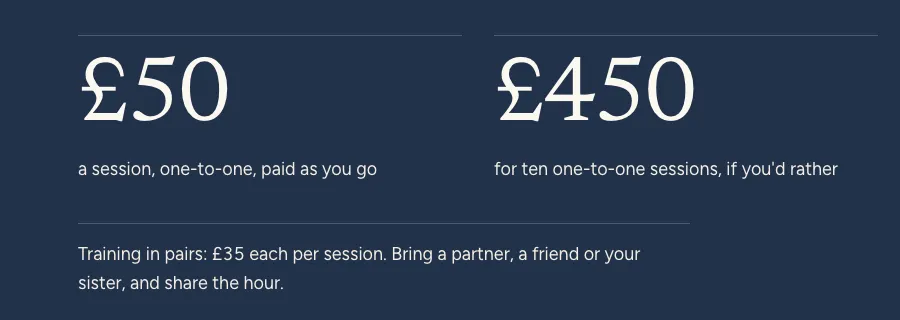
The scan did not count pairs as their own field. The example prices them at £35 each, because sharing the hour changes the fee, and the trainer stays beside each person's sets.
A class or a small group
A class was in the services list on 25.0% (12). Small group or semi-private language was in the page text of 31.3% (15). The counts overlap, so they are not added. Say how many people share the hour, and what each pays.
A screen
Online was in the services list on 35.4% (17). Say whether that is a live hour, a programme someone follows alone, or a mix. The West London page sets online and hybrid training beside the in-person blocks.

The trainers, and the line they will not cross
Ailsa mostly trains women over forty and mothers after a baby. Rory mostly trains people coming back after an injury, and people in their fifties and sixties. Both are described as Level 3 qualified. That qualification is part of the fiction. It is not evidence that the trade requires it.
On injury or a baby, the page says they are personal trainers, not physios or doctors, and they do not treat anything. On food, there are no diets, points or powders. Nobody is weighed, measured or photographed, and the first session has no fitness test.
Home
The opening line is a private studio near the Shore, for people who do not like gyms. The front pages we read name an area on 97.9% (47) and list 7.6 services on average. Put this month's work at the top of that list.
The hour
The training page writes the hour in the order a person meets it. Strength after forty is this brief's ordinary case. Beginner language was on 25.0% (12) of the front pages. Write the hour you actually sell.
Prices and the free first session
The first session is free, with nothing owed afterwards. Then £50 a session, paid as you go, or £450 for ten. Hours are Monday to Thursday 06:30 to 20:00, Friday 06:30 to 18:00, Saturday 08:00 to 13:00, and Sunday closed. The same hours are on the Find us page.
Find us, and what you will not promise
The form asks for a name, an email, a phone if they want a call back, and whether to reply by email or phone. They reply within opening hours, with no mailing list. The phone number and the email are fiction. This page does not repeat the example's client stories or its invented review score.
Where the page has to stop
Describe the session. Leave the result off the page.
Weight-loss, lose weight or fat loss appeared in the page text of 52.1% (25). Before-and-after or transformation language appeared on 31.3% (15). That second figure is a count of words, not a finding that any named site broke a rule. One front page carried a guarantee, 2.1%.
No amount of weight in a stated time
CAP Code section 13 says an advertisement must not claim that people can lose a precise amount of weight within a stated period, or that fat can be lost from a specific part of the body. Testimonials on their own do not substantiate an effectiveness claim. Two of the four real front pages above contain that kind of testimonial. Do not add one of your own.
Before-and-after pictures are testimonials
The ASA's advice on before-and-after photos treats them as testimonials. Hold signed and dated proof, and do not exaggerate. A disclaimer does not repair a misleading picture. Treatment of obesity, at a BMI over 30, is a different advertisement.
Qualifications, said plainly
The GOV.UK register lists chartered fellow or member of CIMSPA as an accreditation. Reserved activities: none. The restriction is on the postnominals MCIMSPA, FCIMSPA, CCIMSPA and the chartered forms. Print them only if you hold them. CIMSPA's careers page describes a Level 3 Certificate or Diploma after a Level 2, often combined by the provider. A statute does not require Level 3 before you coach. One accreditation field contained a REPs string, 2.1%. Do not revive REPs as the current UK register. EREPS, REPS Ireland and ICREPS are for a membership transferred from overseas.
Insurance is a sentence, not a statute
Insured or insurance appeared on 2.1% (1) of these front pages. The official pages we checked do not establish a rule that a website must display a public-liability sentence. If you are insured, you can say so because clients ask. Do not describe diagnosis, rehabilitation as a clinical service, or a diet prescribed for a medical condition. HCPC's list protects physiotherapist, physical therapist, dietitian, dietician, and sport and exercise psychologist. Personal trainer is not on it.
Whatever you build with
Write the rule down, on the site and on the profile.
Match the Google profile to the price
Use the same business name, the same area and the same hours on your Google Business Profile and the site. If you publish a session price, publish the same figure in both places. If you travel to a client's home or meet them in a gym, say whose room it is, and whether travel is included.
Photograph the room, not a result
A picture of the rack, the floor and the daylight tells someone what they are walking into. A picture of you beside a client needs their permission. A before-and-after of a body is a testimonial, and the rules above apply.
Name the button after the hour
"Book your free first session" is clear when the session is free and nothing is owed. If you do not offer a free hour, do not borrow the phrase. "Book a session, £50" is enough when that is your price. WhatsApp was on 4.2% (2) of the front pages. A message is not a held hour unless your reply says the hour is held.
Say what a block does, in one paragraph
Fourteen of the forum items were about the cost, and fifteen were about paying before the session. Under the price, write what one session costs, what a block costs if you sell one, whether the block is optional, and what happens to a session that does not take place.
Website design for personal trainers
A template can hold the words. Someone still has to choose them.
39.6% (19) of the front pages credit a website builder. That is a sensible choice for a sole trainer with a stable offer who will keep the hours and the price current. People searching for a personal trainer website also see suggestions for templates, builders and free sites. A template will not decide whether the figure is a session or a six-week challenge, who else is in the room, or where coaching stops.
We write a brief with you, design and build the site, then look after updates, fixes and ongoing improvements for a monthly fee. You check the work before it goes live. The starting point is the hour you sell and the people booking it.
The build is a one-off cost. Hosting and ongoing work are monthly.
A home page can carry the price, the hour and the way to book. Add a prices page or a trainers page when the work needs it.
Monthly plans
Edits with your assistant use credits. You can buy more, and bought credits do not expire. Monthly billing has no annual contract, no setup fee and no minimum term.
One-off build packs
1 page
3 pages
5 pages
Each pack includes a custom domain, 30 days of Forge edits, global hosting, SSL and backups, and is paired with your first month of whichever plan keeps the site live. Add pages any time, priced per page. You see the price before you pay.
Cancellation takes two clicks from Settings, then Cancel. There is no call and no form. The site keeps running until the end of the billing period. Your domain stays yours, and if you leave we send a static snapshot you can put on another host. Failed builds are not charged, and a person follows up the next working day. There is no introductory rate. We give 30 days' notice before a price change. Moving up or down shows the exact amount first: up is charged straight away for the rest of the month, and down credits what you have not used against the next bill.
Get startedQuestions trainers ask
Before you have your website built.
What should the first screen of a personal trainer website say?
What the session is, what it costs, who else is in the room, and how to book. An area helps: 47 of the 48 front pages named one.
Should I publish a session price if I also sell blocks?
Yes. Publish the single hour beside the block, as the West London and Chester pages do. Eleven front pages showed a price, and four of those were a session, hour or class rate.
Do I need to be a CIMSPA member to have a website?
No. Membership is an accreditation, and the protected part is the postnominal, which you print only if you hold it. One of the 48 front pages named CIMSPA in the accreditation field. The example's Level 3 line is fiction, and this page says so where the trainers are described.
Can I show before-and-after photos or a weight-loss result?
Do not put a precise weight lost in a stated period on the page, and do not rely on a client's words to carry that claim. Before-and-after pictures are treated as testimonials. Describe the session. The 52.1% count of weight-loss language is a reason to be careful.
What should the site say about food, injury, or training after a baby?
Say what the session includes, and name the line. Refer to a physiotherapist or a registered dietitian when the question has left coaching. Those titles are protected. Personal trainer is not.
Is a website builder enough for one trainer?
It can be, if you will write the price, the cancellation rule and the hour yourself, and keep them current. 19 of the 48 front pages already credit a builder.
What does a ThemeSmith site cost, and can I add a prices page later?
Starter is £15/mo for one live site and 150 credits a month. Business is £39/mo for three live sites and 500 credits a month. Build packs are £29, £59 and £89 for one, three and five pages, each with 30 days of Forge edits and paired with the first month of a plan. You can add a prices page later, priced per page, and you see the price before you pay.
Will a new website put me at the top of Google?
We do not promise a ranking. A page that states the session price, the area, the hour and the cancellation rule gives someone a reason to stay. Keep the Google Business Profile and the site on the same facts. Search rankings for this phrase have not been checked.