A website fordentists.
Answer the three questions reception hears every morning.
A caller wants to know if you are taking new patients, what the first visit costs, and whether you will be gentle if they are nervous or in pain. We design the site around those answers, then host it and help you keep the fees and the people current.
From £15/mo, plus a one-off build pack from £29.

The first screen says who is being taken on, and on what terms.
A design example. Wellow & Hart is not a customer.The reception pad
Three answers, in the order the phone rings.
We read the front page of 367 UK dental practices between 25 and 27 August 2026. Whitening, implants and aligners dominate those pages. The calls are about something plainer. Put the plain answers where they can be seen without opening a menu.
Are you taking new patients, and on what terms?
Say yes or no, and say NHS, a plan, or private in the same breath. A mixed practice can be exact: children on the NHS, adults on the plan or on published fees, or the reverse. “Private and cosmetic dentistry” does not tell a parent whether you will see a three-year-old.
On the example, the line under the door is the whole policy: children on the NHS, adults on the practice plan or private. The fees page repeats that a child’s NHS care does not depend on a parent joining the plan.
of the 367 front pages used a phrase such as “accepting new patients”. 15.0% put NHS and private in one explicit phrase. 5.7% said they were not taking patients, or mentioned a waiting list.
What does the first visit cost, and what is included?
An examination price without a time is half an answer. So is a monthly plan price with no list of what the month buys. Write the length of a new-patient visit, whether X-rays are included, and the hygienist fee beside it. If the figure is “from”, say what changes it. If you charge NHS bands, name the country and link the current list. England’s bands are not the charge in Wales.
showed an examination, check-up, consultation or new-patient price. 3.8% showed a hygienist fee. 13.1% showed one or the other. 27.2% showed some price. None of the extracted price lists contained an NHS band.
What happens if someone is nervous, or in pain this morning?
Nervous patients need the order of the visit, not an adjective. Say whether you talk before you look, whether they can stop you, and whether the first appointment can be a conversation. For pain, say who the same-day slots are for, what they cost, and what to do when you are closed. A 24-hour claim is only useful if it is true.
had nervous-patient language, new-patient language and any price on the same front page. The nervous and new-patient counts include text inside reviews. 65.1% mentioned urgent care somewhere. 3.0% of emergency notes said 24/7.
Front pages only. Other pages on those sites were not read. Word counts on the page text include reviews, footers and small print. Prices, booking routes and payment options were taken from the structured fields, which are cleaner. The sample is practices, not laboratories, suppliers or plan companies. It describes these 367 sites, not every practice in the UK.
What the front pages showed
A phone number is common. A check-up price is not.
96.5% offered a phone number and 60.8% offered online booking. 96.7% named a town or an area. The gap is not “can they reach you”. It is whether the page tells them the terms before they ring.
12.0% showed what a check-up costs.
An examination, check-up, consultation or new-patient amount, in the prices on the front page. A hygienist fee was on 3.8% of pages. One or the other was on 13.1%.
44.4% mention the NHS
The word private appears on 68.7%. Both words appear on 37.1%. An explicit “NHS and private” phrase is on 15.0%. Mentioning the NHS in a review, a footer or a finance line is not the same as stating who you will see.
33.0% list a plan
Denplan, a practice plan, a membership plan, a dental plan or a patient plan, inside payment options. Finance, 0% or interest-free is on 49.9%. A plan people can join needs the monthly figure and what the month includes.
29.4% mention the GDC
19.1% put the General Dental Council in the accreditations we extracted. If you name a dentist, the registration number belongs next to the name. CQC is mentioned on 13.9% of pages. CQC does not rate dentists.
Dentist website examples
A house in Frome, built to answer the pad.
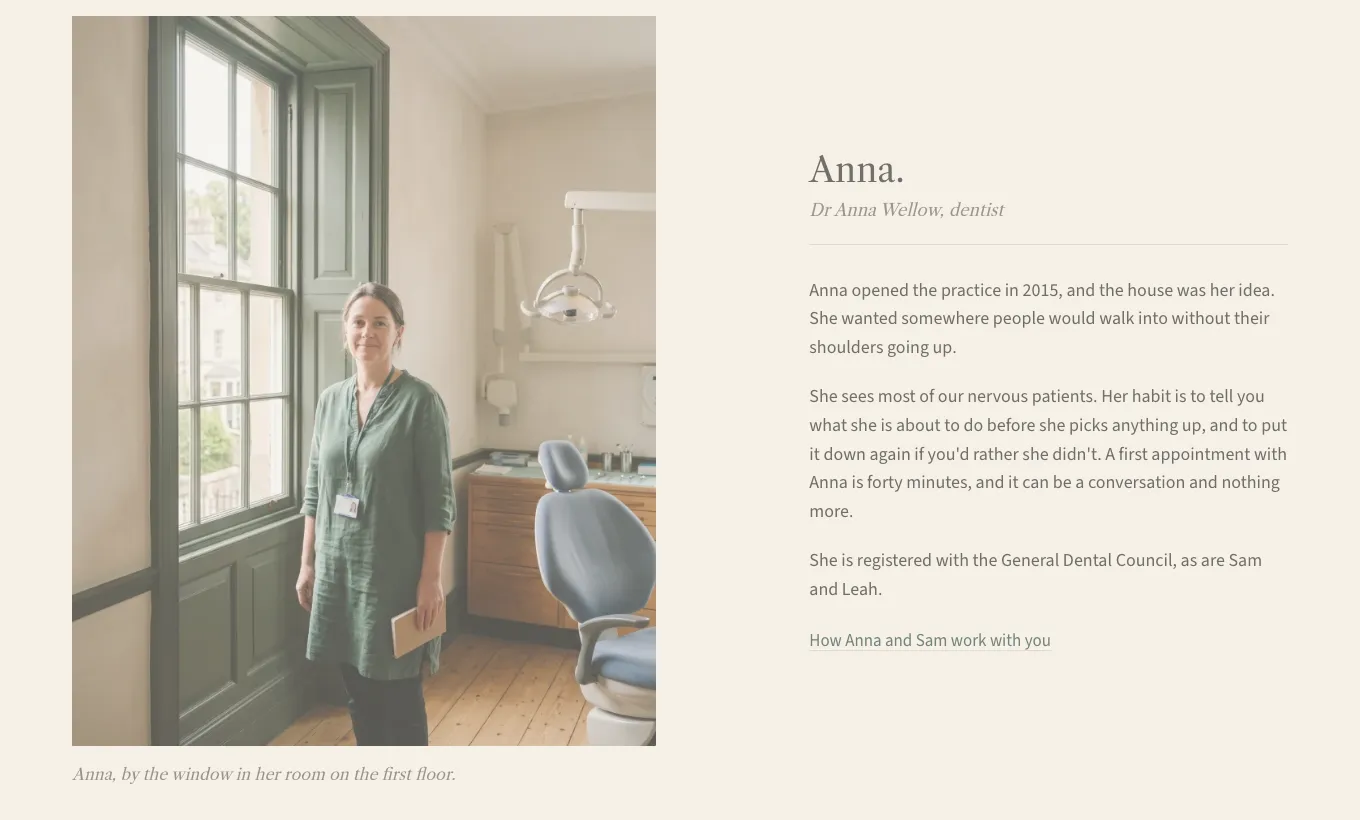
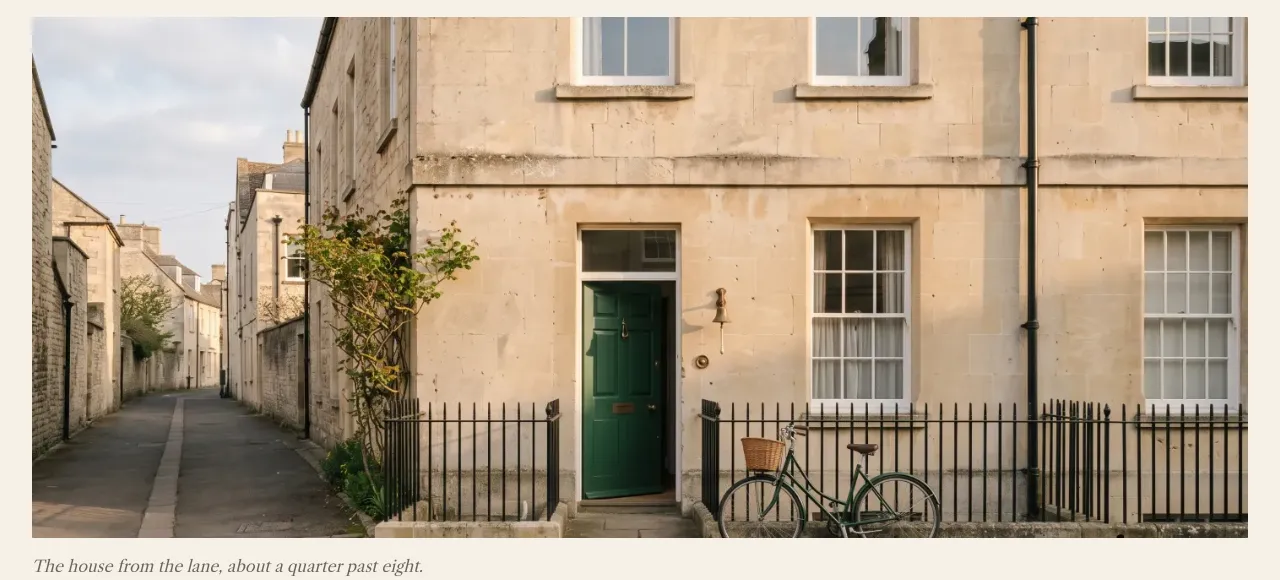
Wellow & Hart Dental is an example build for a fictional two-dentist practice in Frome, Somerset. Anna Wellow and Sam Hart are the dentists. Leah is the hygienist. Two nurses meet people at the door. It has been “here since 2015”, in a Georgian house just off Catherine Hill. None of them are customers, and the Google rating printed on the example is fiction. We do not repeat it here.
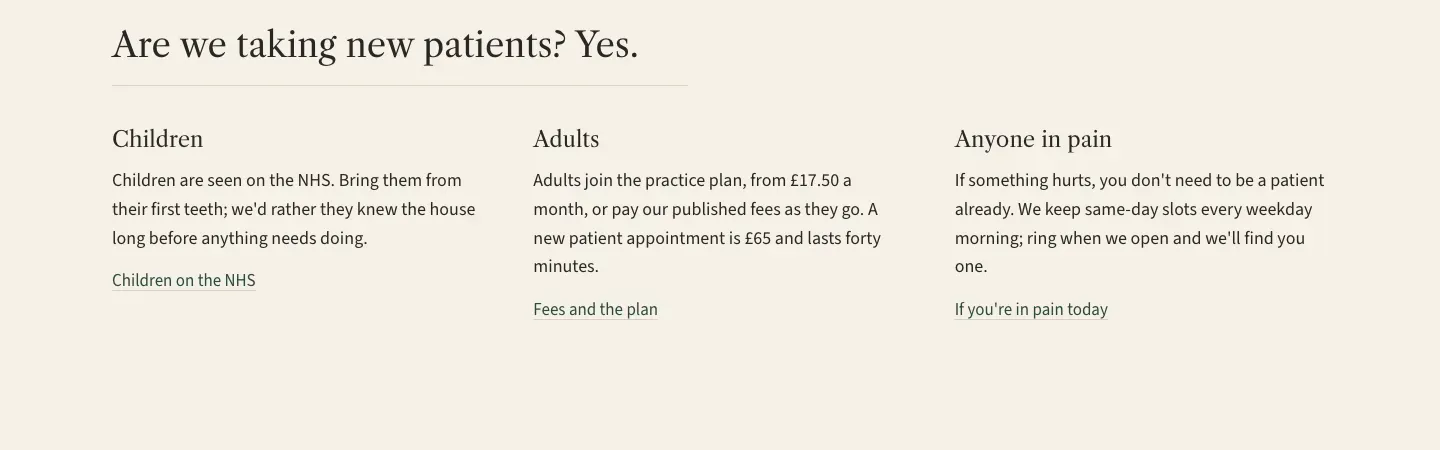
Children, adults, and someone who hurts today.
The home page splits the new-patient question into three. Children are seen on the NHS from their first teeth, including a look round before anyone looks at their teeth. Adults join a practice plan from £17.50 a month, or pay published fees. A new-patient appointment is forty minutes and costs £65. A hygienist visit is £72. People in pain do not need to be patients already: same-day slots are kept every weekday morning.
Hours are on the page. Monday and Wednesday 08:30 to 17:30, Tuesday and Thursday until 19:00, Friday until 16:00, closed at the weekend. The phone number is in Ofcom’s range for use in drama, and the email is a reserved example address.
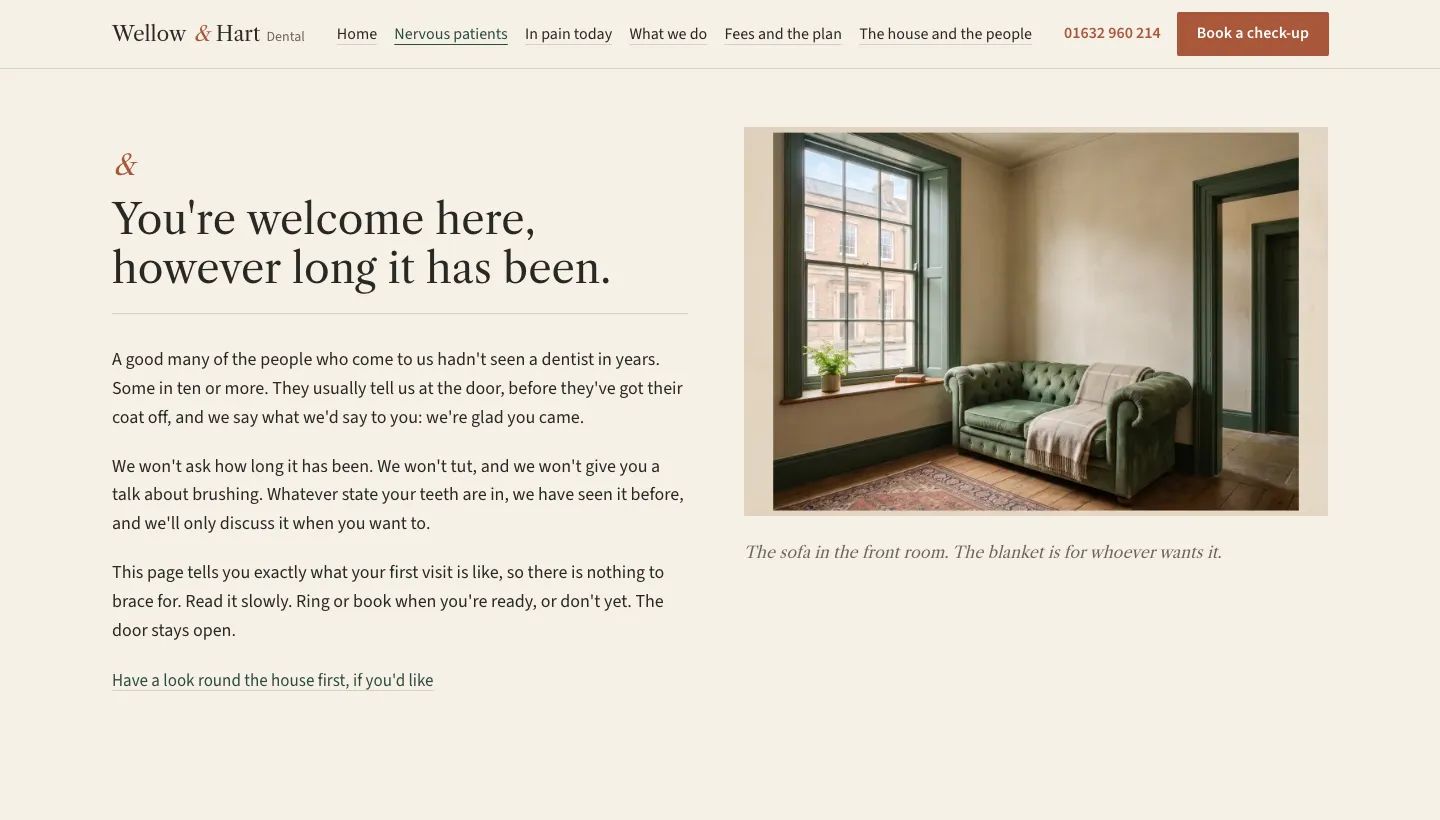
The nervous-patient page is a sequence, not a slogan.
It says a good many people who come have not seen a dentist in years, and that the practice will not ask how long it has been. The first visit is forty minutes, written as four steps. You sit down. Someone talks to you before anything else, in the chair or in an ordinary armchair. A look happens only if you want it, and a raised hand stops it. You leave with a written suggestion and a cost, and nothing is booked until you say so.
The £65 fee is repeated at the bottom of that page, so the reassurance is not separated from the price. 53.1% of the real front pages we read contain the words nervous, anxious or phobic. A large share of that is review text. The example puts the promise in the practice’s own words, and makes it checkable.
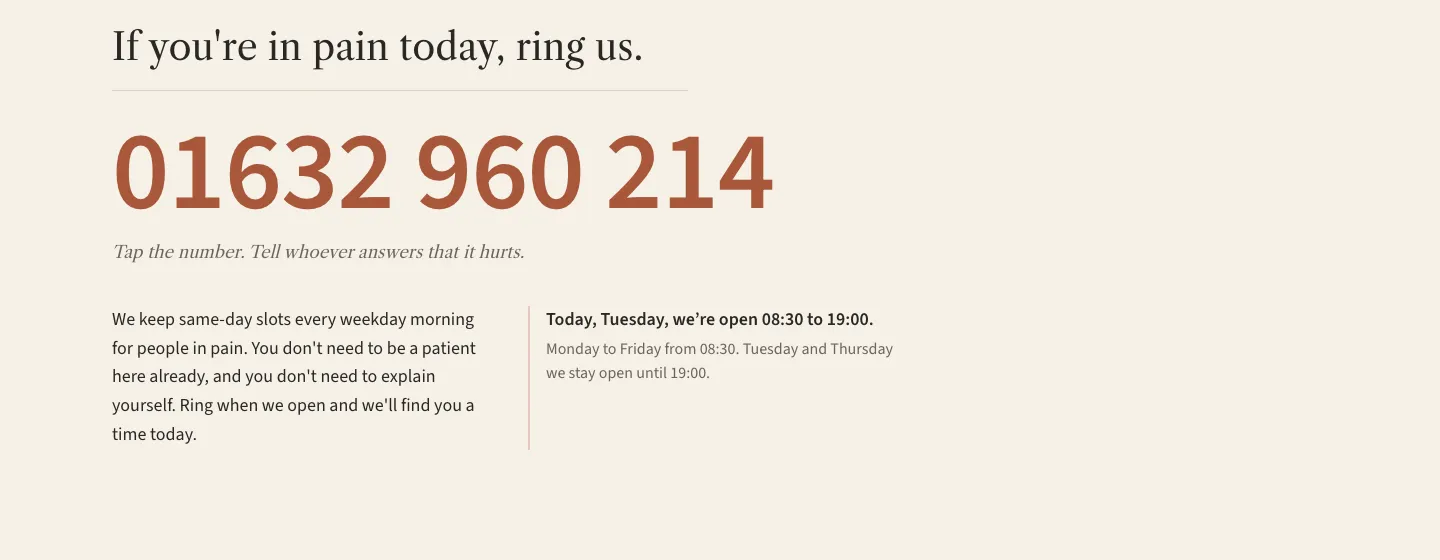
Pain has its own page, including what the practice will not pretend to cover.
Same-day slots are for weekday mornings. The adult visit is charged at the published private fees, and the cost is given on the phone before the person comes in. Children are seen on the NHS, same-day included. The visit is for getting someone out of pain. Anything further waits until another day.
If the face is swelling, swallowing or breathing is difficult, or there has been a heavy knock, the page says not to wait for the practice. Ring NHS 111, or go to A&E. That is the right shape of an emergency claim: what you keep free, who it is for, what it costs, and where to go when you are shut. Across the 367 sites, 9.0% of front pages say 24/7 or 24-hour somewhere in the text, and 3.0% put that wording in the emergency field. “Emergency dentist” as a listed service is 7.4%.
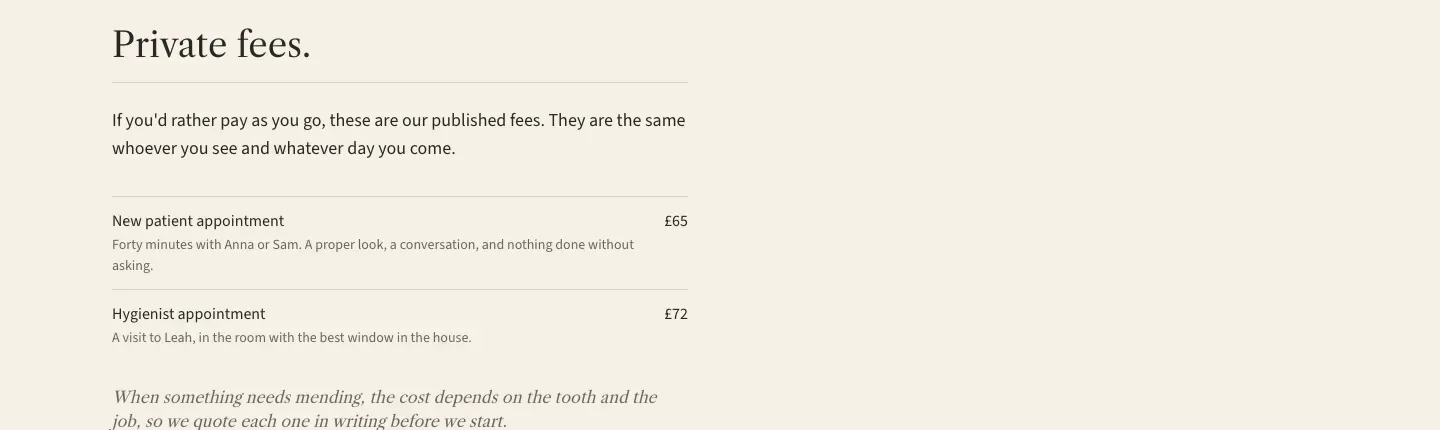
Fees are either published or quoted before anyone starts.
The plan is routine check-ups and hygienist visits, from £17.50 a month, with the exact figure agreed before someone joins. Fillings, crowns, root canal treatment, dentures, bridges, whitening and clear aligners each say “written quote first”. If something else is found once work has started, the dentist stops and talks before going on.
The treatment pages stay in ordinary words. A filling mends a small hole. A crown takes two visits, with a temporary in between. Whitening is a gel in a tray at home, and it does nothing to crowns or fillings. Aligners are described as not right for every mouth. None of this is offered as a result you can count on.
The house is part of the information.
The lane is steep and cobbled in places. People who find stairs difficult are told to say so when they ring. Photographs show the front room, the children’s corner under the stairs, and a surgery with the chair visible from the doorway before anyone sits down. The people are named: who opened the practice, who does most of the mending, who the hygienist is, and that the nurses are the first faces at the door.
Naming them creates a duty. The live example says Anna, Sam and Leah are registered with the General Dental Council, and it does not show a registration number, a qualification, or the country of that qualification. It describes the lane and does not give a building number or postcode. It has no complaints procedure, no link to the GDC, and no date the website was last updated. It also does not show a CQC rating, and it does not print NHS band prices. Use it as a design for the three answers. Do not copy it as a finished set of advertising disclosures. We would ask for the real numbers, the real address and the real complaints route before publishing a practice under its own name.
What real practices already do well
Four front pages that answer before they impress.
These are real UK sites from the August 2026 read. They are described by region, not by name. Their fees belong to them. They are not ThemeSmith customers, and they are not prices we suggest you copy. Star ratings and review quotes on those pages are left out.
Warwickshire, and wholly private.
The practice says it does not accept NHS patients and does not offer NHS treatment. A new-patient appointment is £99.50, lasts 45 minutes, and includes the intra-oral X-rays taken at the time. From that visit it writes a costed plan. A practice plan is offered after a private consultation, once the practice is satisfied the person is ready to join. Nervous patients are told the appointment goes at their pace. Children are welcomed, access is step-free, and there are toys. Founded in 2007, it now has two surgeries and four dentists. Out of hours, the phone takes a message for an on-call dentist. A GDC number is on the page.
Hampshire, with a starting price for ordinary work.
The menu a visitor can read without opening a review: hygiene clean from £75, scale and polish from £75, an examination from £60 for an adult and £30 for a child, fillings from £100, extractions from £210, root canal treatment from £400, crowns from £900, dentures from £650. A registration number sits beside each named clinician. That pairing, person and number, is the part worth copying with your own register entries.
Greater Manchester, plan tiers with the contents written out.
The page presents itself as private and emergency. A new-patient offer is £119 and includes a full examination plus a scale and polish. The practice plan starts from £12.42 a month. A children’s tier, ages 2 to 16, is £6.50 a month: two examinations a year, small X-rays when clinically required, and a choice of a 15% discount on treatment or a five-year warranty. Adult tiers at £12.42, £24.34 and £37.17 say how many examinations, hygiene visits and X-rays the month is buying. The useful habit is the contents list, not the warranty slogan.
Cornwall, including a straight answer on new patients.
The FAQ says yes, the practice is accepting new patients, on a private basis. It has its own nervous-patients wording, children’s dentistry as its own item, and same-day urgent care. Children under 7 are offered a free examination with a registered parent, and ages 7 to 16 are offered reduced costs. Membership starts from £23.50 a month. Interest-free finance is described with its conditions: 0% over 12 months, eligible treatment over £500, provided by Denplan, subject to status, 0% APR representative. The dentists are described as GDC registered. The numbers themselves are a separate job.
Rules that belong on the site
Get the country, the name and the inspector right.
Patients do not need a lecture. They need the current charge for the country you work in, the registration number of the person you name, and no badge the inspector does not issue. We checked the official pages on 6 October 2026. Charges move. Re-check before you print a figure.
Say NHS, mixed, or private.
The General Dental Council’s advertising guidance, effective 30 September 2013 and still the live page, says publicity must show whether the practice is NHS or the equivalent health service, mixed, or wholly private. In our read, 15.0% managed an explicit NHS-and-private phrase. State it in your own sentence, on the first screen. The guidance is on the GDC’s advertising page.
England’s bands, dated.
NHSBSA states that from 1 April 2026 the charges in England are Band 1 £27.90, Band 2 £76.60, Band 3 £332.10, and unscheduled care £27.90. The NHS charges page shows the same amounts and still says it was last reviewed on 13 March 2025. A mix of bands is charged once, at the highest. Further treatment in the same or a lower band within two months is not charged again. Scaling is Band 1 when it is clinically needed, and may be Band 2 if it is extensive. Cosmetic scaling is private. A private white filling has to be explained as a choice. Link NHS.UK and the NHSBSA charges FAQ rather than typing a number from memory. None of the 367 price lists we extracted contained a band.
Wales, Scotland, Northern Ireland.
Wales does not use England’s three bands. On GOV.WALES, last updated 27 July 2026, the maximum for a course of treatment is £384, urgent care is £37.50, a new-patient assessment is £27.21, and an adult recall is £25. Care packages have their own charges, and laboratory fees are often extra. Examinations are free under 25 and at 60 or over. The Welsh charges page is the list to link. NHSBSA describes Scotland as 80% of the cost, up to £384 a course, unless the person is entitled to free treatment. We do not add Scottish age rules beyond that, because the NHS Inform charges page we tried did not load. Northern Ireland publishes its own charges. The nidirect page returned an error on the day we checked, so we do not quote a Northern Ireland figure.
Who is exempt is a page, not a slogan.
In England, NHS dental treatment can be free for under-18s, or under-19s in full-time education, during pregnancy and for twelve months after a baby, and in the benefit cases set out on NHS.UK. That page was last reviewed on 11 February 2025. An exemption is for NHS treatment. Private fees are still due. If you mention free examinations for children, say whether you mean the NHS rules where you work or a private offer of your own, as the Cornwall page does.
A named dentist needs a number.
Where you name a dental professional, the GDC guidance asks for the qualification, the country it comes from, and the registration number. The practice site also needs the geographic address, an email address, a telephone number, a link or address for the GDC, the complaints route (the relevant NHS body for NHS treatment, and the Dental Complaints Service for private treatment), and the date the website was last updated. People who have left should come off the page. Do not compare one dentist’s skill with another’s, and do not promise a result.
Specialist is a list.
A dentist may say “specialist” or “specialist in” only if they are on a GDC specialist list. Otherwise the titles orthodontist, periodontist, endodontist and the rest are not available, and nor is “specialising in”. “Special interest in”, “experienced in” and “practice limited to” are the wordings the guidance allows. Dental care professionals have no specialist lists. The word specialist appears on 26.4% of the front pages we read. That is a count of a word, not a finding about any practice. We do not state how many specialties the list contains.
CQC does not rate dentists.
The Care Quality Commission says it inspects dentists in England and does not give them ratings, because it does not have the legal power to. Do not put Outstanding, Good, or any other rating on the site. CQC is England. A practice in Wales, Scotland or Northern Ireland should not be told to display it. One accreditation in the sample named RQIA. We have not verified the names of the Scottish or Welsh bodies, so we do not invent them. The CQC pages are find a dentist and ratings.
Guarantees of a result are rare, and should stay rare.
4.1% of the front pages offered a guarantee. Several of those promises were about an outcome. A five-year warranty on a plan, with the conditions written next to it, is a commercial offer the practice has to be willing to stand behind. A promise that treatment will not hurt, or that a smile will be perfect, is a different kind of sentence. We will not write the second kind.
Dentist website design
Build the pages the phone call already has.
A focused practice can put the three answers on a single page. A practice with a real nervous-patient way of working, a plan, and a same-day arrangement will want room. The example uses seven pages, including privacy. A five-page pack does not silently become seven. Further pages are added when you want them, priced per page, with the price shown before you pay.
Home
Who you see, on what terms, where you are, and how to book or ring. The new-patient sentence belongs above the cosmetic menu. If you are not taking patients, say so, and say whether children, a plan, or emergencies are the exception.
Nervous patients
The order of a first visit, how to stop you, and the fee for that visit. If the first appointment can be a conversation with no examination, say that. This is your wording. We will not invent a calming claim you do not work to.
In pain today
When the slots are, who they are for, what they cost, and what to do when the practice is closed. NHS 111 and A&E belong in that last sentence if that is the route you mean. Do not write 24/7 unless someone answers.
Fees and the plan
Published fees for the visits you can describe, with what is included. The plan’s monthly range and its contents. NHS charges for your country, linked, if you provide NHS care. Written quotes for everything that depends on the tooth. Say whether VAT applies. Dental fees are usually the patient charge, not a plus-VAT trade price, but if you add VAT, say so.
The people and the building
Names, qualifications, countries of qualification, GDC numbers, and a photograph you have permission to use. How to find the door. What to do if stairs or a steep lane are a problem. Take people off the page when they leave.
Privacy, complaints, and the date
The complaints procedure, with the NHS body for NHS treatment and the Dental Complaints Service for private treatment. A link to the GDC. The date the website was last updated. The geographic address, email and telephone if they are not already impossible to miss.
Searchers type “website for dentists” and “dentist website design”. Google also offers “nhs website for dentists” as a suggestion, which is a different question, about finding a dentist. The first line of yours should be obviously about the practice’s own site. A template can supply a layout. It will not know whether you see children on the NHS, what Leah charges, or which number the GDC holds for Sam. Those have to be yours.
The build is one-off. Keeping it live is monthly.
Two plans, the same for everyone. The build pack is paired with the first month of whichever plan keeps the site live. Each pack includes 30 days of Forge edits after the build.
Monthly plans
Edits with your assistant use credits. Bought credits don’t expire. Move tiers any time and you see the amount first. Moving up is charged for the rest of the month. Moving down credits what you have not used against the next bill.
One-off build packs
1 page
3 pages
5 pages
Add pages any time, priced per page. You see the price before you pay.
No annual contract, no setup fee, no minimum term. Cancel in two clicks from Settings → Cancel. The site keeps running until the period ends. Your domain stays yours. If you leave, you get the site as static HTML, and the content and the brand stay yours. There is no introductory rate. We tell you 30 days before a price change. A failed build is not charged, and a person follows up the next working day.
Get startedQuestions from practices
Before you commission a dentist website.
Do I have to publish fees?
No. You can explain that you quote in writing before treatment. If you do publish a fee, put the time and what is included beside it. If the practice is NHS, mixed or private, say which, whether or not you print a price. England’s current bands, if you use them, are Band 1 £27.90, Band 2 £76.60 and Band 3 £332.10, from 1 April 2026, and they are the wrong figures for a practice in Wales.
What if we are not taking new NHS patients?
Say so. 5.7% of the front pages we read already say they are not accepting patients, or mention a waiting list. A clear no saves the phone, and it is more useful than a menu that implies anyone can book. Say whether children, plan patients or people in pain are exceptions.
Can I call a dentist a specialist?
Only if that dentist is on a GDC specialist list. Otherwise use “special interest in”, “experienced in” or “practice limited to”. Do not use titles such as orthodontist or endodontist, and do not say “specialising in”. Dental nurses, hygienists and therapists have no specialist lists.
Should we display a CQC rating?
No. CQC inspects dentists in England and does not rate them. A rating on the site would describe something the inspector does not issue. Practices outside England are not CQC’s to begin with.
What has to sit next to a dentist’s name?
The qualification, the country it comes from, and the GDC registration number. The site also needs the practice address, email, telephone, a way to reach the GDC, the complaints procedure, and the date the pages were last updated. The fictional Frome example names its clinicians and still misses the numbers. A real site should not.
Can one site talk about implants and nervous patients?
Yes. Give each its own route so a frightened new patient is not dropped into a whitening menu, and an implant enquiry is not written as if it were a check-up. Whitening is already on 76.6% of the front pages we read. The nervous-patient sequence is the part most of those pages do not actually write.
Can we start smaller than the example?
Yes. The example is seven pages because the practice had seven things to say. A one-page pack is £29, three pages £59, five pages £89, each with 30 days of Forge edits and the first month of a plan. Further pages are priced per page, and you see that price before you pay. Starter is £15/mo for one live site. Business is £39/mo for three.
What happens if we cancel?
Two clicks, Settings then Cancel. No phone call and no form. The site runs to the end of the period you have paid for. The domain stays yours. You get the site as static HTML, and the pages, copy, brand and photographs in standard formats. There is no introductory price that later jumps.