A website for driving instructors.
Show the hour, and which badge is in the windscreen.
A learner comparing instructors wants the hourly rate, whether manual and automatic differ, whether a block changes that rate, how soon the first lesson is, and whether you are a qualified ADI or a trainee. We design and build your website around those answers, then host it and help you keep the rate and the diary current.
From £15/mo, plus a one-off build pack from £29.

The first screen is about restarting. The rate is not on it.
This is a live example of our work, not a customer business.Of the sites we read
None of them named the badge.
We read the front page of 60 UK driving-school websites between 25 and 27 August 2026 and recorded what each one said and offered. Other pages were not read. The figures describe those sites, not every driving instructor in the UK. Where a figure comes from page text, it includes reviews and footers.
0 of 60. front pages said green badge or pink badge.
Anyone you pay to teach you to drive has to be a qualified approved driving instructor or a trainee, and the GOV.UK guide tells the learner to look at the windscreen. Green means qualified. Pink means trainee.
On the page text, 47 of the 60 (78.3%) said ADI, “approved driving instructor”, or DVSA. Thirteen (21.7%) said none of those. The accreditation field says DVSA on 32 (53.3%). The letters ADI are in that field on 4 (6.7%), because most of those pages say DVSA rather than ADI. Grade A is in the accreditation field of 1 (1.7%) and in the page text of 1 (1.7%).
35.0%priced an hour.
Twenty-one of the 60 had an hour, or a lesson sold by the hour, in the price field. Any price at all was on 26 (43.3%). A block, a package or a 10-hour price was on 16 (26.7%). Automatic is on the service list of 45 (75.0%) and in the price field of 10 (16.7%). If the two rates differ, the page has to show both.
43.3%mentioned a pass.
Twenty-six front pages used “pass rate”, “first-time pass”, “guaranteed pass” or “pass guarantee” somewhere in the page text, reviews and footers included. Guarantee language is in the price field of 1 (1.7%). The guarantees field has anything on 6 (10.0%). A pass is the learner’s result. It is not a line the site can promise.
33.3%offered online booking.
Twenty front pages had an online booking route. A phone number was on 58 (96.7%), email on 49 (81.7%), a contact form on 35 (58.3%) and WhatsApp on 17 (28.3%). Two had no phone. Walk-in was on none. The button must not pretend to book the driving test.
8.3%said dual control.
Five front pages said the car has dual controls. Motorway lessons are on the page text of 22 (36.7%). Instructor training is on the service list of 33 (55.0%). The motorway rule is below, and a trainee price needs its own heading.
What the learner is comparing
Six things, in the order they get asked.
An area is named on 59 of the 60 (98.3%). The towns are not the hard part. The hard part is the rate, the person, and what the button does. Waiting-list or spaces language appears on 1 (1.7%).
The manual hour, and the automatic hour.
Print both, even when the numbers match. One unnamed price under the word automatic leaves the learner guessing which car it buys.
Whether a block changes that hour.
Put the block next to the single hour and show the sum. Five hours at the same rate is a fair thing to write. A banner that says “save £20” when the grid saves £25 is not. A “from” price has to be a price someone can actually be charged.
The test-day car, as its own line.
Using the instructor’s car for the practical test is not another lesson hour. Give it a price of its own, and say what is included.
How soon the first lesson is.
Put the wait where you will change it. A number you will not update is worse than a sentence that says the current wait is in the reply. The reply still has to contain it before anyone pays.
Green, or pink.
Write it beside your name. A learner can ask your grade. In England, Scotland and Wales, A is 43 to 51, B is 31 to 42, and Fail is 0 to 30, on the grade explainer. Old grades from 6 to 1 last only until the next check.
What the button books.
The learner books, changes and cancels their own car test. You are not allowed to book it for them. Say that, link to the booking service, and offer your personal reference number so they can check you are free. Your button is for a lesson.
Driving instructor website examples
Four front pages put a rate where it can be used.
These are real UK front pages from the same read, described by region only. Their prices belong to those businesses. They are not ThemeSmith customers, and they are not fees to copy.
Greater Glasgow, East Dunbartonshire and Lanarkshire
A small team, established in 2005. Manual is £42 an hour, £210 for five at the same rate, £410 for ten and £820 for twenty. Ten hours is £10 under ten times £42, and twenty is £20 under. Automatic is £45, £225 for five at the same rate, £440 for ten and £860 for twenty. Twenty automatic hours is £40 under twenty times £45, not the same saving as manual. The same fully qualified instructor stays to the test. DVSA, criminal-records and PVG checks are mentioned. So is “high pass rates”. Leave that claim off.
Bicester, Oxfordshire
One instructor. Two hours is £90, which is £45 an hour. Ten hours is £450, the same £45, taken as two hours a week in a printed slot: Monday to Thursday from 08:00, in two-hour blocks, and Friday mornings. The block is not a discount. It buys the time. The cars are dual-controlled, and pickup is offered. DVSA is in the accreditation field. The page says pupils consistently pass first time. Leave that sentence off.
South West London
Kingston, Wimbledon, Sutton and the neighbouring towns, recorded as a larger firm. Beginners pay £70 for the first two hours, written as £35 an hour, then £37.50 for manual or automatic. Ten hours at £375 and twenty at £750 stay on £37.50. Thirty hours is £1,155, which is £38.50 an hour, so the long package costs more per hour, not less. Test day is £130, including the car. Experienced, overseas and test-ready drivers are £80 for two hours. DVSA is named. The page also claims pass rates significantly higher than the UK average, without the evidence on the page we read. Leave the claim off.
Hemel Hempstead
£80 for two hours is £40 an hour. Ten hours is £385, which is £38.50. Forty hours is £1,500, which is £37.50. Manual and automatic are not priced apart. A female instructor is a named service: the words appear in the page text of 18 of the 60 (30.0%) and in the service list of 4 (6.7%), so say it beside the price if it is true. DVSA and DBS are in the accreditation field. The same site also sells instructor training and a franchise. Those prices need their own heading, or a learner cannot tell what £385 buys.
Runcorn and Widnes
Automatic-only tuition, including a car adapted for physical disabilities. That is the useful fact. The same screen says £42 an hour and “prices from £40 an hour”. Those figures do not agree, which is what rule 3.22 is there to stop. No DVSA string is in the accreditation field. Do not reuse the five-star line.
Colchester, Clacton and nearby
Manual two hours is £80, so the hour is £40. Ten hours at £375 saves £25, not the £20 on the banner. Twenty hours at £750 saves £50, not £40. Automatic two hours is £85. A “platinum pass guarantee” is £3,200 manual and £3,500 automatic. Copy a grid that matches its own sum. Rule 3.55 says “guarantee” must not confuse a person’s rights, and a pass is not one.
One we built
Skerne writes the lesson down, and leaves the rate off the page.
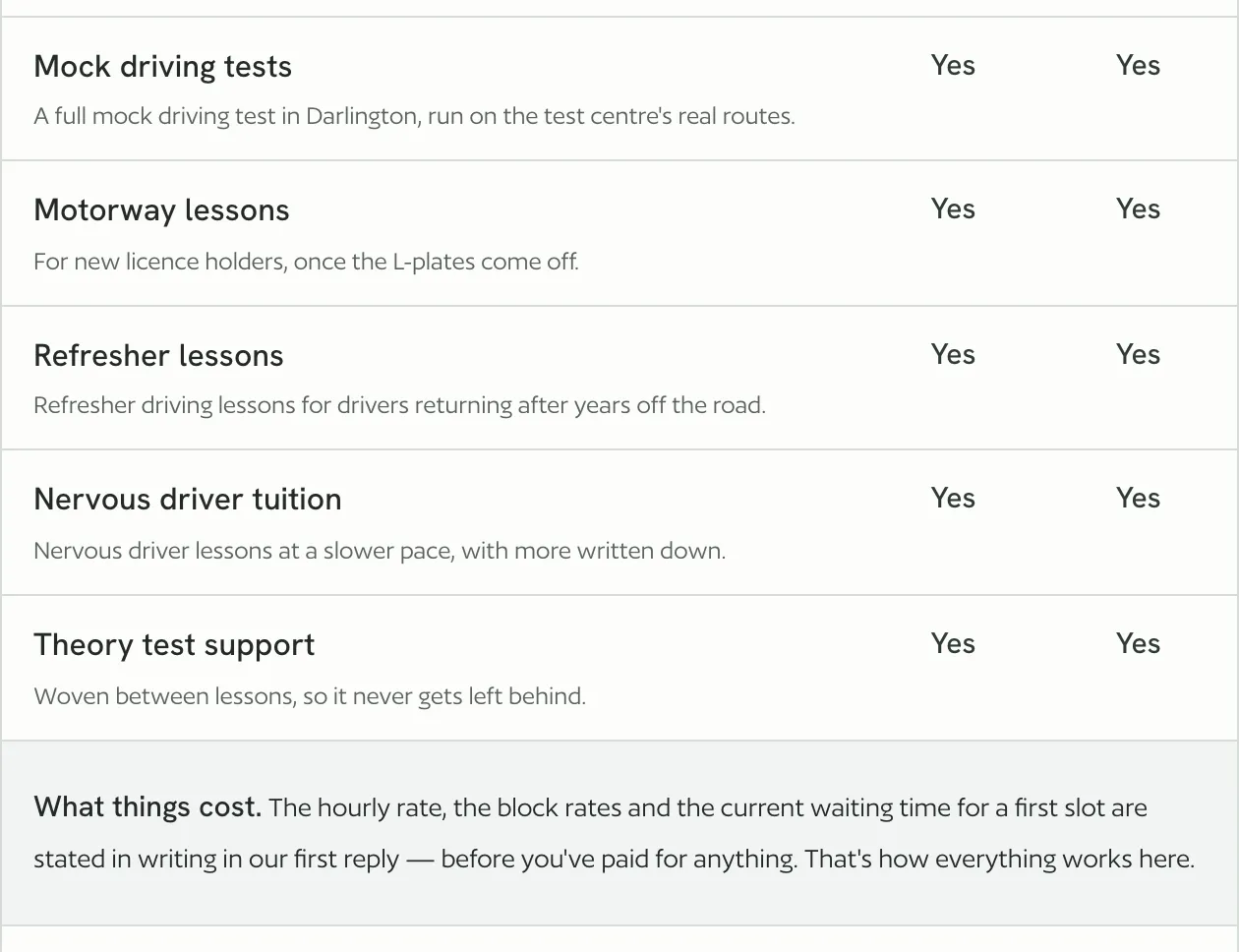
Skerne School of Motoring is an example build for a fictional instructor in Darlington, not a customer, and nothing on it is a testimonial for ThemeSmith. In the fiction the school has been teaching since 2016. The home page is for someone restarting after a fail or a bad experience. There is also a privacy page.

What the page does
The method is an assessment drive, a written plan before any money, then practice on Great Burdon, Haughton Road, North Road and Yarm Road. A short note is texted the same day, and a parent can be copied in. Hours are Monday to Friday 08:00 to 19:00 and Saturday 08:00 to 14:00. The form asks for a name, a phone or an email, manual or automatic, when the person last drove, and an optional note.
Inside the fiction, a lesson the school cancels is replaced free, unused block hours are refunded in full, and the same instructor stays to test day. A parent may sit in. The cars are dual-controlled and insured.
What it leaves out
The hourly rate, the block rates and the wait for a first lesson are not printed. The page says they arrive in the first written reply, before anyone pays. That reply is the right moment to confirm them. It is a poor substitute for the rate itself, which 21 of the 60 managed to put in the price field. The page never says ADI, DVSA, green or pink, even though the fiction is paid tuition.
Motorway lessons are described only after the L plates come off. The supervision guidance also allows a learner on a motorway before the test, with an ADI in a dual-control car. L plates, D plates in Wales, and optional green P plates are not that badge. The plate rules say so.
Where the page has to stop
Describe the lesson. Leave the pass off it.
There is no minimum number of lessons, and instructors set their own prices. There is no official definition of an intensive course in the pages we checked, and no official hour count to quote. If you sell a run of hours across a few days, say the hours, the days, and that it does not buy a test result.
The example breaks its own rule
Skerne prints a public rating of 4.1 from 218 Google reviews. That rating is invented. It also gives three named learners, in Cockerton, Haughton and Mowden, pass stories, including a clean pass and a second attempt. We are not quoting them. A note on the route map says the reader will not fail one junction the way other people do. That is an outcome promise. Do not add any of this to a live site, and do not read it as a review of ThemeSmith.
A grade is a score. A pass rate is a claim.
The check is usually every four years, including when you are not working, and pupils’ test results can trigger an earlier one. A risk-management score of 7 or less, or the examiner stopping the lesson, is a fail. Three fails means leaving the register. See the overview and the result page. Publish grade A or B if you hold it. A pass rate needs evidence this page is not going to invent.
Whatever you build with
Keep the rate, the badge and the diary in one place.
One screen, then the reply.
Name, towns, both hours, green or pink, and a phone number. A phone is already on 58 of the 60. Say on the form whether you reply the same day.
The block, shown as arithmetic.
Write the single hour, the block, and what one hour inside the block costs. If a long package costs more per hour, say so, as the South West London page does at thirty hours. Do not print a saving the prices do not produce. Intensive, Pass Plus, refresher and the test-day car each get their own line. Pass Plus is on the service list of 24 (40.0%). If you sell it, write the hours. Do not leave the name to stand in for a course you have not described.
The same person, named.
The scan left the size of the business blank on 31 of the 60 (51.7%). Sole trader was 5 (8.3%), small team 20 (33.3%) and larger firm 4 (6.7%). If it is you from the first lesson to the test, say that. If a learner may be passed to someone else, say that too. A female instructor, where that is the offer, belongs in the same sentence as the price.
Motorway only if the badge is green.
If you offer motorway lessons, say you are a qualified ADI and that the car has dual controls. Do not offer them as a trainee. Private practice with a friend or parent is unpaid, including fuel, and it stays off the motorway. Link the supervision page rather than paraphrasing a rule you might shorten.
Website design for driving instructors
A template can hold a phone number. It will not choose the hour.
Search suggestions for these phrases run to templates, a free download, GitHub and a builder. “Website for driving instructors” also suggests the government site and the cost of lessons. A template will not decide whether the rates differ, whether a block changes them, or that the learner books the test. Of these front pages, 24 (40.0%) already credit a builder. The average service list has 8.2 items.
We write a brief with you, design and build the site, then look after updates, fixes and ongoing improvements for a monthly fee. You check the work before it goes live.
The build is a one-off cost. Hosting and ongoing work are monthly.
A home page can carry the hour, the badge and how to ask for a lesson. Add a prices page when manual, automatic, the block and the test-day car need their own lines.
Monthly plans
Edits with your assistant use credits. You can buy more, and bought credits do not expire. Monthly billing has no annual contract, no setup fee and no minimum term.
One-off build packs
1 page
3 pages
5 pages
Each pack includes a custom domain, 30 days of Forge edits, global hosting, SSL and backups, and is paired with your first month of whichever plan keeps the site live. Add pages any time, priced per page. You see the price before you pay.
Cancellation takes two clicks from Settings, then Cancel. There is no call and no form. The site keeps running until the end of the billing period. Your domain stays yours, and if you leave we send a static snapshot you can put on another host. Failed builds are not charged, and a person follows up the next working day. There is no introductory rate. We give 30 days’ notice before a price change. Moving up or down shows the exact amount first: up is charged straight away for the rest of the month, and down credits what you have not used against the next bill.
Get startedQuestions instructors ask
Before you have the site built.
What should the first screen show?
Your name, the towns, both hourly rates, green or pink, a phone number, and a way to ask for a lesson. Add the wait only if you will keep it current.
Can the site promise a pass, or a pass rate?
No. Marketing must not mislead, and an objective claim needs evidence you hold before you publish it. A guarantee of a pass confuses what the learner is buying. Your standards-check grade, if you publish it, is a teaching score. It is not their test result.
Who books the practical test?
The learner. You must not book, change or cancel a car test for them. New appointments are released at 6am on Mondays, 24 weeks ahead, and there is no DVSA waiting list. Give them your personal reference number if they want to check you are free, and link to the booking service rather than copying a fee onto your site.
What is the difference between the green badge and the pink badge?
On the GOV.UK learn-to-drive guide, green means a qualified ADI and pink means a trainee. Both may be paid for lessons. Only a qualified ADI, in a dual-control car, may take a learner on a motorway in England, Scotland and Wales. The learner’s L plates, D plates in Wales, and optional green P plates are a different thing. Northern Ireland uses different instructor rules and R plates for a year after the test.
Do I have to publish a price?
You do not have to. Twenty-one of the 60 did put an hour in the price field, and a learner comparing you with them will notice if yours is missing. If manual and automatic differ, publish both. State whether a block changes the hour.
What does a ThemeSmith site cost, and can I add a prices page later?
Starter is £15/mo for one live site and 150 credits a month. Business is £39/mo for three live sites and 500 credits a month. Build packs are £29, £59 and £89 for one, three and five pages, each with 30 days of Forge edits and paired with the first month of a plan. You can add a prices page later, priced per page, and you see the price before you pay.