A website for caterers.
Say what a head buys, and whether the date is free.
A couple comparing wedding breakfasts, a family arranging a wake, and an office booking lunch are all trying to see the same few facts before they write. We design and build your catering website around the price, the menu, the diets and the date, then host it and help you keep it current.
From £15/mo, plus a one-off build pack from £29.

The month is the first question. The sample feast, and what it costs a head, sit underneath it.
This is a live example of our work for a fictional business, not a customer.Of the sites we read
Most caterer websites never say what the money buys.
We read the front page of 144 UK caterer websites between 25 and 27 August 2026. Other pages were not read. The figures describe those front pages, not every food business in Britain. The largest group in the scan is a mixed catering label, so this is event, wedding and outside caterers as the scan classified them.
12.5% showed any price.
That is 18 of the 144. Eight of those price lines were a price per head. None of the 18 said whether VAT was included. Elsewhere on the page, 21 sites used the word VAT, and two had a phrase for a price plus or excluding VAT. A visitor still usually cannot tell whether the figure in front of them includes it. A price per head should say.
84.0%listed a phone number.
Email was on 79.9%, and a contact form on 41.7%. Online booking was on 13.9%, and WhatsApp on 4.2%. A number is the start. The useful page also says when it is answered, and what to send if the call is about a wake at short notice or a date next summer.
13.2%mentioned food hygiene.
A tighter phrase, “hygiene rating”, was on 4.9%. In England, Wales and Northern Ireland the rating runs from 0 to 5. Putting it on the website is encouraged. The business guidance we checked does not say the website must show it. Scotland uses a different scheme, Pass or Improvement Required, not a score out of 5.
11.8%mentioned allergens.
Dietary wording, which is wider, was on 34.7%. No front page claimed an allergen-free or nut-free kitchen. A free-from claim is a guarantee. If wheat flour is in the kitchen and cross-contamination cannot be removed, do not claim gluten-free or wheat-free.
87.5%named where they work.
A menu was mentioned on the same share, 87.5%. Weddings were mentioned on 63.9%, corporate work on 69.4%, and a tasting on 12.5%. The average site listed 8.2 services. The page gets clearer when the work you want is the work a visitor can price.
The figure a guest can compare
A price per head is a list, not a slogan.
People comparing caterers are trying to see what the meal is, what the money includes, and what happens if someone does not eat the hog roast. Put those answers next to the number.
What the figure buys.
Staff, crockery, the kitchen, the setup, the meal itself. One real wedding caterer in Yorkshire puts three feasts on the front page, from £79, £89 and £99 a head, and says the lines include professional staff, setup, and the kitchen and equipment. It also says there are no hidden extras. The captured page does not say whether VAT is included.
Whether VAT is in.
A Hertfordshire and Bedfordshire caterer publishes a 2027 midweek offer for 80 guests, Monday to Thursday, bank holidays excluded. Barbecue platters and a feasting board are £45 a head, two courses £50, three courses £55, and the price includes a tasting for the couple, crockery, cutlery, staffing and VAT. That last word is the one most sites leave off.
How diets are handled.
An East Midlands caterer states buffets from £5.50 a head excluding VAT, hot food from £23.50, barbecue from £13, and a hog roast from £795 for the event. Every buffet is 30% vegetarian before anybody asks. Vegan, gluten-free, dairy-free and halal portions are prepared separately and labelled. A buffet needs the allergen information for each dish, not one note for the whole table.
What the day looks like.
A family-run caterer near King’s Lynn, also working in Cambridgeshire, Suffolk and Lincolnshire, has been going since 2008. The front page walks the day: the team arrives ahead of the guests, then drinks and canapés, then the wedding breakfast. The footer states a food hygiene rating of 5. The captured front page does not put menu prices next to that story. Both kinds of fact belong on it.

Before they enquire
People are choosing the meal, then asking what it costs.
From X (English-language, worldwide) and UK forums (Reddit, Mumsnet), sampled 6 Oct 2026; posts from the last 12–24 months, not every post. 1,241 posts and comments. Each one has a saved link. One theme each, so the counts add up to 1,241. For every theme, the identifiably UK count is the same as the total: the two X posts name UK places, and every forum post is from a UK forum. This sample does not call a global post a UK customer. AskUK and several other UK subreddits were rate-limited and are not included. Reddit here is r/UKweddings.
Which kind of service to book
630 50.8% · all UK
Dietary needs
230 18.5% · all UK
What the price includes
162 13.1% · all UK
What happens on the day
85 6.8% · all UK
Finding someone for the date
79 6.4% · all UK
Whether there will be enough
33 2.7% · all UK
Being let down
22 1.8% · all UK
The largest group is people deciding between a hog roast, pizza, a buffet, a food truck or a seated wedding breakfast. Dietary needs are next: vegetarian plates that are more than the side dishes, and kitchens that will not promise zero cross-contamination. Price is third. Being let down, including a missing reply, is the smallest theme in this sample. That is not proof it rarely happens. These are posts we could read, not every post.
What the real sites get right
The strongest front pages can be compared without a phone call.
These are real UK front pages from that August reading, described without naming the firms. Their prices belong to them. Copy the way they explain the job, not a promise you cannot keep.
Yorkshire. £79, £89 and £99 a head.
The middle price adds canapés and a sharing starter. The top price adds a course and a full choice of evening food. A date form sits on the page. The same firm also covers birthdays, anniversaries and funerals. No VAT wording, and no hygiene rating, on the captured front page.
Hertfordshire and Bedfordshire. £45, £50 and £55, VAT included.
For 80 guests, with the tasting, the crockery, the cutlery and the staff included. The tasting is at their kitchen. The offer is Monday to Thursday in 2027, bank holidays excluded. Seasonal and local produce, and dishes written for the couple.
East Midlands. Buffets from £5.50, excluding VAT.
Delivered buffets include crisps, fruit, cake and juice, ordered by 4pm for the next working day. Hot food from £23.50, barbecue from £13 a head, and a hog roast carved in front of guests from £795, quoted on the date, the numbers and the space. Catering since 2012.
West Norfolk. The day, in order.
Family-run since 2008, also in Cambridgeshire, Suffolk and Lincolnshire. The page follows the guests through arrival, canapés and a seasonal wedding breakfast. A tasting happens where it fits the planning. Food hygiene rating 5 is in the footer. Menu prices are not on that captured front page.
The example we built
Glaven & Crumb puts the month, the head and the date on the site.
It is a fictional wedding and event caterer, cooked from a kitchen unit outside Holt since 2013. Tess Glaven cooks. Joe Crumb runs the floor and the bar. It is not a customer, and it is not a review of a real firm. Phone 01632 960 845 and hello@example.com are example details.
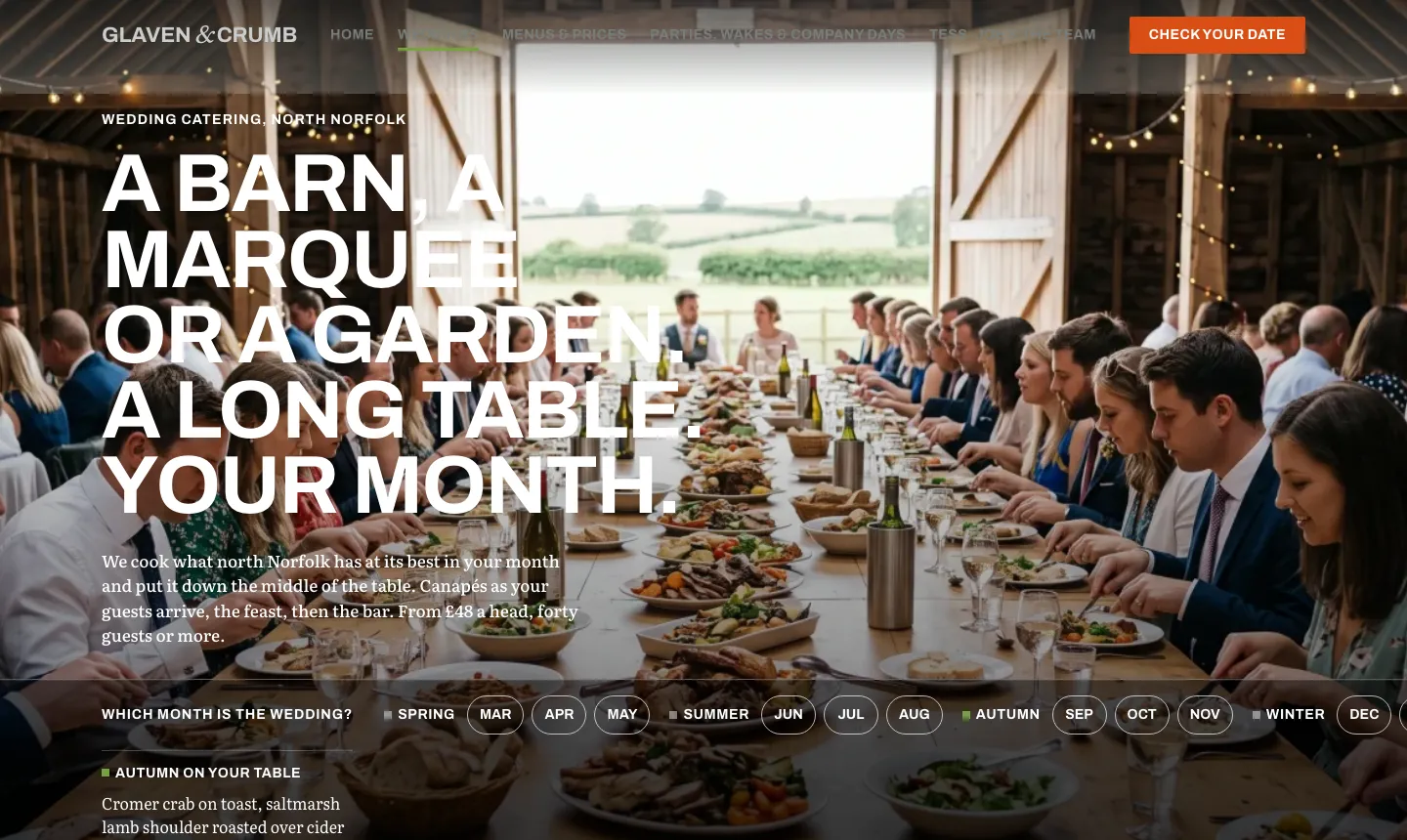
Weddings are a barn, a marquee or a garden, and a long table. Canapés from £14 a head while photographs are taken. The sharing feast from £48 a head. Forty guests or more. Each season has its own sample at that same from-price. The bar is Norfolk beer and cider, written into the same quote as the food. One written quote before anything is booked.
The tasting is for every booked couple, at the unit, after the date is booked, not before. Allergies and dietary needs are written down in advance. A guest with a specific need gets a named plate. The example does not claim an allergen-free or nut-free kitchen. It states a food hygiene rating of 5. The prices per head do not say whether VAT is included, which is the gap on the real sites as well.
The form asks for the month, the exact date if they have it, the kind of day, a range for numbers, and the nearest village or town. Weddings of fewer than forty are turned away on the form itself. Nothing confirms itself. Tess or Joe read it and reply by email in kitchen hours, Monday to Friday, 09:00–17:00. An email outside those hours is read first thing. Parties, wakes and company days are quoted on that season’s menu and the numbers, by phone or email, rather than a tasting. Wakes are the phone call.
A map, not to scale, marks the unit just outside Holt and names Wells-next-the-Sea, Blakeney, Sheringham, Cromer, Fakenham and Norwich. Visits are by arrangement. The privacy page says ThemeSmith hosts the form and does not use the enquiry to market to the sender. Enquiries are kept 180 days, and attached files 90 days.

The site, page by page
Give each kind of day enough room to be booked.
A caterer can start with one strong page. Add a page when the reader needs a different menu, a different minimum, or a different way to ask. A wake and a summer party should not have to share one vague contact box.
Home: the work you want.
Name the meals, the area, and how to reach you. If weddings are the point, the from-price and the minimum belong near the top. If delivered buffets are the point, the cutoff time belongs there instead.
Weddings: the day in three parts.
Canapés, the meal, the evening. What changes between a barn, a marquee and a garden: power, water, rain, the door the boards come through. The minimum number of guests, in digits.
Menus and prices: the head, in writing.
Every sample price sits beside the dishes. Say what is included and what is extra, such as the bar. Say whether VAT is included. Say that the menu is for the month, not a promise of strawberries in January.
Parties, wakes and company days.
Same kitchen, different enquiry. A wake needs a phone number that is answered, and a plain description of how people eat when they are ready. A company day needs dietary needs taken down by name.
The people who will be there.
Who cooks, who runs the floor, and whether those are the people on the day. A tasting policy: who it is for, where it happens, and whether it is before or after the date is booked.
Check the date, and the privacy page.
Month, numbers, place, and a reply by a person. No automatic “you’re booked”. Say what the form stores, how long you keep it, and how someone asks for it to be deleted.
Checked 6 Oct 2026
The rules worth getting right on the page.
These are the public pages we opened. Where a fee or a date was not on that page, it is not repeated here.
Register before you trade.
If you sell, cook, store, handle, prepare or distribute food, you may need to register with the local authority, including from home, a mobile unit, a stall or online. In England, Wales and Northern Ireland, register at least 28 days before trading. Scotland is signposted to Food Standards Scotland and the Scottish local authority. The page we opened does not state a fee. Food business registration.
Say which hygiene scheme you are in.
England, Wales and Northern Ireland use the Food Hygiene Rating Scheme, 0 to 5. Wales and Northern Ireland require the sticker at customer entrances. England premises display is voluntary. The online section of the business guidance points to a publicity toolkit. It does not say a website must show the rating. Link the ratings site rather than inventing a duty. Scotland uses the Food Hygiene Information Scheme: Pass, Improvement Required, Exempt Premises, or Awaiting Inspection. Do not give a Scottish caterer a score out of 5. FHRS guidance. Food Hygiene Information Scheme.
Allergens, dish by dish.
Food businesses must say if food contains any of the 14 allergens, and must manage them in preparation. For the usual event meal, which is loose food, the information can be written or given verbally with a clearly visible written notice of how to get it. Written information, plus a conversation, is the advice that works best. A buffet needs each dish, not one note for the table. A phone or website order needs the information before the purchase is completed, and again when the food is delivered. Vegan is not a promise of freedom from egg, milk, fish or shellfish. Do not promise an allergen-free or nut-free kitchen. Allergen guidance. Scottish wording was not opened as a separate page. Food Standards Scotland publishes its own.
Say whether VAT is included.
On the HMRC rates list, food and drink are usually zero-rated, and some items are always standard-rated. Catering is on that list. The section we used does not print a percentage, so nor does this page. A caterer’s price per head should still say whether VAT is included. None of the 18 price lines in the scan did. VAT rates on different goods and services.
Website design for caterers
A template can hold a menu. It will not decide what the head includes.
People searching for a catering website are also offered templates, builders, and pages about other countries. A builder is a sensible choice if the offer is stable and you have time to write it. The template will not know your minimum, your cutoff for tomorrow’s buffets, or that a tasting happens only after the date is booked.
We write the brief with you, design and build the site, then look after updates for a monthly fee. You check the work before it goes live. Of the 144 front pages, 38.9% already credited a web agency or a builder. The starting point is still the days you want to cook, not a layout to fill.
The build is a one-off cost. Hosting and ongoing work are monthly.
Start with the work you do today. Add pages as the business needs them.
Monthly plans
Edits with your assistant use credits.
One-off build packs
1 page
3 pages
5 pages
Each includes 30 days of Forge edits after the build and is paired with your first month on a plan. Add pages any time, priced per page; you see the price before you pay.
Cancellation takes two clicks from your account. The site keeps running until the end of the billing period. Your domain stays yours, and if you leave we send a static snapshot for another host. Failed builds are not charged; a person follows up the next working day. There is no introductory rate. If prices change, we tell you at least 30 days before, and you can move tiers or cancel without a penalty.
Get startedQuestions caterers ask
Before you have the site built.
What should a website for caterers say about the price?
Say the price per head or per event, what that figure includes, and whether VAT is included. If there is a minimum number of guests, or a time by which tomorrow’s buffet has to be ordered, put that next to the number. Eighteen of the 144 front pages showed any price. None of those price lines mentioned VAT.
Does a caterer have to show a food hygiene rating on the website?
The Food Hygiene Rating Scheme guidance we checked, for England, Wales and Northern Ireland, does not say a website must display the rating. Wales and Northern Ireland do require the sticker where customers can read it before they enter. England premises display is voluntary. Scotland uses Pass or Improvement Required, not a mark out of 5. If you state a result, name the scheme and link the official register.
How should allergens be explained for a wedding or a buffet?
For loose food, give the information for every item that contains any of the 14 allergens, either in writing or verbally with a written notice of how to get it. A buffet needs that for each dish. Do not use one note for the whole table, and do not promise an allergen-free or nut-free kitchen unless that is actually true. A free-from claim is a guarantee.
What is different for a caterer in Scotland?
Scotland’s Food Hygiene Information Scheme is not the 0 to 5 rating used in England, Wales and Northern Ireland. The result is Pass, Improvement Required, Exempt Premises, or Awaiting Inspection for a new business. Do not print an FHRS score for a Scottish kitchen. Allergen wording for Scotland was not opened as a separate page. Use Food Standards Scotland’s own guidance.
Can the site start as one page?
Yes. Start with the meals you want, the area, the price, how diets are handled, and how someone asks about a date. Add a page when weddings, wakes or delivered buffets need a different explanation. You see the price of an extra page before you pay.
What does it cost to have the site built and looked after?
Starter is £15/mo for one live site and 150 credits a month. Business is £39/mo for three live sites and 500 credits a month. Build packs are £29, £59 and £89 for one, three and five pages, each with 30 days of Forge edits, paired with the first month on a plan. There is no introductory rate.